

The Best Siding Colors for Michigan Homes in 2026
Choosing siding colors for Michigan's climate? Learn which colors hold up best against freeze-thaw cycles, UV fade, and resale value in Southeast Michigan.

Here's what we've learned after installing siding on 500+ homes across Macomb, Oakland, and St. Clair counties: the color you choose matters just as much as the material itself. Not because of trends or Pinterest boards, but because Michigan's climate is brutal on exterior finishes, and some colors simply hold up better than others.
The wrong color on the wrong material can fade within five years, show dirt and algae growth from our humid summers, or cause heat-related expansion problems that lead to warping. The right color, paired with the right siding product, will look sharp for decades and add real value when you sell.
This isn't about what's "in style." It's about what works in Michigan — what holds color through freeze-thaw cycles, what hides the green algae bloom we get every June, what looks good against red brick on a 1960s Colonial in Sterling Heights, and what buyers actually want when they're shopping for homes in Rochester Hills or Grosse Pointe Farms.
We've been a Detroit siding company since 1988, and we're a CertainTeed 5-Star Contractor and a James Hardie Elite Preferred installer. That means we've seen what happens to every color, on every material, in every Michigan season. Let's walk through what actually works.
How Michigan Weather Affects Siding Color Performance
Michigan isn't kind to siding. We get UV exposure that rivals Southern states in summer, freeze-thaw cycles that crack weak materials in winter, humidity that feeds algae and mold, and lake-effect moisture that accelerates rot and paint failure. Your siding color choice has to account for all of it.
UV Exposure and Fade Rates
People assume Florida or Arizona are the worst for UV fade. They're not. Michigan gets intense summer sun — especially in open subdivisions without mature tree cover — and that UV exposure breaks down pigments in siding over time. Darker colors fade faster because they absorb more heat, which accelerates the breakdown of the color molecules in the finish.
This is where material quality matters. Cheap vinyl siding uses surface-applied pigments that fade within 3-5 years. Premium vinyl like CertainTeed's Monogram or Cedar Impressions uses color-through technology, where the pigment is baked into the entire panel. CertainTeed's fade resistance warranty covers color loss for up to 25 years on their top-tier products, and we've seen those warranties hold up in real-world Michigan conditions.
James Hardie fiber cement uses ColorPlus Technology — a baked-on finish applied in a controlled factory environment. It's not paint. It's a multi-coat system that resists UV fade better than any field-applied finish. We've installed James Hardie siding in Metro Detroit that's been up for 15+ years, and the color still looks factory-fresh.
Freeze-Thaw Cycles and Color Expansion
Dark colors absorb more heat. On a sunny February day when it's 20°F outside, a south-facing wall with dark siding can heat up to 60-70°F. Then the sun sets, and it drops back to 20°F. That thermal cycling causes expansion and contraction, and if the siding isn't installed correctly — with proper fastening and expansion gaps — it can warp, buckle, or pull loose from the wall.
This is a bigger issue with vinyl than fiber cement or engineered wood. Vinyl expands and contracts more than any other siding material. Dark vinyl siding (navy, charcoal, black) needs to be installed with extra care. We use stainless steel nails, leave proper expansion gaps at J-channels and trim, and never face-nail panels. A sloppy install on dark vinyl will show problems within one Michigan winter.
Fiber cement doesn't expand and contract nearly as much. James Hardie and LP SmartSide can handle dark colors without the same thermal movement issues. That's one reason we recommend fiber cement or engineered wood for homeowners who want deep, saturated colors like navy, forest green, or charcoal.
Moisture, Algae, and Dirt Visibility
Michigan summers are humid. We get algae growth on north-facing walls, green streaks under eaves, and dirt buildup from spring pollen and summer dust. Light colors show dirt more obviously, but they also reflect more light, which discourages algae growth. Dark colors hide dirt better but can show water stains and algae streaks more prominently because of the contrast.
Mid-tone colors — grays, taupes, soft blues — strike the best balance. They don't show every speck of pollen, but they also don't highlight algae streaks the way pure white or deep navy can.
The Most Popular Siding Colors in Southeast Michigan (And Why They Work)
We track every siding job we do. Here's what homeowners in Macomb, Oakland, and St. Clair counties are actually choosing — and why these colors make sense for Michigan homes.
Neutral Grays and Taupes
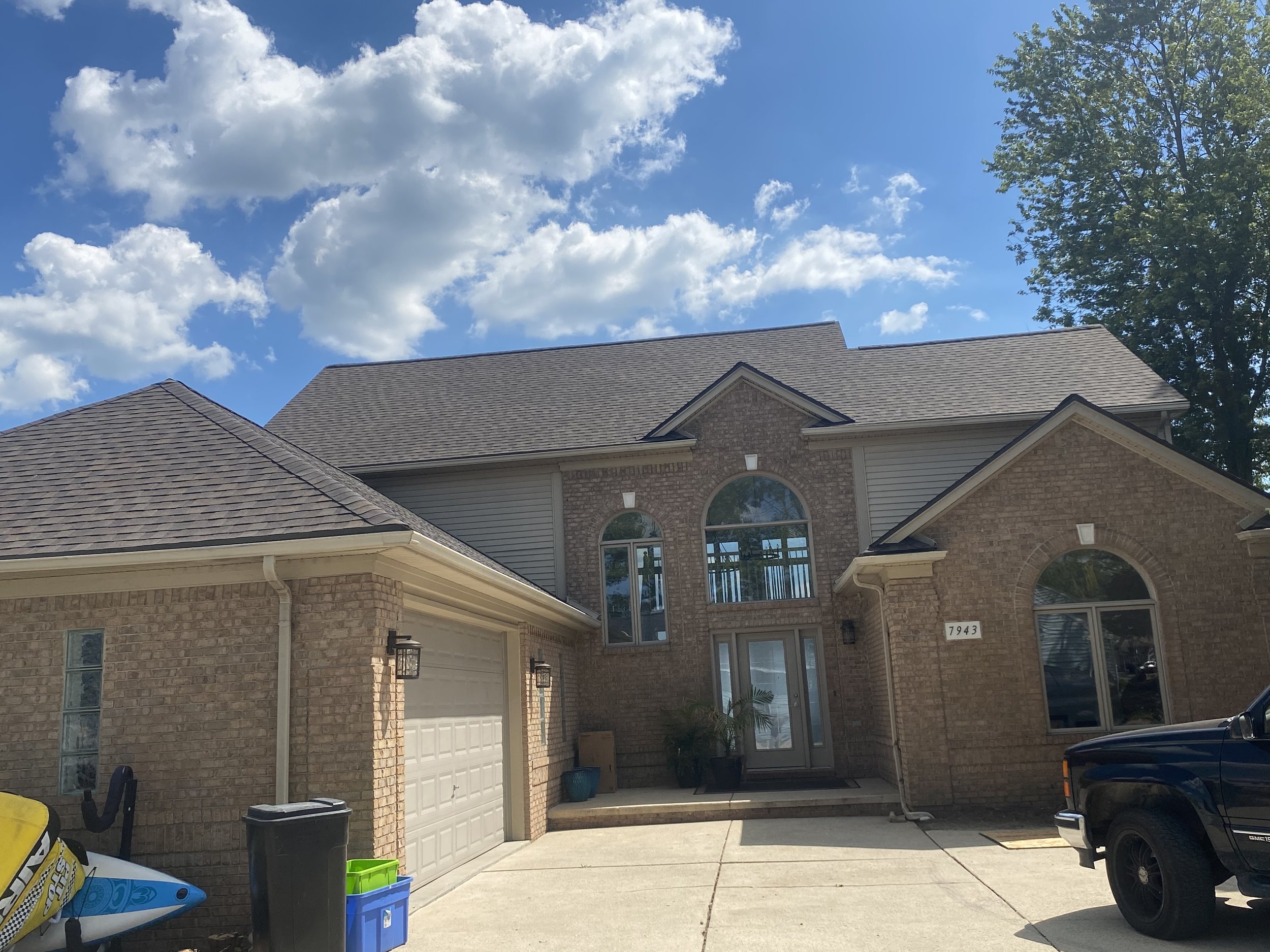
Gray is the most requested siding color in Southeast Michigan right now, and it's not just a trend. Gray works because it's neutral enough to pair with any roof color (charcoal, weathered wood, black), it hides dirt and algae better than white, and it has broad resale appeal. Buyers in Troy, Bloomfield Hills, and Rochester Hills expect modern, updated exteriors, and gray delivers that without being polarizing.
Popular shades: CertainTeed's "Granite Gray," James Hardie's "Iron Gray," and LP SmartSide's "Oyster Gray." These are mid-tone grays — not too light, not too dark — that work on Colonials, ranches, and modern farmhouse builds.
Taupe is the warmer alternative. It's gray with brown undertones, and it pairs beautifully with brick. If you have a 1970s brick Colonial in Sterling Heights or Clinton Township, taupe siding on the upper story or gables will complement the brick without clashing. It's softer than gray but still neutral enough for resale.
Classic Whites and Off-Whites
White siding never goes out of style in Michigan. It's traditional, it reflects heat (which helps with cooling costs in summer), and it works on every architectural style from historic Victorians in Lake Orion to Cape Cods in St. Clair Shores.
But pure white shows dirt. We usually recommend off-white or cream tones instead — colors like James Hardie's "Arctic White" or CertainTeed's "Natural Clay." These shades have just enough warmth to hide pollen and dust while still giving you that clean, crisp look.
White siding also pairs well with darker trim (black, charcoal, navy) for a high-contrast look that's popular on modern farmhouse-style homes. We've done dozens of jobs in Shelby Township and Chesterfield where homeowners go with white siding, black window trim, and a dark roof — it's a sharp, timeless combination.
Navy and Deep Blues
Navy is the most popular bold color we install. It's sophisticated, it pairs well with white trim and stone accents, and it works on both traditional and contemporary homes. We see it most often on newer builds and full exterior renovations where homeowners want something distinctive without being too loud.
Navy works best on fiber cement or engineered wood. As we mentioned earlier, dark vinyl can have thermal expansion issues. James Hardie's "Night Gray" (a deep blue-gray) and LP SmartSide's "Deep Ocean" are both excellent choices. They hold color well, they don't fade quickly, and they handle Michigan's temperature swings without warping.
One caution: navy siding shows water stains and algae more than lighter colors. If you have poor drainage, overhanging trees, or north-facing walls that don't get much sun, you'll need to clean the siding more often. Pairing navy siding with seamless gutters in Detroit, MI that channel water away from the walls will help prevent staining.
Earth Tones and Sage Greens
Earthy greens, soft browns, and sage tones are gaining traction, especially on homes with natural wood accents, stone foundations, or wooded lots. These colors blend with Michigan's landscape — they look at home next to oak trees, they complement natural stone, and they age gracefully.
LP SmartSide's "Sage" and CertainTeed's "Olive" are both solid choices. These aren't bright or trendy greens — they're muted, sophisticated tones that work well on Craftsman-style homes, ranches with wood shutters, and newer builds with mixed materials.
Earth tones also hide dirt exceptionally well. If you live near a gravel road, have mature trees that drop sap and leaves, or just don't want to pressure-wash your siding every spring, a soft green or brown will require less maintenance than white or light gray.
Colors That Hold Up Best Against Fade and Weather Damage
Not all siding colors are created equal when it comes to longevity. Here's what we've learned from decades of installs and callbacks.
Material-Specific Fade Resistance
Vinyl siding fades more than fiber cement or engineered wood, period. That doesn't mean vinyl is bad — it just means you need to choose the right product and the right color. Premium vinyl like CertainTeed's Monogram line uses color-through technology and UV inhibitors that slow fade rates. Cheap vinyl from big-box stores uses surface pigments that break down in 5-7 years.
If you're going with vinyl, stick to mid-tone colors (gray, taupe, beige) rather than dark or bright colors. Dark vinyl fades faster and has expansion issues. Bright colors (red, yellow, bright blue) fade noticeably within a few years, even on premium products.
Fiber cement holds color better than vinyl. James Hardie's ColorPlus finish is baked on in a factory-controlled environment with multiple coats and UV inhibitors. It's covered by a 15-year fade warranty, and we've seen it perform exactly as advertised. We have vinyl vs. fiber cement comparisons from real Michigan homes, and the fiber cement consistently looks better after 10+ years.
Engineered wood (LP SmartSide) also holds color well, especially with their SmartFinish pre-primed or pre-painted options. LP's factory finish is more durable than field-applied paint, and it comes with a 5-year labor and materials warranty if installed by a certified contractor like NEXT Exteriors.
Dark vs. Light: Heat Absorption and Expansion Concerns
Here's the rule: if you want a dark color (navy, charcoal, black, deep green), use fiber cement or engineered wood. Don't use vinyl unless you're working with a contractor who understands thermal expansion and installs it correctly.
Light colors (white, cream, light gray) work fine on vinyl, fiber cement, or engineered wood. They reflect heat, they don't expand as much, and they're less prone to warping or buckling in Michigan's temperature swings.
Mid-tone colors (medium gray, taupe, soft blue) are the safest choice for vinyl. They don't absorb as much heat as dark colors, they hide dirt better than light colors, and they have broad resale appeal.
Pro Tip: If you're replacing siding and windows at the same time, coordinate the colors before you order materials. We've done hundreds of siding and window replacement projects in Metro Detroit, and the homes that look best are the ones where the siding, trim, and window frames are chosen as a system, not as separate decisions.

Matching Siding Colors to Michigan Home Styles
Michigan has distinct architectural styles, and certain colors work better on certain home types. Here's what we recommend based on the most common styles we see in Southeast Michigan.
Brick Colonials (1950s-1970s)
This is the most common home style in Macomb and Oakland counties. Two-story Colonial with brick on the first floor, siding on the upper story and gables. The brick is usually red, orange, or brown, and it's not going anywhere — replacing brick is expensive and rarely makes sense.
Your siding color needs to complement the brick, not compete with it. Here's what works:
- Gray or taupe: Neutral tones that pair with any brick color. Gray is cooler, taupe is warmer. Both work.
- Off-white or cream: Classic choice that lightens up the upper story and creates contrast with darker brick.
- Soft blue-gray: A subtle, sophisticated option that works especially well with red or orange brick.
Avoid: Pure white (too stark against aged brick), dark colors that make the upper story feel heavy, and any color that clashes with the brick undertones (e.g., cool gray with warm orange brick).
Ranch Homes (1960s-1980s)
Single-story ranches are everywhere in Sterling Heights, Warren, and St. Clair Shores. They're low-profile homes with horizontal lines, and the siding color can make or break the curb appeal.
Best colors for ranches:
- Medium gray: Modern, clean, and makes the home look updated without major structural changes.
- Navy or deep blue: Adds character and works well with white or black trim.
- Sage green or earth tones: Great for wooded lots or homes with natural stone accents.
Avoid: Colors that are too light (they make the home disappear into the lot) or too dark (they can make a low ranch feel even lower and heavier).
Modern Farmhouse and New Construction
Modern farmhouse is the dominant style for new builds in Shelby Township, Lake Orion, and Chesterfield. These homes mix siding with board-and-batten accents, stone or brick foundations, and often have metal roofs or dark asphalt shingles.
Popular color schemes:
- White siding with black trim and accents: High-contrast, clean, and very popular right now.
- Light gray siding with white trim: Softer than white/black but still modern.
- Navy or charcoal siding with white trim: Bold but timeless, works well with stone or brick accents.
We're also seeing more mixed-material exteriors — LP SmartSide lap siding on the main walls, board-and-batten in the gables, and stone or brick on the foundation. When you mix materials, keep the color palette simple: two colors maximum, plus trim.
Historic Districts and HOA Considerations
If you live in a historic district (parts of Mount Clemens, Grosse Pointe, or downtown Rochester), you may have restrictions on siding materials and colors. Historic commissions often require fiber cement over vinyl, and they may require specific color palettes that match the original architectural style.
HOAs in newer subdivisions also have color restrictions. Before you order siding, check your HOA covenants and get approval for your color choice. We've had jobs delayed because homeowners didn't realize their HOA required pre-approval for exterior changes.
What Siding Colors Do for Resale Value in Metro Detroit
If you're planning to sell within the next 5-10 years, your siding color matters. Here's what real estate agents and buyers actually care about in Southeast Michigan.
Safe Choices vs. Bold Statements
Neutral colors (gray, taupe, white, off-white) have the broadest appeal. They don't turn off buyers, they photograph well in listings, and they pair with any landscaping or roof color. If you want maximum resale value and minimal risk, go neutral.
Bold colors (navy, deep green, charcoal) can increase curb appeal and make your home stand out in a competitive market, but they also narrow your buyer pool. Some buyers love navy siding. Others hate it. If you're selling in a hot market where homes move fast, a bold color can work. If you're in a slower market or a price-sensitive area, neutral is safer.
Coordinating with Roofing, Trim, and Shutters
Your siding color doesn't exist in isolation. It needs to work with your roof, trim, shutters, front door, and foundation. Here's what we recommend:
- Dark roof (charcoal, black, weathered wood): Pair with light or mid-tone siding (white, gray, taupe). The contrast looks sharp and makes the home feel balanced.
- Light roof (tan, light gray): You have more flexibility. Light or mid-tone siding works well. Dark siding can work if the trim is light.
- Trim color: White trim is the safest choice. It works with any siding color. Black or dark gray trim is modern and works well with white, light gray, or navy siding. Avoid matching trim to siding — it flattens the look and reduces curb appeal.
We often coordinate siding projects with Detroit roofing services so homeowners can update both at once and ensure the colors work together. A new roof and new siding together can increase home value by 10-15% in the right market.
Real Estate Trends in Macomb, Oakland, and St. Clair Counties
Buyers in Oakland County (Bloomfield Hills, Rochester Hills, Troy) tend to prefer modern, updated exteriors. Gray siding, black or white trim, and clean lines sell well. Buyers in Macomb County (Sterling Heights, Clinton Township, Shelby Township) are more practical — they want low-maintenance siding that looks good and won't need replacing in 10 years. Buyers in St. Clair Shores and Grosse Pointe Farms lean traditional — white, cream, or light gray siding with classic trim and shutters.
If you're unsure what will sell in your specific neighborhood, ask a local real estate agent or look at recent sales comps. What colors are the recently sold homes using? That's your best indicator of what buyers in your area actually want.

How to Choose the Right Siding Color for Your Home
Here's the process we walk homeowners through when they're choosing siding colors.
Start with What's Not Changing
Look at the parts of your exterior that aren't changing: roof color, brick or stone, foundation, and any permanent architectural features. Your siding color needs to work with all of these. If you have red brick, don't choose a siding color that clashes with red. If you have a dark roof, don't choose siding that's too dark — the whole house will feel heavy.
Use a Digital Visualizer
Most manufacturers (James Hardie, CertainTeed, LP SmartSide) have online visualizer tools where you can upload a photo of your home and test different siding colors. It's not perfect — the colors on your screen won't match reality exactly — but it's a good way to narrow down your options before you order samples.
We also have a home visualizer tool on our site that lets you test colors and materials on different home styles. It's free, and it's a helpful starting point.
Order Physical Samples and Test Them in Michigan Light
Once you've narrowed it down to 2-3 colors, order physical samples. Manufacturers will send you small siding panels in your chosen colors. Take those samples outside and look at them in different lighting conditions — morning sun, afternoon sun, overcast days, and evening light.
Michigan light is different from Florida light or California light. We have more overcast days, more diffuse light in winter, and more intense sun in summer. A color that looks great in a showroom might look completely different on your house in February.
Hold the samples up against your brick, your roof shingles, and your existing trim. Do they work together? Do they create the look you want? If not, order different samples and try again.
Work with a Contractor Who Understands Local Preferences
We've installed siding on hundreds of homes across Southeast Michigan. We know what colors are popular in different neighborhoods, what colors hold up best in Michigan's climate, and what colors create problems (heat expansion, visible dirt, poor resale value). We're not going to push you toward a color you don't like, but we will tell you if a color choice is going to cause issues down the road.
If you're considering a bold color, we'll show you photos of similar homes we've done and explain the pros and cons. If you're on the fence between two neutrals, we'll tell you which one we see more often and which one tends to photograph better in real estate listings.
As a licensed contractor offering comprehensive exterior services in Detroit, we also coordinate siding with other projects — windows, doors, trim, gutters, and roofing — so everything works together visually and functionally.
Related Services: If you're updating your siding, it's often the right time to address other exterior issues. We also provide Detroit window replacement, attic insulation in Metro Detroit, and exterior painting in Southeast Michigan using Sherwin-Williams products exclusively.
Ready to Choose the Right Siding Color for Your Michigan Home?
NEXT Exteriors has been installing siding in Southeast Michigan since 1988. We're a CertainTeed 5-Star Contractor, a James Hardie Elite Preferred installer, and an LP SmartSide Pro contractor. We'll help you choose a color that works with Michigan's climate, matches your home's style, and holds its value for decades.
Get Your Free Siding QuoteOr call us: (844) 770-6398
Frequently Asked Questions
Dark colors (navy, charcoal, black, deep red) and bright colors (bright blue, yellow, red) fade faster than neutral tones, especially on vinyl siding. Dark colors absorb more UV radiation and heat, which accelerates pigment breakdown. If you want a dark color, use fiber cement (James Hardie) or engineered wood (LP SmartSide) with a factory-applied finish — they hold color much better than vinyl. Mid-tone neutrals (gray, taupe, beige) fade the slowest and are the safest choice for long-term color retention.
Your siding color should complement both, not match either one exactly. If you have brick (common on Michigan Colonials), choose a siding color that works with the brick undertones — gray or taupe for red or orange brick, off-white or cream for brown brick. Your roof color is usually neutral (charcoal, black, weathered wood), so it's easier to work around. The goal is balance: light siding with a dark roof creates contrast and makes the home feel proportional. Dark siding with a dark roof can make the house feel heavy unless you use light trim to break it up.
You can use dark colors on vinyl, but it requires a premium product and expert installation. Dark vinyl absorbs heat, which causes expansion and contraction. If it's not installed with proper fastening techniques and expansion gaps, it will warp or buckle. We only install dark vinyl from manufacturers like CertainTeed that engineer their products for thermal movement. For most homeowners, we recommend fiber cement or engineered wood for dark colors — they're more dimensionally stable and hold color better over time. If budget is a concern and you want dark siding, we'll walk you through the pros and cons of each material.
Gray — specifically mid-tone grays like CertainTeed's "Granite Gray" or James Hardie's "Iron Gray." Gray is neutral, modern, and works with any roof color or architectural style. It hides dirt better than white, it doesn't fade as quickly as dark colors, and it has broad resale appeal. We're also seeing a lot of requests for taupe (a warmer, brown-toned gray) and navy (especially on fiber cement). White and off-white are still popular on traditional homes, but gray dominates new construction and full exterior renovations.
Order physical samples from the manufacturer and test them on your house in different lighting conditions. Digital visualizers are helpful for narrowing down options, but they don't show you how the color will actually look in Michigan light. Hold the samples against your brick, roof shingles, and existing trim. Look at them in morning sun, afternoon sun, and overcast conditions. If you're still unsure, we can show you photos of similar homes we've done in your area, or we can drive you past completed projects in your neighborhood so you can see the color in real life.
It depends on your market and your buyer pool. In hot markets with high demand (parts of Oakland County, for example), a bold color like navy or deep green can increase curb appeal and help your home stand out. In slower markets or price-sensitive areas, neutral colors (gray, taupe, white) are safer because they appeal to the widest range of buyers. If you're planning to sell within 3-5 years, ask a local real estate agent what colors are selling well in your neighborhood. If you're staying in the home for 10+ years, choose the color you love — by the time you sell, trends will have shifted anyway.
Yes, but the effect is smaller than most people think. Light-colored siding reflects more sunlight and absorbs less heat, which can reduce cooling costs in summer by a few percent. Dark-colored siding absorbs more heat, which can slightly increase cooling costs but may also reduce heating costs in winter (though the effect is minimal because most heat loss happens through windows, doors, and attic insulation, not siding). The bigger energy factor is what's behind the siding — proper insulation, air sealing, and moisture barriers make a much bigger difference than color. If energy efficiency is a priority, focus on upgrading your attic insulation and replacing old, drafty windows before worrying about siding color.
Troy MI Siding Contractor: What to Look for Before You Hire
Hiring a siding contractor in Troy, MI? Learn the credentials, red flags, and questions that separate quality contractors from costly mistakes.

You're standing in your driveway in Troy, looking at faded vinyl siding that's cracked at the corners, warped near the garage, and pulling away from the trim. You know it needs to be replaced. You've got three estimates sitting on your kitchen counter, and they're all over the map — different materials, different prices, different promises.
Here's the problem: A bad siding job doesn't just look ugly. It lets water into your wall cavities. It creates thermal bridges that spike your heating bills. It voids manufacturer warranties. And in Michigan, where we cycle through freeze-thaw conditions 40+ times every winter, poor installation turns into expensive repairs within five years.
I've been running siding jobs across Oakland County since 1988, and I've seen what happens when homeowners hire based on the lowest bid or the smoothest sales pitch. This guide walks you through exactly what to look for when hiring a house siding company in Detroit and the surrounding areas — the credentials that matter, the questions that separate pros from pretenders, and the red flags that should send you running.
Why Hiring the Right Siding Contractor Matters in Michigan
Siding isn't just cladding. It's the primary weather barrier between your home's structure and Michigan's relentless climate. When installed correctly, quality siding sheds water, blocks wind-driven rain, allows vapor to escape, and maintains its integrity through decades of temperature swings.
When installed poorly, it fails in ways most homeowners don't notice until the damage is done:
- Water infiltration behind the siding: No drainage plane, improper flashing around windows, or gaps at trim transitions let water migrate into wall cavities. You won't see it until you notice interior stains, mold growth, or rotted sheathing during a future renovation.
- Thermal performance loss: Siding installed without proper insulation backing or with gaps at seams creates thermal bridges. Your furnace works harder, your energy bills climb, and rooms feel drafty even with new windows.
- Voided warranties: James Hardie, LP SmartSide, and CertainTeed all require certified installers to maintain product warranties. A contractor who isn't certified can't honor those warranties, and you're left paying for premature failure.
- Structural damage from improper fastening: Overdriven nails, face-nailing instead of blind-nailing, or fastening through the siding face (instead of into studs) causes buckling, cracking, and panel failure during thermal expansion cycles.
Troy's housing stock — a mix of 1960s brick Colonials, 1980s ranch homes, and newer construction — requires contractors who understand how different substrates, wall assemblies, and architectural details interact with modern siding materials. A crew that's only worked on new construction in Florida won't know how to flash a brick ledge transition or handle Michigan's freeze-thaw movement.
Real Example: We were called to a home in Rochester Hills in 2024 where a homeowner had hired a "siding contractor" who quoted $8,000 under our estimate. Eighteen months later, water was pooling behind the fiber cement panels because the crew never installed a drainage plane. The repair cost $22,000 — tearing off the new siding, replacing rotted OSB sheathing, installing proper housewrap and flashing, and re-siding the entire house. The original contractor had disappeared.
This is why vetting your contractor isn't optional. You're not just buying siding — you're buying expertise, accountability, and long-term protection for what's likely your largest financial asset.
Michigan Licensing Requirements: What's Legally Required
In Michigan, any contractor performing residential construction work valued over $600 must hold a Michigan Residential Builder's License issued by the Department of Licensing and Regulatory Affairs (LARA). This isn't a suggestion. It's the law.
Here's what that license actually means:
- Verified trade knowledge: The contractor passed a state exam covering building codes, safety standards, and construction practices.
- Financial responsibility: They posted a surety bond and maintain liability insurance as required by state law.
- Accountability: If they violate building codes, commit fraud, or abandon a job, you have legal recourse through LARA's complaint process.
- Workers' compensation coverage: If a crew member gets injured on your property, you're not liable for medical bills or lost wages.
When a contractor shows up to give you an estimate, ask for their license number. Then verify it yourself through Michigan LARA's online lookup tool. Confirm:
- The license is active (not expired or suspended)
- The license name matches the business name on the estimate
- There are no disciplinary actions or complaints on record
If a contractor says "I'm working on getting my license" or "I work under someone else's license," walk away. Unlicensed contractors can't pull permits, can't legally contract for jobs over $600, and leave you with zero protection if something goes wrong.
NEXT Exteriors operates under a Michigan Residential Builder's License through our parent company, Premier Builder Inc. We've held this license since 1988, maintain full liability and workers' compensation insurance, and carry an A+ rating with the Better Business Bureau since 2006. You can verify all of this before we ever start work.
Beyond the License: Manufacturer Certifications
A Michigan builder's license proves legal compliance. Manufacturer certifications prove product expertise.
Companies like CertainTeed, James Hardie, and LP SmartSide certify contractors who complete factory training on proper installation techniques, material handling, and warranty compliance. These certifications matter because:
- Extended warranties: James Hardie's 30-year product warranty is only valid if installed by a James Hardie-certified contractor. Same with CertainTeed's warranties on vinyl siding.
- Installation standards: Certified contractors learn the specific fastening patterns, expansion gaps, trim details, and flashing methods each product requires. Vinyl expands and contracts differently than fiber cement. LP SmartSide requires different fastener spacing than Hardie. Generic "siding crews" don't know these details.
- Access to technical support: When we run into unusual conditions — curved walls, complex trim transitions, historic home details — we can call the manufacturer's technical team for guidance. Uncertified contractors can't.
Ask any contractor you're considering: "Are you certified by the manufacturers whose products you're proposing?" If they say yes, ask to see proof. If they say certifications don't matter, that's a red flag.
Material Knowledge and Product Partnerships
A quality siding contractor doesn't just install products — they understand how those products perform in Michigan's climate and can explain why they're recommending specific materials for your home.
Here's what separates material expertise from sales pitches:
Vinyl Siding
Vinyl is the most common siding material in Michigan for good reason: it's affordable, low-maintenance, and handles freeze-thaw cycles well when installed correctly. But not all vinyl is created equal.
A knowledgeable contractor will discuss:
- Thickness: Premium vinyl (0.046" to 0.052" thickness) resists impact damage and warping better than builder-grade vinyl (0.040" or thinner). In Michigan, where hail storms and ice can batter siding, thickness matters.
- Color retention: Cheaper vinyl fades within 5-7 years. CertainTeed's Cedar Impressions and Monogram lines use advanced fade-resistant pigments that maintain color for 20+ years.
- Expansion and contraction: Vinyl expands up to 1/2" over a 12-foot panel during summer heat and contracts during winter cold. Proper installation leaves expansion gaps at trim and fastens panels loosely to allow movement. Contractors who don't understand this create buckling and cracking.
We've covered the differences between vinyl siding vs. fiber cement in Michigan weather in detail elsewhere, but the key point is this: A contractor who only sells one material — or who pushes the most expensive option regardless of your needs — isn't working in your best interest.
Fiber Cement (James Hardie, LP SmartSide)
Fiber cement offers superior durability, fire resistance, and design flexibility compared to vinyl. It's also heavier, more expensive, and requires precise installation to avoid cracking.
A contractor experienced with fiber cement will explain:
- Moisture management: Fiber cement absorbs water if not properly primed and painted. James Hardie's ColorPlus technology pre-finishes panels at the factory with baked-on color that resists moisture penetration. Field-painted fiber cement requires careful edge sealing and regular maintenance.
- Fastening requirements: Fiber cement must be face-nailed into studs with corrosion-resistant fasteners. Overdriving nails cracks the panels. Underdriving leaves panels loose and vulnerable to wind damage. The sweet spot is flush with the surface — no more, no less.
- Expansion gaps: Unlike vinyl, fiber cement doesn't expand much with temperature changes, but it does expand with moisture absorption. Proper installation leaves 1/8" gaps at butt joints and 1/4" gaps at trim transitions, sealed with elastomeric caulk.
LP SmartSide — an engineered wood product — offers a different set of characteristics. It's lighter than fiber cement, accepts paint better, and costs less. But it requires more frequent maintenance (repainting every 10-12 years vs. 15-20 for Hardie) and isn't as fire-resistant.
A contractor who understands these trade-offs will walk you through them based on your budget, maintenance preferences, and home style. A contractor who says "this is the best siding, period" either doesn't know the products or is prioritizing their margin over your needs.
At NEXT Exteriors, we're certified installers for CertainTeed, James Hardie, and LP SmartSide. We don't push one product over another — we explain the performance characteristics, cost differences, and maintenance requirements of each, then let you decide what fits your priorities. Our job is to install it correctly, not to upsell you into materials you don't need.
Installation Quality Indicators
Here's the truth most homeowners don't realize: The quality of the installation matters more than the quality of the product. Premium James Hardie siding installed poorly will fail faster than builder-grade vinyl installed correctly.
When evaluating contractors, ask about these installation details. A quality contractor will answer confidently and specifically. A mediocre contractor will give vague responses or change the subject.
Drainage Plane and Moisture Management
Siding is not a waterproof barrier. It's a rain screen. Water will get behind it — from wind-driven rain, capillary action, and condensation. The question is: How does that water get back out?
Proper installation includes:
- Housewrap or building paper: A weather-resistant barrier (Tyvek, Typar, or felt paper) installed over the sheathing, lapped shingle-style so water drains downward.
- Flashing at all penetrations: Windows, doors, utility penetrations, and trim transitions get metal or membrane flashing that directs water away from vulnerable areas.
- Ventilation gaps: Some installations (especially with fiber cement) use furring strips or rainscreen systems to create an air gap behind the siding, allowing water vapor to escape and preventing trapped moisture.
Ask your contractor: "How do you handle moisture management behind the siding?" If they say "the siding keeps water out," they don't understand building science. If they describe the drainage plane, flashing details, and ventilation strategy, they know what they're doing.
Flashing and Trim Details
The most common failure points in siding installations are at transitions: where siding meets windows, doors, corners, roof lines, and deck ledgers. These areas require careful flashing to prevent water intrusion.
Quality contractors:
- Install metal or membrane flashing over window and door trim, lapped under the housewrap above and over the housewrap below
- Use kickout flashing where roof lines meet siding to direct water into gutters instead of behind the siding
- Flash deck ledgers with membrane flashing and metal Z-flashing to prevent water from wicking into the rim joist
- Seal all trim joints with high-quality elastomeric caulk rated for exterior use and UV resistance
Ask to see photos of previous jobs that show flashing details. If a contractor doesn't have photos or says "we don't need flashing with this product," walk away.
Fastening Techniques
How siding is fastened determines how long it lasts.
- Vinyl siding: Fastened through slots (not through the face) into studs or sheathing, with nails driven loosely to allow thermal expansion. Nails should be centered in the slots, not at the ends. Overdriven nails create buckling. Underdriven nails let panels rattle and blow off in windstorms.
- Fiber cement: Face-nailed into studs (not sheathing) with corrosion-resistant nails or screws. Fasteners must be flush with the surface — not recessed, not protruding. Spacing follows manufacturer specs (typically 16" on center for horizontal siding, 12" for vertical).
- LP SmartSide: Similar to fiber cement, but uses ring-shank nails for better holding power in the engineered wood substrate.
Ask your contractor: "What fastening pattern do you use, and how do you ensure proper fastener depth?" A good answer references manufacturer specs and describes quality control measures (like checking fastener depth throughout the job).

Pricing Transparency and Contract Details
Siding estimates in Troy typically range from $8,000 to $25,000+ depending on home size, material choice, and complexity. That's a wide range, and it's easy to get confused comparing bids.
Here's what a transparent, detailed estimate should include:
Material Specifications
The estimate should specify:
- Brand and product line: Not just "vinyl siding" — CertainTeed Monogram, James Hardie ColorPlus, LP SmartSide Lap, etc.
- Color and profile: Dutch lap, clapboard, board-and-batten, shingle style, etc.
- Thickness or gauge: For vinyl, the thickness (0.046", 0.050", etc.). For fiber cement, the thickness (5/16", 1/4", etc.).
- Trim materials: Are corners, J-channel, and window trim included? Are they the same material as the siding or different?
If an estimate just says "premium siding" or "contractor-grade materials," it's too vague. You can't compare bids if you don't know what you're buying.
Scope of Work
The estimate should detail exactly what's included:
- Removal and disposal of existing siding
- Repair of damaged sheathing or framing (if discovered during tear-off)
- Installation of housewrap or building paper
- Flashing at windows, doors, and penetrations
- Installation of new siding, trim, and accessories
- Cleanup and final walkthrough
It should also specify what's not included. For example: "Estimate does not include repair of rotted window sills or replacement of fascia boards. These will be quoted separately if discovered during tear-off."
Vague estimates create disputes. Detailed estimates create accountability.
Payment Schedule
Michigan law prohibits contractors from requiring more than one-third of the total contract price as a deposit. If a contractor asks for 50% or more upfront, that's a red flag.
A typical payment schedule looks like this:
- Deposit: 30-33% upon contract signing (covers materials and scheduling)
- Progress payment: 30-33% at project midpoint (after tear-off and prep work, before final installation)
- Final payment: 30-40% upon completion and final walkthrough
Never pay in full before the job is done. You lose all leverage if problems arise.
Warranty Terms
The estimate should specify:
- Manufacturer warranty: What does the product warranty cover, and for how long? (CertainTeed vinyl typically carries a lifetime limited warranty; James Hardie offers a 30-year non-prorated warranty.)
- Installation warranty: What does the contractor's workmanship warranty cover, and for how long? (We offer a 10-year workmanship warranty on all siding installations.)
- Warranty transferability: If you sell the home, does the warranty transfer to the new owner?
Beware of contractors who offer "lifetime warranties" without explaining what's actually covered. Most "lifetime" warranties are limited — they cover material defects but not labor, or they're prorated after 10 years, or they're voided if you don't use the contractor's recommended maintenance schedule.
Red Flags in Estimates:
- No written contract — just a verbal agreement or a one-page "proposal"
- Pressure to sign immediately ("this price is only good today")
- Requests for large upfront payments (50%+ of total cost)
- Vague material descriptions ("premium siding," "contractor-grade")
- No mention of permits, insurance, or licensing
- Prices significantly lower than other bids (often a sign of unlicensed labor, substandard materials, or plans to cut corners)
Local Experience and References
A contractor who's been working in Troy, Rochester Hills, and the surrounding Oakland County communities for years understands things an out-of-area contractor doesn't:
- Local building codes: Troy has specific requirements for setbacks, exterior materials in historic districts, and permit processes. A local contractor knows these rules and handles permits as part of the job.
- Architectural styles: Troy's housing stock includes brick Colonials, mid-century ranches, Tudor revivals, and modern builds. Each style requires different siding details, trim profiles, and installation techniques.
- Weather patterns: Southeast Michigan gets lake-effect snow, ice dams, summer storms with high winds, and rapid freeze-thaw cycles. A contractor who's worked through 35+ Michigan winters knows how to detail siding to handle these conditions.
- Supplier relationships: Local contractors have established relationships with regional material suppliers, which means better pricing, faster delivery, and access to technical support when unusual situations arise.
When evaluating contractors, ask:
- "How long have you been working in Troy and Oakland County?"
- "Can you provide references from recent projects in my neighborhood?"
- "Do you have photos of completed jobs I can see in person?"
A contractor with deep local roots will happily provide references and project addresses. A contractor who's new to the area or who works primarily out of a truck won't.
At NEXT Exteriors, we've been serving Troy, Sterling Heights, Rochester Hills, and the surrounding communities since 1988. We've completed 500+ projects across Southeast Michigan, and we maintain a 5.0-star average rating across 87+ reviews. We can provide references from your neighborhood, and we're happy to show you completed projects in person.
Check Online Reviews — But Read Them Carefully
Online reviews (Google, BBB, Angi, etc.) provide valuable insight, but don't just look at the star rating. Read the actual reviews and look for patterns:
- Consistent praise for specific qualities: "Showed up on time every day," "explained everything clearly," "left the jobsite cleaner than they found it" — these details indicate a professional operation.
- How the contractor responds to negative reviews: Every contractor gets an occasional complaint. What matters is how they handle it. Do they respond professionally? Do they offer to make it right? Or do they get defensive and blame the customer?
- Recent reviews vs. old reviews: A company with 50 five-star reviews from 2015 and nothing recent may have changed ownership, lost key staff, or stopped prioritizing quality.
We're proud of our BBB A+ rating and our consistent five-star reviews across multiple platforms. We encourage every prospective client to read what our customers say — and to call those customers directly if they want to hear about their experience firsthand.

Signs You've Found the Right Contractor
After you've vetted licensing, checked references, and reviewed estimates, here are the green flags that indicate you're working with a professional contractor:
- They ask questions about your goals: A good contractor wants to understand why you're replacing your siding. Are you preparing to sell? Solving moisture problems? Improving energy efficiency? Updating the home's appearance? Your goals shape their recommendations.
- They conduct a thorough site inspection: They don't give you a price over the phone or from Google Street View. They come to your home, inspect the existing siding, check for moisture damage, measure carefully, and discuss potential challenges.
- They explain trade-offs, not just benefits: Every material has pros and cons. A trustworthy contractor discusses both — vinyl is affordable but can look "plasticky," fiber cement is durable but more expensive, LP SmartSide offers great aesthetics but requires more maintenance, etc.
- They provide a detailed written estimate: Everything we discussed in the pricing section — material specs, scope of work, payment schedule, warranty terms — is documented in writing.
- They're responsive and communicative: They return calls and emails promptly. They answer questions clearly. They provide updates throughout the project. You're never left wondering what's happening.
- They carry proper insurance and pull permits: They provide certificates of insurance without being asked. They handle permit applications and inspections as part of the job. They don't suggest "skipping the permit to save money."
- They've been in business locally for years: They have a physical office address, an established reputation, and a track record you can verify. They're not operating out of a P.O. box or a cell phone.
If a contractor checks all these boxes, you've found someone you can trust.
Other Services We Offer
While siding is a major investment in your home's protection and appearance, it's often part of a larger exterior upgrade. At NEXT Exteriors, we offer a full range of exterior services in Detroit and Southeast Michigan, including Detroit roofing services for roof replacements and repairs, window replacement in Detroit to improve energy efficiency, top-rated insulation services in Detroit for attic and wall insulation upgrades, seamless gutters in Detroit, MI to protect your foundation and landscaping, and Southeast Michigan painting professionals using Sherwin-Williams products exclusively.
Many of our clients bundle services — replacing siding and windows at the same time, or upgrading insulation during a siding project to maximize energy savings. If you're planning multiple exterior improvements, we can coordinate the work to minimize disruption and often provide better pricing than hiring separate contractors for each trade.
Ready to Get Started?
NEXT Exteriors has been protecting Michigan homes since 1988. Get a free, no-pressure estimate from a team that shows up on time and does the job right.
Get Your Free QuoteOr call us: (844) 770-6398
Frequently Asked Questions
Yes, in most cases. Troy requires building permits for siding replacement projects. The permit ensures the work meets Michigan building codes and local requirements. A licensed contractor handles the permit application, submits plans, and coordinates inspections as part of the project. Skipping permits can create problems when you sell your home, void insurance coverage if damage occurs, and result in fines from the city. At NEXT Exteriors, we pull all necessary permits and handle inspections as part of our standard service.
Most single-family homes in Troy take 5-10 days for a complete siding replacement, depending on size, complexity, and weather. A straightforward 1,500 sq ft ranch might take 5-6 days. A 3,000 sq ft Colonial with complex trim details, multiple gables, and brick transitions might take 10-12 days. Weather delays are common in Michigan — we don't install siding in rain, snow, or temperatures below 40°F (fiber cement adhesives and caulks don't cure properly in cold). We provide a detailed timeline in your contract and keep you updated if weather affects the schedule.
There's no single "best" material — it depends on your priorities. Vinyl siding handles freeze-thaw cycles well, requires minimal maintenance, and costs less upfront, but it can crack in extreme cold and fade over time. Fiber cement (James Hardie, LP SmartSide) offers superior durability, fire resistance, and design flexibility, but costs more and requires periodic repainting. Engineered wood (LP SmartSide) provides excellent aesthetics and paint retention at a mid-range price point. We walk through the trade-offs based on your budget, maintenance preferences, and home style. For more detail, see our comparison of best siding options for Michigan homes.
Siding replacement in Troy typically ranges from $8,000 to $25,000+ depending on home size, material choice, and project complexity. A 1,500 sq ft home with standard vinyl siding might cost $10,000-$14,000. The same home with James Hardie fiber cement could run $16,000-$22,000. Larger homes (2,500+ sq ft), complex architectural details (multiple gables, bay windows, brick transitions), and premium materials increase costs. We provide detailed, transparent estimates that break down material costs, labor, and any additional work (like sheathing repair or trim replacement). For more specific pricing, see our guide to siding replacement costs in Michigan.
Technically yes, but we don't recommend it in most cases. Installing new siding over old siding (called "overlaying") hides potential problems — rotted sheathing, moisture damage, insect damage, and structural issues you won't discover until they're severe. It also creates an uneven surface that affects the appearance and performance of the new siding. Removing old siding allows us to inspect the wall assembly, repair damage, install proper housewrap and flashing, and ensure the new siding performs as designed. The only exception is when the existing siding is in excellent condition, the sheathing is sound, and the homeowner understands the trade-offs. We inspect carefully and provide honest recommendations based on what we find.
We stop work, document the damage with photos, and provide a written estimate for the repair before proceeding. Rotted sheathing is common in older Michigan homes, especially around windows, doors, and roof lines where water infiltration has occurred over years. Repairing it is essential — you can't install new siding over compromised sheathing. The repair involves removing the damaged OSB or plywood, inspecting the framing for rot or insect damage, replacing the sheathing with new material, and ensuring proper flashing to prevent future water intrusion. We don't surprise you with unexpected charges — we discuss the issue, explain the repair, and get your approval before proceeding. Most homeowners appreciate discovering hidden damage before it causes structural problems.
Maintenance depends on the material. Vinyl siding requires minimal maintenance — wash it once or twice a year with a garden hose and mild detergent to remove dirt, pollen, and algae. Inspect caulk joints annually and re-caulk any gaps. Fiber cement (James Hardie, LP SmartSide) requires periodic repainting — typically every 10-15 years for factory-finished products, every 7-10 years for field-painted siding. Inspect for cracks or damage after severe storms, and repair promptly to prevent moisture intrusion. Check flashing and trim details annually to ensure they're still sealed properly. We provide detailed maintenance guidelines specific to your siding material when we complete the installation, and we're available for questions or service calls if issues arise.
Siding Repair vs. Replacement: Southeast Michigan Guide
Learn when to repair vs. replace your siding in Southeast Michigan. Expert contractor advice on costs, materials, and what Michigan weather does to your home's exterior.
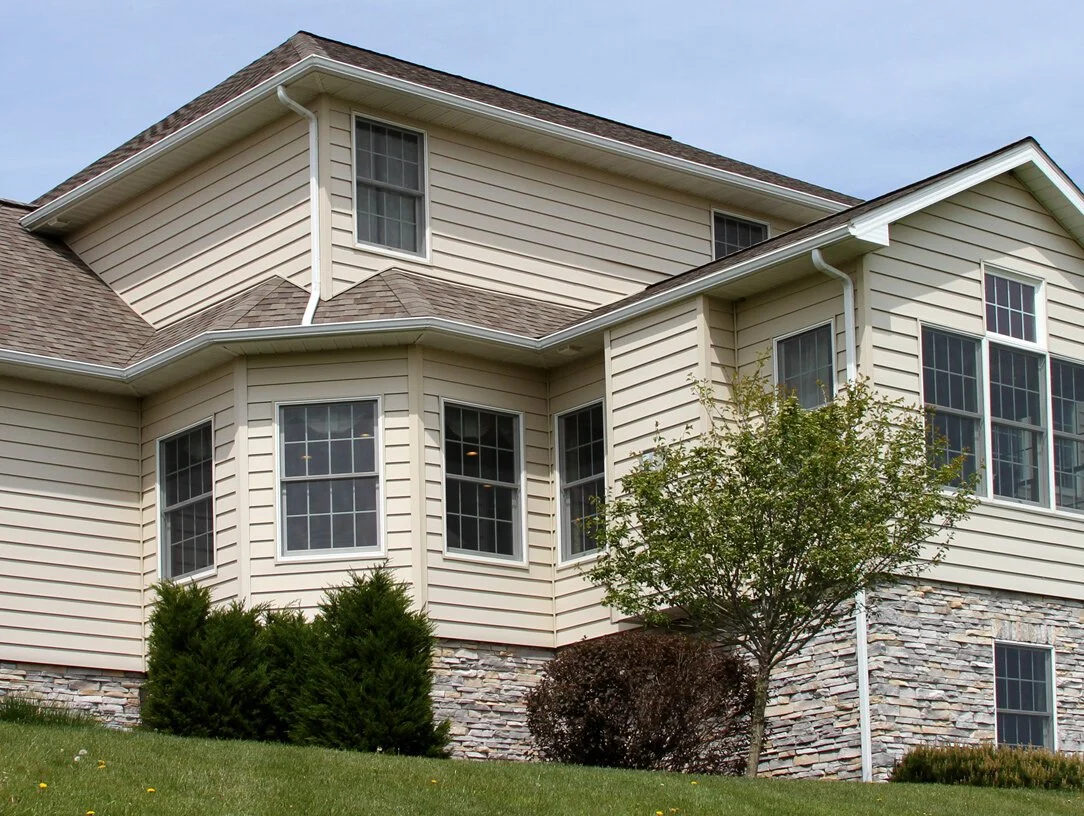
You're standing in your driveway in Sterling Heights, looking at a few cracked vinyl panels on the south side of your house. Or maybe you're in Rochester Hills noticing that the fiber cement siding is starting to show its age after 20 Michigan winters. The question hits you: do I patch this, or is it time to replace the whole thing?
It's not always obvious. And in Southeast Michigan, where freeze-thaw cycles can turn a small crack into a major problem in one season, making the wrong call can cost you thousands down the road.
After 35 years installing and repairing house siding in Detroit and across Macomb, Oakland, and St. Clair counties, we've seen every scenario. We've done the $400 repair that bought a homeowner five more years. We've also seen the $2,000 in repairs that should have been a $12,000 replacement from the start.
This guide walks you through the decision. No sales pitch — just the factors that matter, the costs you'll actually face, and the signs that tell you which direction to go.
When Siding Repair Makes Sense
Siding repair is the right move when damage is isolated, recent, and doesn't indicate a larger pattern. Here's what that looks like in practice:
Isolated Panel Damage
A single cracked vinyl panel from a baseball or hail strike. A few boards of fiber cement that took a direct hit from a falling branch. If the damage is confined to one area and the rest of your siding is in good shape, a targeted exterior siding repair in Metro Detroit makes financial sense.
We can usually match existing materials if your siding is less than 15 years old. Vinyl color matching gets trickier after that due to UV fading, but it's still possible in many cases.
Minor Storm Damage
Southeast Michigan gets its share of summer storms. If you've got a few panels that blew off or cracked from wind-driven debris, and the underlying house wrap and sheathing are intact, repair is straightforward.
Timeline matters here. A repair we can complete in a day or two costs a fraction of full replacement and gets your home weather-tight immediately. That's especially important if you're dealing with an insurance claim and need documentation of prompt mitigation.
Small Holes or Punctures
Holes from old satellite dishes, electrical work, or exterior light fixtures can usually be patched or covered with a replacement section. If the hole is in a high-visibility area, we'll often replace the full panel to avoid a visible patch.
The 30% Rule: If less than 30% of your siding shows damage and it's concentrated in one or two areas, repair is almost always more cost-effective than replacement. Once you cross 40-50% damaged area, the math shifts toward full replacement.
Material Availability
One practical consideration: can we get matching material? Vinyl siding manufacturers change product lines every few years. If your siding is 20+ years old, finding an exact match might be impossible. In those cases, we sometimes repair a less-visible side of the house with a close (but not perfect) match, or we discuss replacement options.
Fiber cement products like James Hardie and LP SmartSide have more consistent product lines, making repairs easier even on older installations.
When Full Siding Replacement Is the Right Call
Some situations don't make sense to patch. Here's when we recommend full replacement:
Widespread Cracking or Warping
When you see cracks on multiple walls, warping across large sections, or panels pulling away from the house in different areas, that's a pattern failure. It usually means the siding has reached the end of its service life, or it was installed incorrectly from the start.
Vinyl siding that's become brittle and cracks easily when you touch it has degraded from UV exposure. You can't repair your way out of that. The material has failed.
Age-Related Deterioration
Vinyl siding typically lasts 20-30 years in Michigan. Fiber cement (James Hardie, LP SmartSide) can go 30-50 years if installed correctly. Engineered wood products fall somewhere in between at 25-35 years.
If your siding is approaching or past these ranges and showing any signs of damage, replacement is the smarter investment. Repairs on old siding are temporary fixes on a failing system.
Moisture Intrusion and Hidden Damage
This is the big one. If you've got water stains on interior walls, soft spots when you press on the siding, or visible mold growth, the problem isn't just the siding — it's what's happening behind it.
When moisture gets past the siding and into the sheathing or wall cavity, you're looking at structural damage. At that point, you need to remove the siding to assess and repair the underlying materials. Once you're doing that, replacing the siding makes more sense than trying to reinstall old, potentially compromised panels.
We see this often in older homes in Troy and Warren where the original house wrap has failed or was never installed properly. Modern exterior services in Detroit include proper moisture barriers that weren't standard 30+ years ago.
Energy Efficiency Upgrades
If your heating bills are climbing and you're feeling drafts, old siding might be part of the problem. Replacement gives you the opportunity to add or upgrade insulation, install a modern weather barrier system, and seal air leaks.
Insulated vinyl siding or fiber cement over properly installed rigid foam can make a measurable difference in energy performance. That's especially valuable in Michigan's climate extremes. Pairing siding replacement with top-rated insulation contractor services in Detroit can dramatically improve your home's thermal envelope.
Pre-Sale Home Preparation
If you're preparing a home for sale in Grosse Pointe Farms or Bloomfield Hills, curb appeal matters. Patched siding with mismatched colors signals deferred maintenance to buyers. Fresh siding signals a well-maintained home and often returns 75-85% of its cost in increased sale price.
Realtors know this. We work with several in the area who specifically recommend siding replacement before listing because it moves homes faster and at better prices.
What Michigan Weather Does to Your Siding
Michigan's climate is tough on exterior materials. Understanding how weather causes damage helps you make smarter repair-or-replace decisions.
Freeze-Thaw Cycles
This is the killer in Southeast Michigan. Water gets into small cracks or behind siding panels. It freezes, expands, and makes the crack bigger. It thaws, more water gets in, and the cycle repeats.
A hairline crack in November can be a gaping hole by March. Vinyl becomes brittle in cold temperatures, making it more susceptible to impact damage. Fiber cement is more resistant to freeze-thaw damage, but if water gets behind it and reaches the sheathing, you've got problems.
This is why we always check for proper flashing around Detroit window installations during siding inspections. Windows are common entry points for water that eventually damages siding and sheathing.
Ice Dam-Related Damage
Ice dams form when heat escapes through your attic, melts snow on the roof, and the water refreezes at the eaves. That ice can back up under shingles and run down behind your siding at the roofline.
We see this frequently in older homes in Clinton Township and Shelby Township where attic insulation is inadequate. The siding damage is a symptom; the cause is poor attic insulation in Metro Detroit.
If you're replacing siding due to ice dam damage, address the attic insulation at the same time or the problem will come back.
UV Degradation and Summer Heat
Michigan summers aren't as brutal as southern states, but UV exposure still breaks down siding materials over time. Dark-colored vinyl fades and becomes chalky. The south and west sides of your home take the most UV damage.
Heat also causes expansion and contraction. Vinyl siding installed too tightly in summer can buckle. Installed too loosely in winter can rattle and pull away from fasteners. Proper installation accounts for seasonal movement.
Wind-Driven Rain
Lake-effect weather systems bring wind-driven rain that can force water behind siding if it's not properly overlapped and sealed. This is especially common on gable ends and around dormers.
Seamless gutters in Detroit, MI play a role here too. Overflowing or poorly positioned gutters dump water directly onto siding, accelerating deterioration.

Material-Specific Repair vs. Replace Guidelines
Different siding materials age differently and have different repair thresholds.
Vinyl Siding
Vinyl is the most common siding in Southeast Michigan for good reason: it's affordable, low-maintenance, and performs well in our climate when installed correctly.
Repair makes sense when:
- Damage is isolated to a few panels
- The siding is less than 15 years old and we can find matching material
- The color hasn't faded significantly (south and west sides fade faster)
- The panels aren't brittle or cracking from age
Replace when:
- Multiple panels are cracked or warped across different walls
- The vinyl has become brittle and cracks easily
- Severe fading or chalking across large areas
- The siding is 25+ years old
We've written extensively about vinyl siding vs. fiber cement in Michigan weather if you're considering an upgrade during replacement.
Fiber Cement (James Hardie, LP SmartSide)
Fiber cement is the most durable siding option for Michigan homes. It resists moisture, doesn't rot, won't warp from temperature swings, and holds paint exceptionally well.
Repair makes sense when:
- Individual boards are damaged from impact
- Caulking or trim pieces need replacement (common maintenance)
- Paint touch-ups are needed in isolated areas
Replace when:
- Multiple boards show edge swelling from moisture intrusion (indicates installation or flashing failure)
- Widespread paint failure (usually means it's time to either repaint the whole house or replace with pre-finished product)
- The siding is 40+ years old and showing multiple issues
Fiber cement repairs are often easier than vinyl because individual boards can be removed and replaced without disturbing surrounding material. We work with both James Hardie siding installers in Metro Detroit specifications and LP SmartSide installation standards regularly.
Engineered Wood
Products like LP SmartSide have improved dramatically over the years, but older engineered wood siding (especially pre-2000s products) had moisture resistance issues.
Repair makes sense when:
- Damage is minor and limited to a few boards
- The product is modern (post-2010) with good moisture resistance
- Regular maintenance (painting, caulking) has been kept up
Replace when:
- You see widespread swelling, delamination, or rot
- The siding is older-generation engineered wood with known moisture issues
- Paint is failing in multiple areas (indicates moisture intrusion)
Aluminum and Steel Siding
Common on 1960s-1980s homes in Warren and St. Clair Shores. Durable but prone to denting and fading.
Repair makes sense when:
- A few panels are dented or damaged
- You can find matching material (getting harder)
- The overall condition is still good
Replace when:
- Severe fading or chalking across most of the house
- Multiple dents or damage across different walls
- You want better energy efficiency (aluminum and steel have poor insulation value)

Real Cost Breakdown: Repair vs. Replacement in 2026
Let's talk numbers. These are real-world costs for Southeast Michigan in 2026, based on actual projects we've completed.
Typical Siding Repair Costs
- Single panel replacement (vinyl): $150-$300 including labor and materials
- Small section repair (3-5 panels): $400-$800
- Fiber cement board replacement (individual boards): $200-$400 per board depending on size and accessibility
- Storm damage repair (5-10 panels): $800-$1,500
- Corner trim or J-channel replacement: $300-$600 depending on length
These costs assume we can match existing materials. If custom color matching or special-order materials are needed, costs go up.
Full Siding Replacement Costs
For a typical 1,500-2,000 square foot home in Southeast Michigan:
- Vinyl siding (mid-grade): $8,000-$14,000
- Vinyl siding (premium insulated): $12,000-$18,000
- Fiber cement (James Hardie, LP SmartSide): $15,000-$25,000
- Engineered wood: $12,000-$20,000
These ranges include removal of old siding, new house wrap, installation, trim, and cleanup. They don't include repairs to underlying sheathing (if needed) or window/door trim upgrades.
For more detailed cost breakdowns, see our post on siding replacement cost in Michigan with real project numbers.
Hidden Costs to Consider
When comparing repair vs. replacement, factor in these often-overlooked costs:
Sheathing repairs: If we find rotted or damaged OSB or plywood when removing old siding, that needs to be replaced. Budget $200-$400 per 4x8 sheet including labor.
Window and door trim: Old trim often doesn't work with new siding profiles. Upgrading trim adds $100-$300 per opening.
Paint (for fiber cement): If you're installing raw fiber cement, add $3,000-$6,000 for professional painting. Pre-finished products cost more upfront but eliminate this expense.
Permit fees: Most municipalities in Southeast Michigan require permits for full siding replacement. Budget $150-$400 depending on location.
Color matching for repairs: If your siding has faded significantly, we might need to replace an entire wall section to avoid obvious color differences. This turns a small repair into a larger project.
ROI Considerations
According to Remodeling Magazine's 2025 Cost vs. Value report, siding replacement in the Midwest returns about 75-80% of its cost when you sell. That's one of the better returns for exterior projects.
Repairs don't add value the same way, but they prevent value loss from visible damage and deferred maintenance.
If you're planning to sell within 2-3 years and your siding is showing age, replacement often makes more sense than multiple repairs. If you're staying in the home long-term, strategic repairs can extend the life of good siding by 5-10 years.
Signs You Need a Professional Assessment
Some situations are obvious — a baseball through a panel is a straightforward repair. Others require professional evaluation. Here's when to call in a licensed contractor:
Multiple Problem Areas
If you're seeing damage on more than one side of the house, or in different types (cracks, warping, discoloration), that suggests a pattern issue. A professional can determine if it's installation failure, material failure, or underlying moisture problems.
Water Stains or Interior Damage
Any time you see water stains on interior walls near exterior siding, or you notice soft spots when you press on the siding from outside, you've got moisture intrusion. This requires investigation behind the siding to assess sheathing and framing condition.
Age Uncertainty
If you don't know how old your siding is, a contractor can usually estimate based on product type, installation methods, and condition. This helps determine if you're dealing with end-of-life failure or premature damage.
Insurance Claims
Storm damage claims require documentation. A professional inspection provides the detailed assessment and photos insurance companies need. We work with adjusters regularly and know what documentation they require.
Buying or Selling a Home
If you're buying a home in Lake Orion or Royal Oak and the inspection report mentions siding concerns, get a specialist to assess it. Home inspectors note problems but don't usually provide repair vs. replace recommendations or cost estimates.
If you're selling, a pre-listing siding assessment can help you make smart decisions about what to fix before listing.
What a Proper Siding Inspection Includes: We check for visible damage, test panels for brittleness, look for signs of moisture intrusion, examine flashing around windows and doors, check trim and corner pieces, assess color fading and UV damage, and probe suspected problem areas to check sheathing condition. You get a written report with photos, repair recommendations, and cost estimates for both repair and replacement options.
Working with NEXT Exteriors
We've been doing this work in Southeast Michigan since 1988. We're a siding company serving Macomb County, Michigan and the surrounding areas with one goal: honest assessments and quality work.
When we inspect your siding, we'll tell you if a $600 repair will solve the problem or if you're looking at replacement. We don't upsell. If you can get five more years out of your current siding with a targeted repair, we'll tell you that.
We're also a licensed Detroit roofing services contractor, which matters when siding damage is related to roof issues or when you're considering coordinating both projects for efficiency.
Our crew shows up on time, works carefully, and cleans up every day. We pull permits, follow Michigan building codes, and back our work with real warranties. You can see examples of our projects in our project gallery.
Making the Decision
Here's a simple decision framework based on what we've covered:
Choose repair if:
- Damage affects less than 30% of your siding
- Damage is isolated to one or two areas
- Your siding is less than 15 years old (vinyl) or 25 years old (fiber cement)
- We can match existing materials
- There's no evidence of moisture intrusion or underlying damage
- You plan to stay in the home 5+ years and the repair will extend siding life
Choose replacement if:
- Damage affects more than 40-50% of your siding
- Your siding is near or past its expected lifespan
- You see signs of moisture intrusion or underlying damage
- Multiple repairs would cost more than 40% of replacement cost
- You're preparing to sell and curb appeal matters
- You want to upgrade energy efficiency
- Material matching is difficult or impossible
Sometimes the decision isn't clear-cut. That's when professional assessment helps. We can show you exactly what you're dealing with and walk through the cost-benefit analysis of each option.
We also offer home visualization tools so you can see what different siding options would look like on your actual house before making a decision.
For homeowners considering multiple improvements, we often coordinate siding and window replacement together in Metro Detroit for efficiency and better results.
We've also documented top mistakes homeowners make when choosing siding in Michigan to help you avoid common pitfalls.
Ready to Get Started?
NEXT Exteriors has been protecting Michigan homes since 1988. Get a free, no-pressure estimate from a team that shows up on time and does the job right. We'll assess your siding, explain your options, and give you honest recommendations — repair or replacement.
Get Your Free QuoteOr call us: (844) 770-6398
Frequently Asked Questions
Quality vinyl siding lasts 20-30 years in Michigan's climate when properly installed. The south and west sides of your home typically show wear first due to UV exposure. Factors that affect lifespan include installation quality, product grade, color (darker colors fade faster), and maintenance. Premium vinyl products with UV inhibitors can last toward the upper end of that range, while builder-grade vinyl might show significant wear by year 20.
It depends on the extent of damage and color matching. For isolated damage (a few panels), we can often replace just the damaged section. However, if your siding has faded significantly from UV exposure, new panels will be noticeably different in color. In those cases, replacing an entire wall section from corner to corner gives a better visual result. For fiber cement, individual board replacement is usually easier and less noticeable than with vinyl.
Repairing means fixing specific damaged areas — replacing individual panels, boards, or sections while leaving the rest of your existing siding in place. Residing (or replacement) means removing all existing siding and installing new siding across the entire house. Repair is appropriate for isolated damage on otherwise sound siding. Residing is necessary when damage is widespread, the siding has reached the end of its lifespan, or you're upgrading to better materials or improved energy efficiency.
Siding repair costs vary based on damage extent and material type. Single vinyl panel replacement typically runs $150-$300. Small section repairs (3-5 panels) cost $400-$800. Fiber cement board replacement ranges from $200-$400 per board. Storm damage repairs affecting 5-10 panels typically cost $800-$1,500. These estimates assume we can match existing materials. Custom color matching or special-order materials increase costs. For accurate pricing on your specific situation, a professional assessment is the best approach.
James Hardie fiber cement costs roughly 50-80% more than quality vinyl siding, but it lasts significantly longer (30-50 years vs. 20-30 years) and requires less maintenance. It resists moisture better, won't warp from temperature changes, holds paint exceptionally well, and provides better fire resistance. For homeowners planning to stay in their homes long-term, the durability and low maintenance often justify the higher upfront cost. For those planning to sell within 5-10 years, vinyl might make more financial sense. We've written a detailed comparison of LP SmartSide vs. James Hardie for Michigan homes that covers the cost-benefit analysis in depth.
It depends on the cause of damage. Most homeowners insurance policies cover sudden, accidental damage from storms (hail, wind, falling trees) but not gradual wear, age-related deterioration, or maintenance issues. If storm damage is suspected, document it with photos and contact your insurance company promptly. We work with insurance adjusters regularly and can provide the detailed damage assessment and repair estimates they require. Keep in mind that filing a claim may affect your premiums, so for minor damage, paying out-of-pocket might make more sense.
If your siding is visibly damaged, badly faded, or shows signs of deferred maintenance, replacement before listing usually makes financial sense. Fresh siding dramatically improves curb appeal and signals to buyers that the home has been well-maintained. According to industry data, siding replacement typically returns 75-80% of its cost in increased sale price in the Midwest market. If your siding is in decent shape with only minor issues, targeted repairs might be sufficient. Realtors we work with in Southeast Michigan often recommend siding replacement specifically because it helps homes sell faster and at better prices.
How New Siding Increases Your Home Value in Metro Detroit
New siding delivers 68-85% ROI in Southeast Michigan. Learn what drives resale value, which materials perform best, and real project costs from a licensed contractor.

Here's the number that matters: new siding returns between 68% and 85% of its cost when you sell your home in Southeast Michigan. That's not marketing hype—that's data from the 2024 Remodeling Magazine Cost vs. Value Report, and it tracks with what we've seen across 500+ projects in Macomb, Oakland, and St. Clair counties since 1988.
But the ROI story is more nuanced than a single percentage. The material you choose, the quality of installation, the condition of what's underneath, and the timing of your sale all impact what you actually get back. After 35 years installing house siding in Detroit and surrounding communities, we've learned exactly what drives resale value—and what doesn't.
This isn't a sales pitch. It's a breakdown of how siding affects home value in the Metro Detroit market, what buyers and appraisers actually care about, and the real project costs you'll face in 2026. If you're trying to decide whether siding replacement makes financial sense before listing your home in Sterling Heights, Rochester Hills, or Grosse Pointe Farms, this is the information you need.
The Dollar Reality: What Siding Actually Returns in Southeast Michigan
Let's start with the numbers that matter to homeowners in Oakland and Macomb counties. According to the 2024 Remodeling Magazine Cost vs. Value Report—the industry's most reliable benchmark—here's what different siding materials return at resale:
| Siding Material | Average Cost | Resale Value | ROI % |
|---|---|---|---|
| Vinyl Siding | $18,662 | $13,487 | 72.3% |
| Fiber Cement Siding | $22,000 | $18,150 | 82.5% |
| Engineered Wood | $19,500 | $14,625 | 75.0% |
These are national averages. In Metro Detroit, we see slightly different patterns based on neighborhood expectations and the prevalence of brick homes. In areas like Bloomfield Hills or Lake Orion, fiber cement siding (James Hardie) often returns closer to 85% because buyers in that price range expect premium materials. In working-class neighborhoods throughout Warren or Clinton Township, quality vinyl siding from CertainTeed or GAF delivers the strongest return because it meets market expectations without overbuilding.
The key insight: siding replacement is one of the highest-ROI exterior improvements you can make. It consistently outperforms deck additions, window replacements, and even some Detroit roofing services projects when it comes to recouping costs at sale.
Real Example: We replaced the vinyl siding on a 1,600-square-foot ranch in Sterling Heights in 2024. Total cost: $14,200. The home sold four months later for $18,000 more than comparable homes on the same street with original siding. That's a 127% return—well above the national average—because the new siding eliminated the buyer's biggest objection and made the home show-ready.
Why Siding Impacts Value More in Michigan Than Other States
Siding isn't just about looks in Southeast Michigan. It's a functional necessity that protects your home from some of the most punishing weather conditions in the country. Buyers here know this. Appraisers know this. And that knowledge directly affects how much your home is worth.
Michigan's freeze-thaw cycles are brutal. Water gets into cracks, freezes, expands, and tears materials apart. This happens 40-60 times per winter in Metro Detroit. Old, damaged, or improperly installed siding shows this damage visibly: warped panels, cracked seams, moisture stains, and rot around trim boards. According to Building Science Corporation, freeze-thaw damage causes approximately 80% of premature siding failures in cold climates.
When a buyer walks up to your home in Troy or Royal Oak and sees siding that's faded, buckled, or pulling away from the house, they're not just seeing an aesthetic problem. They're seeing:
- Potential moisture damage behind the siding that could mean rotted sheathing, mold, or structural issues
- Higher heating costs from air leaks and poor insulation performance
- Immediate repair expenses they'll need to budget for after closing
- Deferred maintenance that signals other problems throughout the home
Home inspectors in Michigan specifically call out siding condition in their reports. If your siding is compromised, expect the buyer to either negotiate the price down or request repairs before closing. We've seen deals fall apart over siding issues that could have been addressed for $12,000-$15,000 before listing.
New siding eliminates all of these objections. It signals that the home has been maintained, that the thermal envelope is intact, and that the buyer won't face surprise repair bills in their first year of ownership. That peace of mind has measurable value in the Metro Detroit market.
What Buyers Actually Notice (And What Appraisers Measure)
Let's separate curb appeal from structural value. Both matter, but they matter differently to different stakeholders in a home sale.
What Buyers See First: Curb Appeal
Buyers form an opinion about your home in the first 7-10 seconds. New siding completely transforms that first impression. Fresh, clean siding in a modern color makes your home look updated, well-maintained, and move-in ready. It photographs well for online listings—critical when 97% of buyers start their search online.
We've worked with dozens of realtors in Macomb and Oakland counties who specifically recommend siding replacement before listing because it makes homes show better and attract more offers. One agent in St. Clair Shores told us bluntly: "I can't sell a house with bad siding at full price. Buyers see it and immediately start calculating what they'll need to fix."
Color choice matters more than most homeowners realize. Neutral, modern colors (grays, taupes, navy, deep greens) appeal to the broadest buyer pool. Dated colors (beige, builder-grade tan, bright blue) can actually hurt value because they signal the home hasn't been updated.
What Appraisers Measure: Comparable Sales and Condition
Appraisers use a different lens. They're looking at:
- Comparable sales: How does your home compare to similar homes that sold recently? If comparable homes have newer siding and yours doesn't, that's a negative adjustment.
- Condition rating: Appraisers rate homes on a C1-C6 scale. Homes with damaged or deteriorating siding typically fall into C4 (needs repair) or C5 (needs significant work), which directly lowers the appraised value.
- Effective age: New siding can reduce the effective age of your home, which increases its appraised value. A 30-year-old house with new siding might appraise as if it's 15-20 years old.
- Functional utility: Does the siding perform its job (weather protection, insulation, moisture barrier)? If not, it's a functional deficiency that lowers value.
The bottom line: new siding helps your home appraise higher because it improves both the condition rating and the comparable sales analysis. That higher appraisal directly translates to a higher sale price—or at minimum, ensures the appraisal supports your asking price so the deal doesn't fall apart.
Material Choice Matters: ROI Breakdown by Siding Type
Not all siding delivers the same return. Here's what we've learned from hundreds of projects across Southeast Michigan about which materials perform best for resale value.
Vinyl Siding: The Budget-Friendly Workhorse (68-72% ROI)
Vinyl siding from quality manufacturers like CertainTeed, GAF, or Mastic delivers solid returns in most Metro Detroit neighborhoods. It's affordable, low-maintenance, and meets buyer expectations for homes in the $150,000-$350,000 range.
Best for: Ranch homes, colonials, and split-levels in middle-market neighborhoods. Areas like Clinton Township, Chesterfield, and parts of Sterling Heights.
ROI driver: Cost efficiency. You're spending $8,000-$16,000 to eliminate a major buyer objection and refresh curb appeal. The math works.
What matters: Quality installation with proper underlayment and attention to trim details. Cheap vinyl installed poorly actually hurts resale value because it looks cheap and performs poorly.
Fiber Cement Siding (James Hardie): The Premium Play (75-85% ROI)
James Hardie fiber cement siding is the gold standard in Metro Detroit's higher-end markets. It looks like real wood, resists fire and insects, and carries a 30-year warranty. Buyers in premium neighborhoods expect it.
Best for: Homes in Bloomfield Hills, Rochester Hills, Grosse Pointe, and other upscale communities where buyers expect premium materials.
ROI driver: Perceived quality and longevity. James Hardie signals that the home was built or maintained to a higher standard. It also performs exceptionally well in Michigan's climate—no warping, no fading, no moisture absorption.
What matters: Installation by a certified James Hardie contractor (like NEXT Exteriors) who follows manufacturer specs. Improper installation voids the warranty and creates performance issues.
For a detailed comparison, see our guide on LP SmartSide vs. James Hardie siding in Michigan.
Engineered Wood Siding (LP SmartSide): The Middle Ground (70-78% ROI)
LP SmartSide offers the look of real wood with better performance and lower cost than fiber cement. It's a smart choice for homeowners who want premium aesthetics without the premium price tag.
Best for: Homes where wood siding is traditional (Cape Cods, Craftsman-style homes, historic districts) but real wood maintenance isn't practical.
ROI driver: Authentic wood appearance at a mid-range price point. Buyers who want the wood look but understand the maintenance requirements of real wood appreciate LP SmartSide.
What matters: Proper painting and sealing. LP SmartSide comes primed but needs a quality topcoat. Our Southeast Michigan painting professionals use Sherwin-Williams products exclusively to ensure long-term performance.
The Hidden Value Drivers: What Happens Behind the Siding
Here's what most homeowners don't realize: the biggest value drivers aren't visible from the street. They're what happens during installation—the upgrades and improvements that separate a $10,000 siding job from a $25,000 siding job.
Insulation and Air Sealing
When we remove old siding, we often find gaps, missing insulation, and air leaks that have been driving up heating costs for decades. Professional contractors use this opportunity to upgrade the thermal envelope:
- Adding rigid foam insulation board (1/2" or 1" thickness) beneath the new siding
- Sealing gaps around windows, doors, and penetrations
- Upgrading to modern house wrap (Tyvek or similar) for better moisture and air control
These upgrades don't show in photos, but they show up in energy bills. Buyers who do their homework—especially those using FHA 203(k) loans or energy-efficient mortgages—value homes with documented energy improvements. Our top-rated insulation contractor services in Detroit often complement siding projects for maximum performance.
Moisture Barrier Upgrades
Michigan's humidity, rain, and snow create constant moisture challenges. Modern moisture barriers (house wraps and weather-resistive barriers) prevent water intrusion while allowing water vapor to escape. This prevents mold, rot, and structural damage.
When we install new siding, we upgrade to current building science standards. That means proper flashing around windows and doors, sealed seams, and drainage planes that channel water away from the structure. These details aren't glamorous, but they're what keeps your home dry and valuable for the next 30 years.
Trim and Fascia Replacement
Old trim boards—especially wood trim on older homes—often show rot, insect damage, or paint failure. Smart contractors replace compromised trim with modern materials (PVC, fiber cement, or composite) that won't rot or need constant repainting.
This matters for resale because trim condition is one of the first things home inspectors check. Rotted fascia or soffit suggests water damage, poor maintenance, and potential structural issues. New trim eliminates these red flags and gives your home a finished, professional appearance.
Why Cheap Siding Jobs Hurt Resale Value
We see this constantly: homeowners who hired the lowest bidder to save $3,000-$5,000 upfront, only to discover the work was substandard when they try to sell. Common problems:
- No insulation or moisture barrier upgrades
- Improper nailing (too tight, wrong placement) that causes buckling
- Missing or incorrect J-channel and trim details
- Poor color matching or visible seams
- Voided manufacturer warranties due to improper installation
These issues don't just look bad—they create functional problems that show up in home inspections and appraisals. We've been called to fix dozens of botched siding jobs before home sales, and the repair costs often exceed what the homeowner would have paid for quality work in the first place.
For more on what quality installation looks like, read our breakdown of siding services in Metro Detroit and what to expect in 2026.
Real Project Costs in Metro Detroit (2026)
Let's talk real numbers. These are actual project costs from our work across Macomb, Oakland, and St. Clair counties in 2025-2026. Your specific cost will vary based on home size, material choice, and complexity, but these ranges are accurate for typical single-family homes.
Vinyl Siding Replacement
Typical ranch (1,200-1,600 sq ft): $8,000-$14,000
Two-story colonial (1,800-2,400 sq ft): $12,000-$18,000
Large home (2,500+ sq ft): $16,000-$24,000
This includes removal of old siding, house wrap upgrade, quality vinyl siding (CertainTeed or GAF), trim work, and proper installation. Add $2,000-$4,000 if significant trim replacement or insulation upgrades are needed.
James Hardie Fiber Cement Siding
Typical ranch: $14,000-$22,000
Two-story colonial: $20,000-$32,000
Large home: $28,000-$42,000
Fiber cement costs more due to material price and specialized installation requirements. But the ROI is higher in premium neighborhoods, and the warranty and performance justify the investment.
LP SmartSide Engineered Wood
Typical ranch: $12,000-$18,000
Two-story colonial: $16,000-$26,000
Large home: $22,000-$34,000
SmartSide sits between vinyl and fiber cement in both cost and performance. It's a strong value play for homeowners who want the wood look without the wood maintenance.
What Affects Your Specific Cost
- Home size and complexity: More square footage, more corners, more trim details = higher cost
- Story height: Two-story homes require scaffolding and more labor time
- Trim replacement: Rotted fascia, soffit, or window trim adds cost but increases value
- Insulation upgrades: Adding rigid foam or spray foam increases upfront cost but improves energy performance and resale appeal
- Color and style: Premium colors or specialty profiles (board-and-batten, shake, scallops) cost more than standard lap siding
For a detailed cost breakdown, see our guide on siding replacement cost in Michigan with 2026 real numbers.
When Siding Replacement Makes Financial Sense
Not every home needs new siding before selling. Here's how to think through the decision based on your specific situation.
Pre-Sale Timing: The 3-6 Month Window
If you're planning to sell in the next 3-6 months, new siding makes the most financial sense if:
- Your current siding is visibly damaged, faded, or outdated
- Comparable homes in your neighborhood have newer siding
- Your realtor recommends it to hit your target price
- You're in a competitive market where presentation matters
The ROI is highest when you replace siding shortly before listing because you capture the full value in the sale price without years of waiting.
Damage vs. Cosmetic Aging
Structural damage (rot, water intrusion, missing panels) should always be addressed before selling. Buyers and inspectors will find it, and you'll negotiate from a position of weakness.
Cosmetic aging (fading, minor discoloration) is more situational. In a hot market, you might sell without addressing it. In a buyer's market, fresh siding can be the difference between sitting on the market for 90 days versus selling in 14.
Energy Cost Reduction Calculations
If you're not selling immediately, factor in energy savings. Properly installed siding with insulation upgrades can reduce heating costs by 15-25% in Michigan winters. On a $2,000 annual heating bill, that's $300-$500 per year in savings.
Over a 10-year period, those savings add up to $3,000-$5,000—which partially offsets the siding cost even before you sell. Combined with the resale value increase, the total financial benefit can exceed 100% ROI over time.
Insurance Claim Opportunities
If your siding was damaged by wind, hail, or falling trees, your homeowner's insurance may cover replacement costs. We work with insurance adjusters regularly and can help document damage for claims.
This is especially common after severe storms. If you have storm damage, file a claim before selling—it's often the most cost-effective way to get new siding and maximize your sale price.
Bottom Line: New siding makes financial sense when the ROI (sale price increase + energy savings) exceeds the project cost. In most Metro Detroit markets, that math works if you're selling within 1-3 years or if your current siding is damaged enough to hurt marketability.
Beyond siding, comprehensive exterior services in Detroit can further enhance your home's value. From window replacement by Detroit's window experts to seamless gutters in Detroit, MI, each improvement contributes to overall curb appeal and buyer confidence.
Ready to Get Started?
NEXT Exteriors has been protecting Michigan homes since 1988. Get a free, no-pressure estimate from a team that shows up on time and does the job right.
Get Your Free QuoteOr call us: (844) 770-6398
Frequently Asked Questions
Yes. National data shows vinyl siding returns 68-72% of cost at resale, while fiber cement returns 75-85%. In Metro Detroit, we consistently see homes with new siding sell faster and for higher prices than comparable homes with old or damaged siding. The value increase comes from improved curb appeal, better energy performance, and elimination of buyer objections during negotiations.
It depends on your neighborhood and price point. In middle-market areas (Clinton Township, Sterling Heights, Warren), quality vinyl siding from CertainTeed or GAF delivers the best ROI because it meets buyer expectations at a reasonable cost. In premium markets (Bloomfield Hills, Rochester Hills, Grosse Pointe), James Hardie fiber cement returns more because buyers in that price range expect premium materials. LP SmartSide engineered wood sits in the middle and works well for homes where wood siding is traditional.
Properly installed vinyl siding lasts 20-30 years in Michigan's climate. James Hardie fiber cement is warrantied for 30 years and often lasts 50+ years. LP SmartSide carries a 5/50 warranty (5 years on finish, 50 years on substrate). The key is quality installation—cheap work fails early due to moisture intrusion, improper nailing, or inadequate underlayment. Michigan's freeze-thaw cycles are unforgiving of installation shortcuts.
If your siding is damaged, faded, or outdated, yes—especially if you're selling in the next 3-6 months. New siding helps your home show better, photograph better, and appraise higher. It also eliminates a major negotiation point that buyers use to reduce your price. If your siding is in good condition and you're in a hot market, you might not need to. Talk to your realtor about comparable sales in your area to make the decision.
Yes. Many homeowners use home equity lines of credit (HELOCs), home equity loans, or personal loans to finance siding projects. Some contractors offer financing through third-party lenders. If you're selling soon, the ROI often justifies the financing cost because the increased sale price covers the interest. If you're staying in the home, the energy savings help offset monthly payments.
Yes. Neutral, modern colors (grays, taupes, navy, sage green, charcoal) appeal to the broadest buyer pool and photograph well for online listings. Dated colors (beige, builder-grade tan, bright blue) can signal that the home hasn't been updated, which hurts perceived value. Bold colors work in specific architectural styles but limit your buyer pool. When in doubt, choose a color that's popular in new construction in your area.
The difference is usually material quality, installation standards, and what happens behind the siding. A $10,000 job might be basic vinyl with minimal prep work and no insulation upgrades. A $25,000 job typically includes premium materials (James Hardie or LP SmartSide), full trim replacement, insulation board, upgraded moisture barriers, and meticulous installation by experienced crews. The cheaper job might look fine for a few years, but it won't perform as well or last as long—and it often shows problems during home inspections when you try to sell.
CertainTeed Siding: Why We Are a Certified 5-Star Contractor
NEXT Exteriors earned CertainTeed's 5-Star Contractor status through rigorous training, proven craftsmanship, and 35+ years serving Southeast Michigan homes.
If you're researching house siding in Detroit and the surrounding areas, you've probably noticed that some contractors advertise themselves as "CertainTeed Certified" or "CertainTeed 5-Star Contractors." It sounds impressive, but what does it actually mean for your project?
After 35 years installing exterior services in Detroit and Southeast Michigan, we've seen plenty of contractors slap certification logos on their websites without understanding what's behind them. At NEXT Exteriors, we earned CertainTeed's 5-Star Contractor designation the hard way — through factory training, proven craftsmanship, and a track record that meets their strictest standards.
Here's what that certification really means, why it matters for Michigan homeowners, and how to verify whether your contractor actually has it.
What CertainTeed's 5-Star Contractor Certification Actually Means
CertainTeed doesn't hand out 5-Star Contractor status to anyone who asks. It's a tiered certification program that requires contractors to meet specific benchmarks in training, volume, and customer satisfaction. The 5-Star level is the highest tier — reserved for contractors who've proven they can consistently deliver quality installations at scale.
To earn and maintain this certification, a contractor must:
- Complete factory-authorized training: Hands-on instruction at CertainTeed facilities or through approved regional programs, covering product specifications, installation methods, and warranty requirements.
- Demonstrate installation volume: You can't get certified by installing one or two jobs a year. CertainTeed requires proof of consistent project completion using their products.
- Maintain proper licensing and insurance: This includes a valid Michigan Residential Builder's License, general liability coverage, and workers' compensation insurance.
- Pass background and reputation checks: CertainTeed reviews complaint histories, BBB ratings, and customer feedback before granting certification.
- Renew annually: The certification isn't permanent. Contractors must requalify every year, which weeds out companies that let their standards slip.
For NEXT Exteriors, this certification complements our CertainTeed Master Shingle Applicator credential for roofing and our partnerships with other premium manufacturers like James Hardie, LP SmartSide, and Sherwin-Williams. It's part of a larger commitment to staying current with the best products and methods in the industry.
The Training Behind the Certification
The training required for CertainTeed certification isn't a one-day seminar. It's a detailed, technical education in how vinyl and fiber cement siding systems actually work — and how Michigan's climate affects their performance.
Here's what we cover in CertainTeed's training programs:
Material Science and Expansion Coefficients
Vinyl siding expands and contracts with temperature changes. In Michigan, where we see 100°F summer days and -10°F winter nights, that movement is significant. CertainTeed's training teaches precise nailing techniques and panel overlap methods that allow for this expansion without buckling or pulling loose. Get it wrong, and you'll see rippled siding within a year.
Moisture Management and Vapor Barriers
Siding isn't just a decorative shell — it's the first line of defense against water intrusion. We learn how to integrate housewrap, flashing, and J-channels to create a continuous drainage plane that sheds water away from the wall cavity. This is especially critical in Michigan, where freeze-thaw cycles can turn trapped moisture into structural damage.
Wind Load Ratings and Fastening Patterns
CertainTeed products are engineered to withstand specific wind speeds when installed correctly. The training covers proper fastener placement, starter strip alignment, and corner post installation to ensure the siding stays put during Michigan's summer storms. We've seen plenty of DIY and unlicensed contractor jobs where siding blew off after one strong wind event — usually because they skipped these details.
Trim Work and Finishing Details
The difference between a good siding job and a great one often comes down to trim. CertainTeed's program emphasizes clean corner posts, properly mitered J-channels around windows, and seamless transitions between siding and soffit and fascia. These aren't just cosmetic details — they're critical for long-term weatherproofing.
Why This Matters for Your Siding Project
Certification sounds nice on paper, but what does it actually do for you as a homeowner? Three things: better warranties, proven installation quality, and accountability.
Enhanced Warranty Coverage
When a CertainTeed 5-Star Contractor installs your siding, you're eligible for enhanced warranty coverage that non-certified installers can't offer. This typically includes:
- Extended product warranties: CertainTeed's standard product warranties are already solid, but certified installations can qualify for additional coverage periods.
- Workmanship warranties: Separate from the manufacturer's product warranty, this covers installation defects. If a panel wasn't nailed correctly and fails prematurely, it's covered.
- Transferable warranties: If you sell your home, the warranty can often transfer to the new owner, which is a selling point in competitive real estate markets like Bloomfield Hills or Grosse Pointe Farms.
We've had homeowners call us years after installation with questions about their siding, and because we're a certified contractor with proper documentation, CertainTeed stands behind both the product and our work. That's rare in the siding industry.
Installation Quality You Can Measure
CertainTeed's installation standards are specific and measurable. Panels must be level within 1/8 inch over 10 feet. Nails must penetrate at least 3/4 inch into solid backing. J-channels around windows in Detroit must be cut and mitered, not simply overlapped. These aren't suggestions — they're requirements.
When you hire a certified contractor, you're getting someone who knows these specs and has been trained to meet them consistently. Non-certified contractors might get it right, but there's no third-party verification of their methods.
Accountability Through the Manufacturer
If something goes wrong with a certified installation, you have recourse beyond just the contractor. CertainTeed has a vested interest in maintaining the reputation of its certified network, so they'll step in to mediate disputes or verify whether an installation meets their standards. That's leverage you don't have with an uncertified contractor using CertainTeed products.
Michigan-Specific Consideration: Our freeze-thaw cycles are brutal on improperly installed siding. Water gets behind panels, freezes, expands, and pops fasteners loose. CertainTeed's training specifically addresses cold-climate installation techniques that prevent these failures — techniques that many contractors skip because they don't understand the building science behind them.
CertainTeed Siding Options We Install in Southeast Michigan
CertainTeed manufactures a range of siding products, from budget-friendly vinyl to premium fiber cement. Here's what we typically install for Michigan homes, and why each option works well in our climate.
Vinyl Siding: Monogram and Mainstreet
CertainTeed's vinyl lines are engineered for durability and low maintenance. The Monogram series offers premium thickness (0.046 inches) and a lifetime limited warranty, while Mainstreet provides solid performance at a more accessible price point.
Vinyl is popular in Michigan because it doesn't rot, doesn't need painting, and handles temperature swings well when installed correctly. We see it most often on 1960s ranch homes in Sterling Heights and Shelby Township, where homeowners want a clean, updated look without the maintenance burden of wood.
Color options are extensive — from classic whites and creams to deeper grays and blues. CertainTeed's ColorCoach tool lets you visualize different combinations before committing, which we use during consultations at our home visualizer page.
Fiber Cement: CedarBoards
For homeowners who want the look of wood without the maintenance, CertainTeed's CedarBoards fiber cement siding delivers. It's a composite of cement, sand, and cellulose fibers, molded to replicate the grain and texture of real cedar.
Fiber cement is heavier and more labor-intensive to install than vinyl, which affects cost. But it's also more impact-resistant, fire-resistant, and dimensionally stable. We recommend it for historic districts in Detroit or upscale neighborhoods like Lake Orion, where architectural authenticity matters.
It requires painting every 10-15 years, which is a consideration compared to vinyl's maintenance-free profile. But when paired with Sherwin-Williams exterior paint, it holds color exceptionally well.
Trim and Accessories
CertainTeed's trim system — including corner posts, J-channels, and soffit panels — is designed to integrate seamlessly with their siding. Using the manufacturer's matched accessories ensures consistent expansion rates, color matching, and warranty coverage. Mixing brands can create compatibility issues that void warranties and cause premature failure.
The Real Cost of CertainTeed Siding Installation
Homeowners in Macomb, Oakland, and St. Clair counties want straight answers about pricing. Here's what CertainTeed siding actually costs in Southeast Michigan, based on our 35 years of project data.
Vinyl Siding: $7,500 to $18,000
For a typical 1,500-square-foot ranch home, expect to pay between $7,500 and $12,000 for CertainTeed Mainstreet vinyl siding, fully installed. That includes material, labor, trim, soffit, fascia, and removal of old siding.
Upgrade to CertainTeed Monogram, and the same project runs $10,000 to $18,000. The premium comes from thicker panels, better color retention, and enhanced warranty coverage.
Factors that push costs higher:
- Two-story homes: Scaffolding and additional labor add 20-30% to the base cost.
- Complex architecture: Bay windows, dormers, and multiple gables require more trim work and custom cuts.
- Rotted sheathing: If we pull off old siding and find water damage underneath, that requires repair before new siding goes on. Budget an extra $1,500 to $3,000 for sheathing replacement on a typical home.
Fiber Cement Siding: $15,000 to $30,000
CertainTeed CedarBoards fiber cement costs roughly double what vinyl does. For the same 1,500-square-foot ranch, expect $15,000 to $22,000. Larger or more complex homes can reach $30,000 or more.
The higher cost reflects the material itself (fiber cement is more expensive to manufacture), the specialized installation (it requires carbide-tipped blades and more precise cutting), and the additional labor time. It's also significantly heavier, which means more careful handling and structural considerations.
Is it worth it? For homeowners planning to stay in their homes long-term and who value the aesthetic of wood siding, yes. For those focused on ROI and low maintenance, vinyl often makes more sense.
How CertainTeed Compares to Other Siding Materials
We install multiple siding brands at NEXT Exteriors, so we can give you an honest comparison. CertainTeed vinyl is competitively priced with other premium vinyl brands like Royal and Alside. James Hardie fiber cement is the market leader and tends to run slightly higher than CertainTeed CedarBoards, though performance is comparable.
LP SmartSide engineered wood sits between vinyl and fiber cement in both cost and performance — it's a solid middle-ground option for homeowners who want the look of wood without the full fiber cement price tag.
For a detailed breakdown of how these materials compare in Michigan's climate, see our guide on vinyl vs. fiber cement siding in freeze-thaw conditions.
How to Verify Your Contractor's Certification
Not every contractor who claims to be "CertainTeed Certified" actually is. Some let their certifications lapse. Others never had them in the first place. Here's how to verify before you sign a contract.
Ask for Documentation
A legitimate CertainTeed 5-Star Contractor will have a current certificate from the manufacturer. It should include the company name, certification level, and the date it was issued. If a contractor can't produce this within 24 hours, that's a red flag.
Check CertainTeed's Contractor Locator
CertainTeed maintains an online database of certified contractors. Go to their website, enter your ZIP code, and see who's listed. If your contractor isn't there, they're not certified — regardless of what their marketing materials claim.
Verify Licensing and Insurance
Certification is meaningless without proper licensing. In Michigan, any contractor doing siding work over $600 must hold a Residential Builder's License. You can verify this through the Michigan Department of Licensing and Regulatory Affairs (LARA). NEXT Exteriors operates under Premier Builder Inc.'s license, which has been active since 1988.
Also confirm that the contractor carries general liability insurance and workers' compensation coverage. Ask for certificates of insurance and verify them with the insurance company directly. If someone gets hurt on your property and the contractor isn't properly insured, you could be liable.
Read the Warranty Fine Print
Ask what warranty coverage comes with your installation. A certified contractor should be able to provide documentation showing both the manufacturer's product warranty and their own workmanship warranty. If they can't explain the warranty in detail or provide written documentation, walk away.
Check References and Reviews
Certification is a good starting point, but it's not the whole story. Ask for references from projects completed within the last 12 months. Call those homeowners and ask about the contractor's communication, cleanliness, timeliness, and quality of work.
Also check online reviews. NEXT Exteriors maintains a 5.0-star average across 87+ reviews on Google and has held an A+ BBB rating since 2006. Those aren't accidents — they're the result of showing up on time, doing clean work, and standing behind our projects.
Red Flags to Watch For: Be wary of contractors who pressure you to sign immediately, offer prices significantly below market rate, or can't provide proof of licensing and insurance. The lowest bid often becomes the most expensive project when you factor in repairs, warranty issues, and the hassle of dealing with subpar work.
Ready to Get Started?
NEXT Exteriors has been protecting Michigan homes since 1988. As a CertainTeed 5-Star Contractor with full licensing, insurance, and manufacturer partnerships, we deliver quality siding installations backed by real warranties. Get a free, no-pressure estimate from a team that shows up on time and does the job right.
Get Your Free QuoteOr call us: (844) 770-6398
Other Services from NEXT Exteriors
While CertainTeed siding is a core part of what we do, it's just one piece of comprehensive exterior protection. NEXT Exteriors also provides professional roofing in Southeast Michigan, including asphalt shingle replacement, storm damage repair, and seamless gutter installation in Detroit, MI to protect your foundation and landscaping.
Energy efficiency is another priority for Michigan homeowners. Our insulation services in Metro Detroit include attic insulation upgrades, spray foam applications, and basement insulation — all designed to reduce heating costs during our long winters. And when your home needs a fresh look, our exterior painting services use Sherwin-Williams products exclusively for long-lasting color and protection.
For a full overview of what we offer, visit our Detroit exterior services page or explore our completed project gallery to see the quality we bring to every job.
Frequently Asked Questions
A CertainTeed 5-Star Contractor has completed factory-authorized training, demonstrated consistent installation volume, maintained proper licensing and insurance, and passed reputation checks. They can offer enhanced warranties and have access to technical support directly from CertainTeed. Regular contractors may use CertainTeed products but haven't met these certification requirements and can't provide the same warranty coverage.
When properly installed by a certified contractor, CertainTeed vinyl siding typically lasts 30-40 years in Michigan's climate. Fiber cement siding can last 50+ years with periodic painting. The key is correct installation — improper nailing, inadequate ventilation, or poor moisture management can cut that lifespan in half. Michigan's freeze-thaw cycles are particularly hard on siding, which is why certified installation techniques matter.
CertainTeed offers a limited warranty on their products regardless of who installs them, but the enhanced warranty coverage — including workmanship protection and extended terms — is only available when a certified contractor does the installation. DIY installations also risk voiding the warranty if CertainTeed determines that improper installation caused a failure. Given Michigan's weather demands and the technical precision required, professional installation is worth the investment.
Late spring through early fall (May through October) offers the most consistent weather for siding installation in Michigan. Vinyl siding should ideally be installed when temperatures are above 40°F to ensure proper expansion and contraction. We can install in colder months, but it requires additional care with material handling and fastening techniques. Winter installations are possible but may extend project timelines due to weather delays.
Siding itself provides minimal insulation — its primary job is weatherproofing. However, a siding replacement project gives us the opportunity to upgrade the insulation behind it. We often recommend adding rigid foam insulation or upgrading wall cavity insulation during siding installation. Combined with proper air sealing, this can significantly reduce heating costs in Michigan winters. For maximum energy efficiency, pair new siding with our attic insulation services to address the biggest source of heat loss in most homes.
CertainTeed vinyl siding is low-maintenance but not no-maintenance. Wash it annually with a garden hose and mild detergent to remove dirt, pollen, and mildew. Avoid pressure washers above 1,500 PSI, which can force water behind the panels. Inspect caulking around windows and doors every few years and re-seal as needed. Check for loose or damaged panels after severe storms. With basic care, the siding will look good and perform well for decades.
Contact your contractor immediately. At NEXT Exteriors, we stand behind our work with a comprehensive workmanship warranty. If there's a legitimate installation issue, we'll come out, assess it, and make it right at no cost to you. For product defects, we'll coordinate with CertainTeed to determine warranty coverage. Document the issue with photos and avoid attempting DIY repairs, which can void warranties. Certified contractors have a direct line to manufacturer support, which speeds up resolution.