

Vinyl vs Fiber Cement Siding: Michigan Freeze-Thaw Guide

NEXT Exteriors
•
February 19, 2026
•
12 min read
After 35 years of installing house siding in Detroit and throughout Southeast Michigan, I've seen every siding material face off against our region's most brutal test: the freeze-thaw cycle. Not once. Not ten times. But more than 100 times every single winter.
Here's what most homeowners in Sterling Heights, Troy, and Rochester Hills don't realize: Michigan doesn't just get cold. We get cold, then warm, then cold again — sometimes in the same day. That constant temperature swing above and below 32°F is what separates siding that lasts 30 years from siding that starts failing after five.
The vinyl versus fiber cement debate isn't about which material is "better." It's about which one survives our specific climate conditions, fits your budget, and matches how you actually use your home. Let's cut through the marketing and look at real performance data from decades of Michigan installations.
Understanding Michigan's Freeze-Thaw Cycle
Southeast Michigan experiences what building scientists call "extreme freeze-thaw cycling." From November through March, we average 25-35 freeze-thaw events per month. That's not a typo. Your siding expands and contracts 100+ times every winter.
Here's what happens at the material level: Water gets into small cracks, seams, or behind the siding. When temperatures drop below freezing, that water expands by about 9%. The ice pushes outward with thousands of pounds of force per square inch. Then it melts. Then it freezes again the next night.
Lake-effect weather makes this worse in Macomb and Oakland counties. We get heavy snow, then a warm front off Lake St. Clair melts it, then temperatures plummet. The moisture never fully dries out before the next freeze.
The Real Enemy: It's not the cold. It's the moisture combined with temperature swings. Siding that would last 50 years in Arizona can fail in 10 years here if it's not designed for freeze-thaw cycles.
This is why Detroit roofing services and siding installations require different approaches than warmer climates. The materials have to handle not just cold, but constant expansion and contraction without cracking, warping, or allowing water intrusion.
Vinyl Siding in Michigan: The Complete Picture
Vinyl siding is polyvinyl chloride (PVC) — the same material used in plumbing pipes, but formulated differently. Modern vinyl siding has come a long way from the brittle, faded panels of the 1980s. But it's still plastic, and plastic behaves in predictable ways when temperatures swing from 5°F to 45°F in 24 hours.
How Vinyl Handles Freeze-Thaw
Vinyl's thermal expansion coefficient is significant: it expands and contracts about 1/2 inch over a 12-foot panel when temperatures change 100°F. In Michigan, that range happens regularly between winter nights and sunny afternoons.
Quality vinyl siding is engineered for this movement. Panels hang on nails rather than being nailed tight, allowing them to slide horizontally as they expand and contract. The problem comes when:
Installers nail panels too tight (extremely common)
Homeowners or contractors nail through the face of the siding for shutters or decorations
The siding is installed in cold weather when it's contracted, leaving no room for summer expansion
Low-grade vinyl becomes brittle after 10-15 Michigan winters

Vinyl Pros for Michigan Homes
Affordability: Vinyl costs $4-8 per square foot installed for quality products. For a typical 2,000 sq ft Michigan Colonial, that's $8,000-16,000 total. It's the most budget-friendly option that still performs well.
Low Maintenance: No painting. No staining. Wash it with a hose once a year. For homeowners in Grosse Pointe Farms who don't want ongoing maintenance, vinyl delivers.
Color Retention: Modern vinyl uses titanium dioxide and UV inhibitors. Quality brands like CertainTeed Monogram hold their color for 20+ years without fading, even on south-facing walls.
Moisture Resistance: Vinyl doesn't absorb water. It won't rot, and it doesn't provide food for insects. In our humid Michigan summers, that matters.
Vinyl Cons for Michigan Homes
Cold-Weather Brittleness: Below 0°F, vinyl becomes brittle. If something impacts it — a ladder, a thrown snowball, a branch — it can crack. We see this every winter on north-facing walls that never get direct sun.
Expansion/Contraction Issues: If installed incorrectly, panels buckle in summer heat or pull apart at seams in winter cold. This is installer error, but it's common enough to be a real concern.
Impact Damage: Hail, falling branches, and lawn equipment can dent or crack vinyl. It's repairable, but you'll see the patch.
Perceived Value: Some buyers view vinyl as "builder grade." In higher-end markets like Bloomfield Hills, fiber cement or wood may add more resale value.
Real Talk: We've installed thousands of vinyl siding projects across Southeast Michigan. When it's quality material installed correctly, it performs well for 25-30 years. The key phrase is "installed correctly" — that's where most failures happen.
Fiber Cement Siding: Built for Michigan Weather
Fiber cement siding — primarily James Hardie and LP SmartSide in our market — is a composite of cement, sand, and cellulose fibers. Think of it as engineered wood that won't rot, or concrete that's light enough to nail to a wall.
James Hardie specifically engineers their ColorPlus products for climate zones. Their "HZ10" climate zone includes Michigan, and the formula accounts for our freeze-thaw cycles. That's not marketing — it's actual material science.
How Fiber Cement Handles Freeze-Thaw
Fiber cement's thermal expansion coefficient is minimal — about 1/8 that of vinyl. A 12-foot fiber cement plank moves less than 1/16 inch across a 100°F temperature swing. That dimensional stability is why it performs so well in Michigan.
The material is also non-porous when properly primed and painted. Water doesn't penetrate the surface, so there's nothing to freeze and expand. The factory-applied ColorPlus finish on James Hardie creates a moisture barrier that holds up to our weather better than field-applied paint.

Fiber Cement Pros for Michigan Homes
Dimensional Stability: It doesn't expand and contract like vinyl. Seams stay tight. Corners stay square. That stability matters when you're going through 100+ freeze-thaw cycles per year.
Impact Resistance: You can hit fiber cement with a hammer and it won't dent. Hail that would destroy vinyl barely marks fiber cement. For homes near golf courses or wooded lots in Rochester Hills, that's significant.
Fire Resistance: Fiber cement is non-combustible. It won't ignite, contribute to fire spread, or produce toxic smoke. Michigan building code doesn't require this for residential siding, but it's valuable insurance.
Longevity: James Hardie warranties their products for 30 years, but we're seeing installations from the 1990s that look nearly new. Real-world lifespan is 50+ years with minimal maintenance.
Resale Value: In higher-end markets, fiber cement adds measurable resale value. Appraisers recognize it. Buyers see it as a premium feature.
Fiber Cement Cons for Michigan Homes
Cost: Fiber cement runs $8-14 per square foot installed. For that same 2,000 sq ft Colonial, you're looking at $16,000-28,000. That's roughly double the cost of quality vinyl.
Installation Complexity: Fiber cement is heavy — about 2.5 pounds per square foot versus 1 pound for vinyl. It requires specialized cutting tools (silica dust is a serious health hazard if cut dry). Not every Detroit siding company has the equipment or expertise.
Paint Maintenance: If you choose primed-only fiber cement and paint it yourself, you'll need to repaint every 10-15 years. Factory-finished ColorPlus eliminates this, but adds cost upfront.
Weight: The added weight requires proper fastening into studs, not just sheathing. On older Michigan homes with questionable framing, this can add structural complexity.
Cost Reality: Investment vs. Longevity
Let's talk real numbers for a typical 2,000 square foot two-story home in Sterling Heights or Troy — the kind of 1960s-1980s Colonial that makes up most of our service area.
Vinyl Siding Costs
Builder-grade vinyl: $4-6/sq ft installed ($8,000-12,000 total)
Premium vinyl (CertainTeed Monogram, Norandex): $6-8/sq ft installed ($12,000-16,000 total)
Expected lifespan: 25-30 years with minimal maintenance
Maintenance costs: Essentially zero beyond annual washing
Fiber Cement Costs
James Hardie primed planks: $8-10/sq ft installed ($16,000-20,000 total)
James Hardie ColorPlus (factory-finished): $10-14/sq ft installed ($20,000-28,000 total)
Expected lifespan: 50+ years
Maintenance costs: Repaint every 10-15 years if primed-only (ColorPlus eliminates this)
30-Year Cost Analysis: Vinyl at $14,000 lasts 30 years = $467/year. Fiber cement at $24,000 lasts 50+ years = $480/year for the first 30 years, then essentially free for the next 20. The lifetime cost is nearly identical, but fiber cement frontloads the expense.
The decision often comes down to cash flow. If you're planning to stay in your home for 20+ years and have the budget now, fiber cement makes financial sense. If you need to keep the upfront cost down or plan to move within 10 years, quality vinyl delivers excellent value.
This cost consideration applies to all exterior services in Detroit — from siding to windows to roofing. The upfront investment in premium materials typically pays off over the life of the home, but only if you're there long enough to realize the benefits.
Installation Matters More Than Material
Here's the truth that most homeowners don't hear: We've seen $15/sq ft fiber cement fail in five years due to poor installation, and we've seen $6/sq ft vinyl perform flawlessly for 25 years because it was installed correctly.
Material choice matters. But installation quality determines whether that material reaches its potential lifespan.
Critical Installation Details for Michigan
Moisture Barriers: Properly installed housewrap (Tyvek, Typar) creates a drainage plane behind the siding. Water that gets past the siding — and some always does — needs a path to drain out. We see failures every year where contractors skipped this step or installed it backward.
Flashing: Every window, door, and penetration needs proper flashing that integrates with the moisture barrier. This is tedious work. It's not visible when finished. But it's what keeps water from rotting your sheathing and framing.
Fastening: Vinyl must hang loose on nails centered in the slots, allowing horizontal movement. Fiber cement must be face-nailed into studs with corrosion-resistant fasteners at specific intervals. Get either wrong and you'll have problems.
Ventilation: Siding needs to breathe. There should be an air gap between the housewrap and the back of the siding (vinyl provides this naturally; fiber cement often needs furring strips). Without ventilation, moisture gets trapped and causes rot.

These details are why top-rated insulation contractor in Detroit work and siding installations go hand-in-hand. Proper wall assembly — from the framing outward through insulation, sheathing, moisture barrier, and siding — is a system. Each layer depends on the others being installed correctly.
Red Flags When Hiring a Contractor
They don't mention housewrap or moisture barriers
The quote is significantly lower than others (they're cutting corners somewhere)
They can't explain how they handle thermal expansion in vinyl
They don't have photos of previous Michigan installations
They push you toward one material without discussing your specific needs
A qualified contractor should ask about your budget, how long you plan to stay in the home, your maintenance preferences, and what you're trying to achieve aesthetically. If they're not asking questions, they're just trying to sell you what's easiest for them to install.
Making the Right Choice for Your Home
After walking through the technical details, let's bring this back to practical decision-making. Here's how to choose between vinyl and fiber cement for your specific situation in Southeast Michigan.
Choose Vinyl Siding If:
Your budget is $8,000-16,000 for a typical home
You plan to move within 10-15 years
You want zero maintenance (no repainting ever)
You're replacing siding on a rental property or investment home
Your home is in a neighborhood where vinyl is standard
You're comfortable with moderate impact resistance
Choose Fiber Cement If:
Your budget allows $16,000-28,000 upfront
You're planning to stay in the home 20+ years
You want maximum durability and impact resistance
Your home is in a higher-end market where materials affect resale value
You're near wooded areas with falling branches or severe weather exposure
You want the look of real wood without the maintenance
The Hybrid Approach: Some homeowners use fiber cement on the front and most visible sides, then vinyl on the back and less visible areas. This saves 20-30% versus all fiber cement while giving you the curb appeal where it matters most.
Your decision should also factor in complementary upgrades. If you're replacing siding, it's often the right time to address Detroit window experts can install energy-efficient windows, upgrade attic insulation in Metro Detroit, or replace aging seamless gutters in Detroit, MI. These projects share staging, scaffolding, and access — bundling them saves money.
Questions to Ask Your Contractor
Before signing any contract, ask these specific questions:
"What housewrap or moisture barrier are you using, and how do you integrate it with flashing?"
"How do you handle thermal expansion with vinyl siding in Michigan's climate?"
"What's your fastening schedule for fiber cement, and do you nail into studs or sheathing?"
"Can I see photos of jobs you completed 10+ years ago? How are they holding up?"
"What's included in your warranty, and what does the manufacturer warranty cover?"
A contractor who can answer these questions confidently — and show you examples — is someone who understands Michigan installations. A contractor who deflects or gives vague answers is someone to avoid.
Signs You Need New Siding
Not sure if you need to replace your siding yet? Here are the warning signs we look for during inspections across Macomb and Oakland counties:
Immediate Replacement Needed
Visible rot or soft spots: Push on the siding near corners and bottom edges. If it feels soft or you can push through it, the sheathing underneath is likely rotted.
Mold or mildew inside the home: This indicates water is getting through the siding and into the wall cavity.
Warped or buckled panels: This means the siding is no longer protecting your home from weather.
Frequent interior paint peeling: Often caused by moisture escaping through walls because the exterior barrier is failing.
Plan Replacement Within 1-2 Years
Fading or chalking: When siding loses its color or leaves a chalky residue when you touch it, UV degradation has begun.
Cracked or missing panels: A few cracks can be repaired, but widespread cracking means the material is brittle.
Loose or separated seams: Gaps between panels let water and insects in.
High heating/cooling bills: Old siding with failing insulation makes your HVAC work harder.
Siding is 25+ years old: Even if it looks okay, it's near the end of its design life.
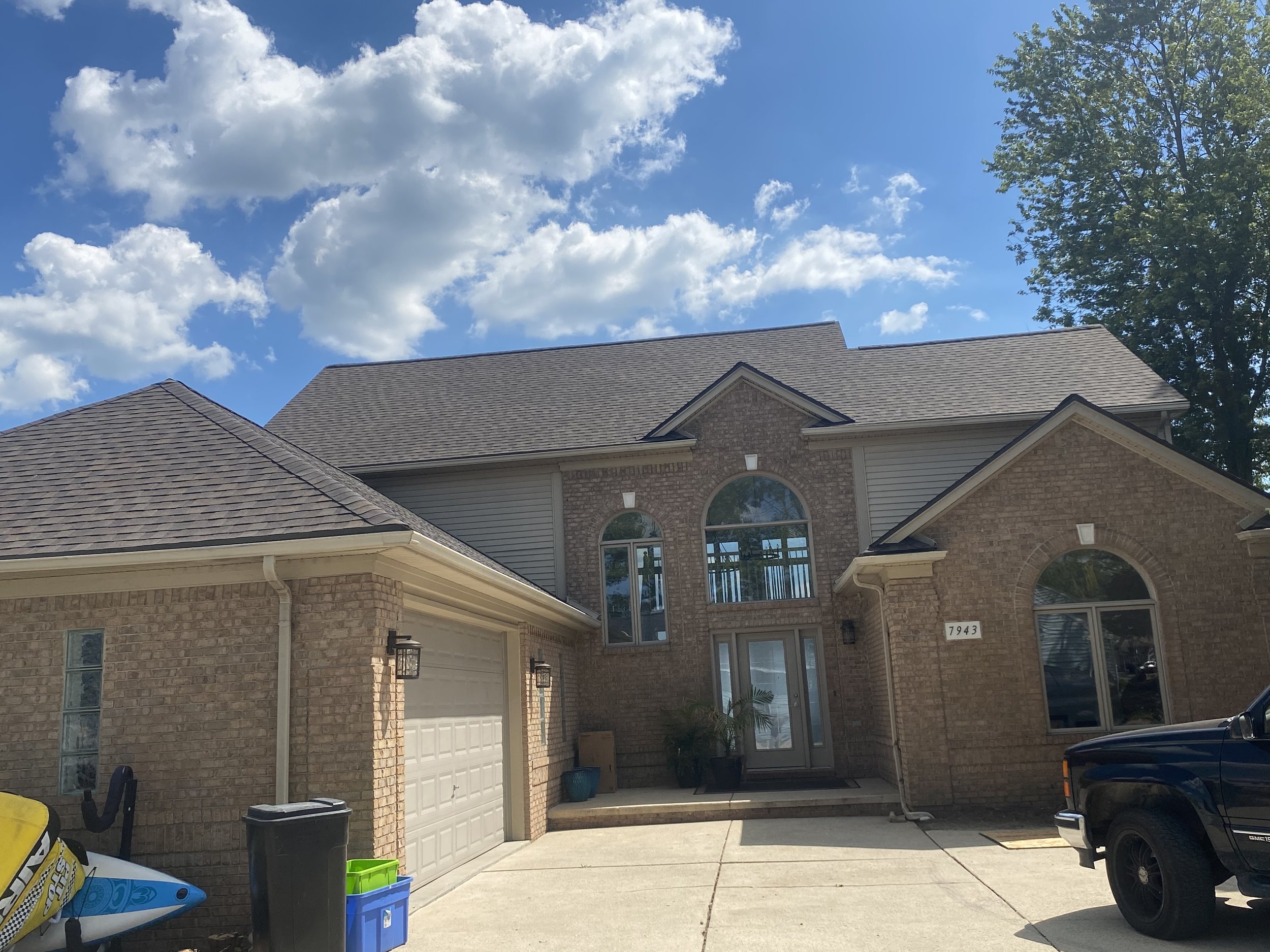
If you're seeing any of these signs, it's worth getting a professional inspection. We offer free assessments throughout Southeast Michigan — no pressure, just honest feedback about what your home needs.
And if you're also noticing issues with other exterior components, it might be time for a comprehensive evaluation of your home's exterior envelope. Problems rarely exist in isolation — failing siding often coincides with aging windows, inadequate insulation, or deteriorating roofing. Our team can assess your entire exterior system and help you prioritize projects based on urgency and budget.
Other Services from NEXT Exteriors
While siding is our focus here, we're a full-service exterior contractor. If you're investing in new siding, it's often the perfect time to address other exterior needs:
Our Southeast Michigan painting professionals can handle all your exterior painting needs using exclusive Sherwin-Williams products. And if storm damage has affected multiple parts of your home's exterior, we can coordinate a complete restoration — from roof replacement in Metro Detroit to siding, windows, and gutters.
We've been serving Southeast Michigan since 1988 because we do things the old-school way: show up on time, do the work right, charge a fair price, and stand behind what we install. No gimmicks. No pressure. Just honest work.
Ready to Get Started?
NEXT Exteriors has been protecting Michigan homes since 1988. Get a free, no-pressure estimate from a team that shows up on time and does the job right.
Or call us: (844) 770-6398
Frequently Asked Questions
Does vinyl siding crack in Michigan winters?
+
Quality vinyl siding is engineered to handle Michigan's freeze-thaw cycles without cracking under normal conditions. However, vinyl does become more brittle below 0°F, making it vulnerable to impact damage from ladders, branches, or debris during extreme cold. Low-grade vinyl or improperly installed siding is more prone to cracking. We've seen premium vinyl from CertainTeed and Norandex perform well for 25+ years in Southeast Michigan when installed correctly.
Is fiber cement siding worth the extra cost in Michigan?
+
If you're planning to stay in your home 20+ years and have the upfront budget, yes. Fiber cement's dimensional stability, impact resistance, and 50+ year lifespan make it cost-competitive with vinyl over the long term. It also adds measurable resale value in higher-end markets like Bloomfield Hills or Grosse Pointe. However, if your budget is tight or you plan to move within 10 years, quality vinyl delivers excellent value for Michigan's climate.
How long does siding last in Michigan's climate?
+
Quality vinyl siding typically lasts 25-30 years in Southeast Michigan with minimal maintenance. Fiber cement (James Hardie, LP SmartSide) lasts 50+ years. Wood siding requires regular maintenance but can last 40+ years if properly cared for. The key factor isn't just the material — it's proper installation with correct moisture barriers, flashing, and ventilation. We've seen cheap vinyl fail in 10 years and premium vinyl look great after 30 years, all based on installation quality.
Can you install siding in Michigan winter?
+
Yes, but with important caveats. Fiber cement can be installed year-round because it doesn't expand and contract significantly. Vinyl siding should ideally be installed when temperatures are above 40°F because the material is contracted in cold weather. If vinyl is installed in winter without accounting for thermal expansion, it can buckle when summer heat arrives. Experienced contractors adjust their fastening technique and panel overlap for temperature at installation. We prefer spring and fall for vinyl, but can safely install fiber cement any time.
What's better for resale value: vinyl or fiber cement?
+
It depends on your market. In mid-range neighborhoods throughout Sterling Heights, Warren, or Clinton Township, quality vinyl siding provides excellent ROI because it's what buyers expect and it looks good. In higher-end markets like Rochester Hills, Bloomfield Hills, or Grosse Pointe, fiber cement adds measurable value because buyers perceive it as premium. According to Remodeling Magazine's Cost vs. Value report, siding replacement typically recoups 75-85% of cost at resale in the Detroit metro area, with fiber cement at the higher end of that range.
Do I need to remove old siding before installing new siding?
+
It depends. If your existing siding is flat and in good condition (not rotted or warped), you can sometimes install new vinyl over it. However, we almost always recommend removing old siding because it lets us inspect the sheathing for rot, upgrade the moisture barrier, and add insulation if needed. You can't install fiber cement over existing siding — it must go on a flat, solid substrate. In Michigan's climate, the inspection opportunity alone makes removal worthwhile. We've found hidden rot and structural issues on probably 40% of homes where we remove old siding.
How do I maintain vinyl or fiber cement siding in Michigan?
+
Vinyl siding requires minimal maintenance: wash it annually with a garden hose or pressure washer (low pressure), inspect caulking around windows and doors, and check for any cracks or loose panels. That's it. Fiber cement with ColorPlus finish needs the same washing and inspection. Primed-only fiber cement needs repainting every 10-15 years. For both materials, keep gutters clean so water doesn't overflow onto the siding, trim trees away from the house to prevent impact damage, and address any caulking failures promptly to prevent water intrusion.