

Architectural vs 3-Tab Shingles for Michigan Weather
📅 February 19, 2026
⏱️ 11 min read
✍️ NEXT Exteriors Team

After 35 years of replacing roofs across Southeast Michigan, I've seen both architectural and 3-tab shingles tested by everything our climate throws at them: 90+ mph summer storms, lake-effect snow dumps that pile two feet overnight, and those brutal freeze-thaw cycles that crack pavement and test every roofing material we install.
Here's what most homeowners don't realize until it's too late: the shingle type you choose isn't just about curb appeal or budget. In Michigan, it's about whether your roof survives the next decade of weather extremes without needing premature replacement. I've pulled off plenty of 3-tab roofs that were only 12 years old but looked 25, and I've inspected 20-year-old architectural shingle roofs in Troy and Sterling Heights that still had another decade of life left.
This isn't a sales pitch for the more expensive option. It's a breakdown of actual performance differences based on thousands of Michigan installations, manufacturer specs, and what holds up when the temperature swings 60 degrees in 48 hours.
What Makes Architectural and 3-Tab Shingles Different
The difference between these two shingle types isn't cosmetic—it's structural, and that matters when wind tries to rip them off your roof deck.
3-tab shingles are single-layer asphalt shingles with cutouts that create three tabs across each strip. They're flat, uniform, and weigh around 200-240 pounds per square (a square covers 100 square feet). The asphalt mat is thinner, typically 1/8 inch thick. They've been the budget standard for decades because they're straightforward to manufacture and install quickly.
Architectural shingles (also called dimensional or laminate shingles) use two or more layers of asphalt bonded together. No cutouts—instead, they're manufactured with varying tab sizes and shadow lines that create depth. They weigh 300-400 pounds per square, with a thickness ranging from 1/4 to nearly 1/2 inch depending on the product line. That extra weight and thickness isn't just for looks.
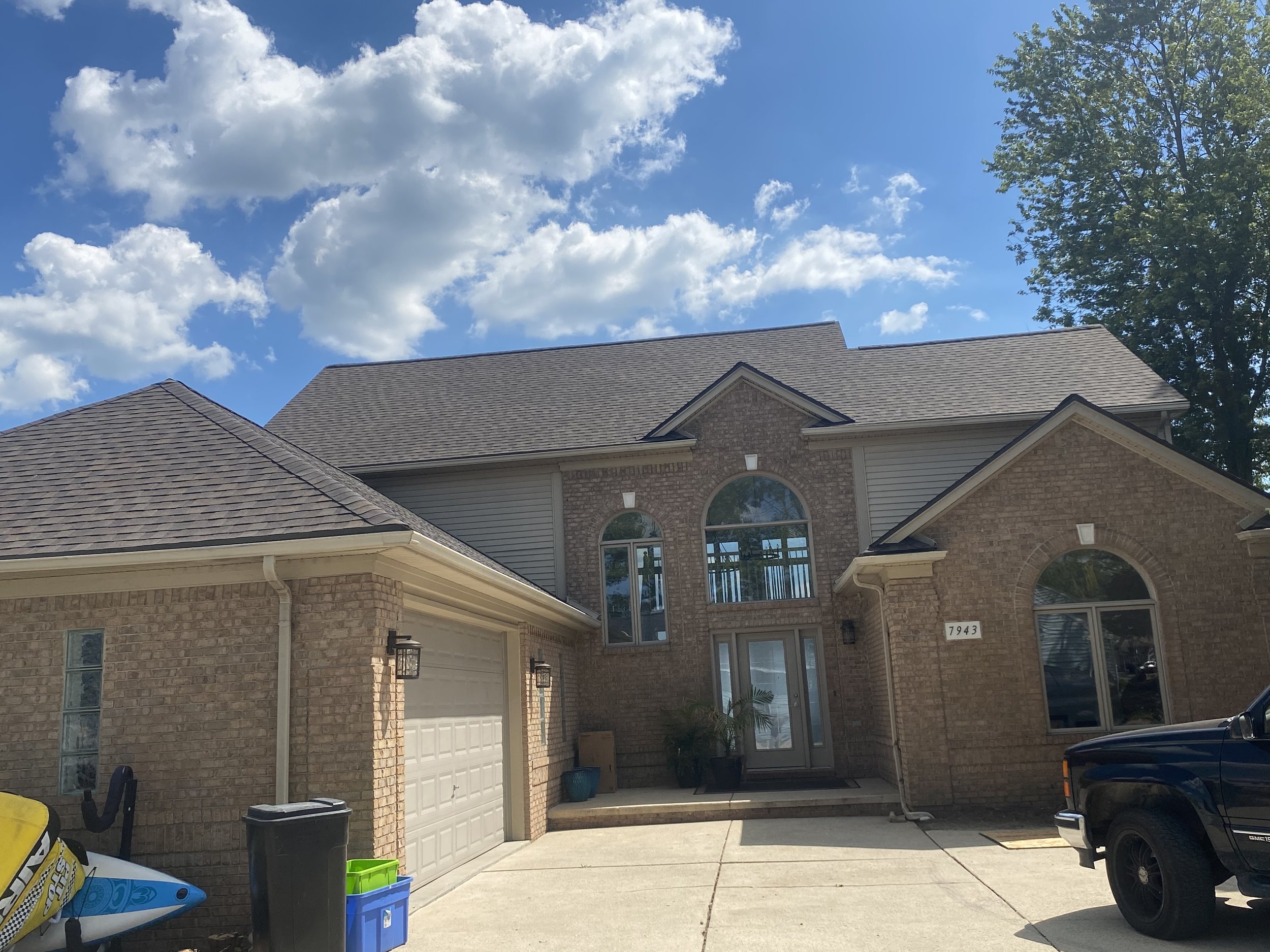
Material Composition That Actually Matters
Both types start with a fiberglass mat saturated with asphalt and covered with ceramic granules. But architectural shingles use a heavier fiberglass mat and more asphalt. The laminated construction means there's more material between the weather and your roof deck. When we're installing roofing systems in Macomb County, that extra material thickness becomes critical during hail storms and when ice dams form along the eaves.
The granules on both types protect against UV degradation, but architectural shingles typically use higher-quality granules with better adhesion. After 15 Michigan winters, that difference shows up clearly: 3-tab shingles often have noticeable granule loss in valleys and along rake edges, while architectural shingles maintain better granule coverage.
How Michigan Weather Tests Your Roof
Michigan doesn't have one roofing challenge—it has four distinct seasonal attacks that happen every year, plus random severe weather events that test everything at once.
Freeze-Thaw Cycles: The Silent Destroyer
Southeast Michigan averages 50-70 freeze-thaw cycles per winter. The temperature crosses 32°F multiple times per week from November through March. Every time that happens, any moisture trapped in or under your shingles expands when it freezes, contracts when it thaws. Over years, this cycling loosens granules, breaks down the asphalt binder, and creates microscopic cracks that grow into real problems.
Thicker shingles with more asphalt handle this cycling better. The additional mass provides thermal stability—they don't heat up and cool down as rapidly, which reduces the stress on the material. We see this difference clearly on older homes in Rochester Hills and Bloomfield Hills where architectural shingles from the early 2000s are still performing while neighboring 3-tab roofs needed replacement years ago.
Wind Load Requirements
Michigan building code requires roofs to withstand 90 mph wind speeds in most of Southeast Michigan, with higher requirements near the lakefront. But code minimums and real-world performance are different things. Summer storms regularly produce 70-80 mph gusts, and severe thunderstorms can hit 100+ mph in straight-line winds.
Wind doesn't just blow over your roof—it creates uplift pressure that tries to peel shingles off from the edges and ridge. The nail pattern, sealant strips, and shingle weight all matter. A 240-pound 3-tab shingle has less resistance to uplift than a 350-pound architectural shingle, even with identical installation methods.
Snow Load Reality
Southeast Michigan's design snow load ranges from 25-30 pounds per square foot depending on your exact location. That's the weight your roof structure must support, but it also affects your shingles. Heavy snow sits on your roof for weeks, trapping moisture underneath. When it melts during the day and refreezes at night, you get ice dams.
Ice dam formation: When heat escapes through your attic (usually due to inadequate insulation), it melts snow on your roof. That water runs down to the cold eaves and refreezes, creating a dam. Water backs up under the shingles. Thicker architectural shingles with better sealant provide more protection against this water intrusion than thin 3-tab shingles.
We address ice dams with proper attic insulation and ventilation, but shingle choice still matters when prevention fails.
Performance Comparison: Wind Resistance
Wind resistance is where the performance gap between 3-tab and architectural shingles becomes undeniable. This isn't marketing—it's physics and testing data from manufacturers we work with daily.
Wind Rating Specifications
Standard 3-tab shingles: Most carry a wind resistance rating of 60-70 mph. Some newer products claim up to 90 mph with proper installation and sealant activation. That sealant needs warm weather to activate properly—something Michigan doesn't always provide during installation season.
Architectural shingles: Entry-level products start at 110 mph wind resistance. Premium lines like CertainTeed's Landmark series (which we install frequently as a CertainTeed Master Shingle Applicator) are rated for 130 mph winds. GAF's Timberline HDZ shingles carry similar ratings. Owens Corning's Duration series hits 130 mph with their SureNail technology.
These aren't theoretical numbers. The testing involves actual wind tunnel studies with shingles installed per manufacturer specs, then subjected to sustained winds at the rated speed. The difference in how architectural shingles perform comes down to weight, thickness, and the laminated construction that prevents the tabs from lifting independently.

Real Storm Performance Data
After severe weather events in Southeast Michigan—like the August 2021 storms that hit Macomb County with 70+ mph winds—we get called out for dozens of inspections. The pattern is consistent: homes with architectural shingles typically have minimal damage (maybe a few ridge caps or edge shingles), while 3-tab roofs in the same neighborhoods often have multiple missing shingles, exposed underlayment, and water intrusion.
The 2023 ice storm that hit Oakland County provided another data point. Homes with architectural shingles and proper gutter systems had far fewer ice dam problems than those with older 3-tab installations. The thicker shingles provided better protection when water did back up under the ice.
Manufacturer Warranty Differences
Wind warranty coverage tells you what the manufacturer actually expects from their product:
3-tab shingles: Typically 10-year wind warranty, sometimes with conditions about proper sealant activation
Architectural shingles: Lifetime wind warranty (meaning the life of the shingle, usually 25-30+ years) up to the rated wind speed
CertainTeed backs their Landmark series with a 15-year StreakFighter algae resistance warranty and lifetime wind warranty. GAF's Timberline HDZ comes with a lifetime limited warranty including wind coverage. These warranties reflect real confidence in the product's Michigan performance.
Performance Comparison: Longevity in Michigan Climate
Lifespan projections on shingle packaging assume ideal conditions. Michigan doesn't provide ideal conditions. Here's what we actually see after decades of installations across Southeast Michigan.
Expected Service Life
3-tab shingles in Michigan: 15-20 years is realistic. I've seen some make it to 22-23 years on homes with excellent attic ventilation and minimal sun exposure, but that's the exception. Most start showing significant wear around year 12-15: curling edges, granule loss in valleys, brittleness that leads to cracking.
Architectural shingles in Michigan: 25-30 years is a reasonable expectation, with premium products potentially reaching 35+ years. The oldest architectural shingle roofs we've replaced were installed in the mid-1990s and were still functional—homeowners replaced them for aesthetic updates or when selling, not because they'd failed.
That 10-15 year lifespan difference matters significantly when you calculate long-term costs and the disruption of roof replacement projects.
Granule Loss and UV Degradation
Granule loss is the most visible sign of shingle aging. Those ceramic granules protect the asphalt from UV radiation and provide fire resistance. When they wash off, the asphalt underneath degrades rapidly.
3-tab shingles lose granules faster because:
Thinner asphalt layer means less adhesive holding granules
Flat profile concentrates water flow in specific paths, accelerating granule wash-off
Single-layer construction provides no backup protection
Architectural shingles retain granules better due to:
Thicker asphalt provides stronger granule adhesion
Dimensional surface disperses water flow across varied paths
Laminated construction means even if the top layer loses granules, there's another layer underneath
Check your gutters after heavy rain. If you see significant granule accumulation and your roof is under 10 years old, that's a red flag. We see this often with 3-tab shingles but rarely with quality architectural shingles during their first 15 years.
Thermal Cycling Effects
Michigan's temperature swings are brutal on roofing materials. A typical spring or fall day might start at 28°F and hit 65°F by afternoon. Dark shingles can reach 150°F+ in summer sun, then drop to 40°F overnight. This constant expansion and contraction stresses the asphalt and fiberglass mat.
Thicker architectural shingles have more thermal mass, so they heat up and cool down more slowly. This reduces the stress cycles. The laminated construction also allows some independent movement between layers, which prevents the stress concentration that causes 3-tab shingles to crack along the cutouts.
Cost Reality: Initial Investment vs Long-Term Value
Let's talk actual numbers for a typical Southeast Michigan home—say, a 2,000 square-foot ranch in Clinton Township or Warren with 2,200 square feet of roof area (accounting for pitch and overhangs).
Typical Material and Installation Costs (2026)
3-tab shingle roof replacement: $7,500-$9,500 for a complete tear-off and replacement, including underlayment, ice and water shield, ventilation, and proper flashing. That's using quality 3-tab shingles from GAF or CertainTeed, not the cheapest big-box options.
Architectural shingle roof replacement: $9,500-$13,500 for the same scope using mid-grade architectural shingles (CertainTeed Landmark, GAF Timberline HDZ, Owens Corning Duration). Premium architectural products can add another $1,500-$2,500.
The difference: roughly $2,000-$4,000 upfront. That's real money, and for some homeowners facing unexpected roof failure, it's the deciding factor. I get that. But let's run the math over 20 years of homeownership.
20-Year Cost Comparison
3-tab scenario: Install at $8,500. Replace again in 17 years at $10,000 (accounting for inflation). Total cost over 20 years: $18,500.
Architectural scenario: Install at $11,500. No replacement needed in 20 years—roof still has 5-10 years of life left. Total cost: $11,500.
The architectural shingle roof saves $7,000 over 20 years, plus you avoid the disruption, contractor shopping, and stress of a second roof replacement. You also avoid the risk of interior damage if the 3-tab roof fails prematurely during a storm.
Insurance Premium Considerations
Some insurance companies in Michigan offer premium discounts for impact-resistant roofing, which includes many architectural shingle products rated Class 4 for impact resistance. The discount is typically 5-10% on the dwelling coverage portion of your premium. On a $300,000 home, that might save $75-150 per year—$1,500-$3,000 over 20 years.
Not all architectural shingles qualify, and not all insurers offer the discount, but it's worth asking your agent about. We can provide the documentation showing your shingles meet Class 4 impact resistance if they do.
Resale Value Impact
A new roof is one of the top ROI home improvements, but the type of roof matters. Real estate agents in Southeast Michigan consistently report that homes with architectural shingle roofs photograph better, show better, and command higher offers than comparable homes with 3-tab roofs.
A 2024 Remodeling Magazine Cost vs. Value report showed roof replacement recoups about 60% of its cost at resale nationally. In Michigan's competitive real estate markets—particularly in Oakland County communities like Royal Oak and Birmingham—a quality architectural shingle roof can be a deciding factor when buyers are comparing similar homes.

When 3-Tab Shingles Make Sense (And When They Don't)
I'm not here to tell you that 3-tab shingles are always the wrong choice. There are legitimate scenarios where they make sense. But those scenarios are narrower than most homeowners realize.
Appropriate Applications for 3-Tab Shingles
Short-term ownership: If you're planning to sell within 3-5 years and your current roof is failing, a 3-tab replacement gets you through the sale without the full investment in architectural shingles. The new roof appeals to buyers, and you avoid the risk of selling with a visibly worn roof.
Rental properties with tight budgets: Investment properties where cash flow is critical and you're not holding long-term might justify 3-tab shingles. But factor in that you'll likely replace the roof again during your ownership period, and consider whether that disruption and cost is worth the initial savings.
Detached garages and outbuildings: For structures where longevity and wind resistance are less critical, 3-tab shingles can be a practical choice. Your garage roof failing in a windstorm is annoying but not catastrophic like your home roof failing.
HOA requirements for specific aesthetics: Some older subdivisions have covenants requiring 3-tab shingles to maintain uniform appearance. Check with your HOA—many have updated their rules to allow architectural shingles, but if yours hasn't, you might be stuck with 3-tab.
When 3-Tab Shingles Are the Wrong Choice
Long-term homeownership: If you're planning to stay in your home for 10+ years, the math favors architectural shingles overwhelmingly. You'll likely avoid a second replacement and deal with fewer maintenance issues.
Homes with previous wind damage: If your current roof failed due to wind damage, don't replace it with the same product that just failed. Upgrade to architectural shingles with higher wind ratings.
Homes with ice dam history: The thicker profile and better water resistance of architectural shingles provide more protection when ice dams form. Combine that with proper attic insulation to prevent ice dams in the first place.
High-visibility homes: If your home is in a prominent location or you care about curb appeal, architectural shingles look significantly better. The dimensional appearance mimics traditional wood shake or slate roofing in a way that flat 3-tab shingles never will.
Homes with complex roof lines: Hips, valleys, dormers, and multiple roof planes all create stress points where wind uplift and water flow concentrate. Architectural shingles handle these stress points better than 3-tab shingles.
Signs You Need a Roof Replacement
Whether you have 3-tab or architectural shingles, knowing when replacement is necessary prevents small problems from becoming expensive interior damage. Here's what we look for during inspections across Macomb, Oakland, and St. Clair counties.
Visible Shingle Damage
Curling or cupping: Edges lifting up (curling) or centers pushing up (cupping) indicate the shingle has reached the end of its life
Cracking or splitting: Visible cracks, especially along the tabs on 3-tab shingles, mean the asphalt has become brittle
Missing shingles: Obvious, but even a few missing shingles indicate the sealant has failed and more will follow
Bald spots: Areas where granules have worn completely away, exposing the black asphalt underneath
Granules in Gutters
Some granule loss is normal in the first year after installation as loose granules wash off. But if your roof is 8+ years old and you're seeing consistent heavy granule accumulation in gutters and downspouts, that's accelerated wear. Check after heavy rains—if the water running out of your downspouts looks like dark sand, your shingles are deteriorating.
Daylight Through Roof Boards
Go into your attic on a sunny day with the lights off. If you see daylight coming through the roof deck, you have gaps where shingles have failed or flashing has separated. This is an immediate concern—water is definitely getting in during rain.
Sagging Roof Deck
A sagging roofline indicates structural problems—either the decking has rotted from long-term water intrusion, or there's a framing issue. This requires immediate professional assessment. We see this occasionally on older homes in Detroit and Mount Clemens where roof maintenance was deferred for years.
Interior Water Stains
Brown stains on ceilings or walls, especially near exterior walls or in upper-floor rooms, indicate water intrusion. Even if the stains are old and dry, the problem that caused them likely still exists. Water takes the path of least resistance, so the stain location might not be directly under the roof leak.
Age Alone
If your 3-tab roof is 15+ years old, start planning for replacement even if you don't see obvious problems yet. Waiting for failure means you're replacing the roof during an emergency, possibly with interior damage already occurring. If your architectural shingle roof is 25+ years old, same advice applies—proactive replacement is cheaper and less stressful than emergency replacement.
Ready to Get Started?
NEXT Exteriors has been protecting Michigan homes since 1988. As a CertainTeed Master Shingle Applicator with an A+ BBB rating, we'll give you straight answers about what your roof needs—no pressure, no gimmicks. Get a free, detailed estimate from a team that shows up on time and does the job right.
Or call us: (844) 770-6398
Frequently Asked Questions
How much longer do architectural shingles last compared to 3-tab in Michigan?
+
In Michigan's climate, architectural shingles typically last 25-30 years compared to 15-20 years for 3-tab shingles. The difference comes from thicker construction, better granule retention, and superior resistance to freeze-thaw cycles and wind damage. Premium architectural products can reach 35+ years with proper installation and maintenance. The 10-15 year lifespan advantage means most homeowners avoid a second roof replacement during their ownership period.
Are architectural shingles worth the extra cost for a Michigan home?
+
For most Michigan homeowners planning to stay in their home more than 10 years, yes. The $2,000-$4,000 upfront premium for architectural shingles saves money over 20 years because you avoid a second replacement. They also provide better wind resistance (110-130 mph vs 60-70 mph), superior protection against ice dam damage, and potential insurance discounts. The main exception is if you're selling within 3-5 years and just need a functional roof to complete the sale.
What wind speed rating do I need for Southeast Michigan?
+
Michigan building code requires roofs to withstand 90 mph winds in most of Southeast Michigan. However, summer storms regularly produce 70-80 mph gusts, with severe thunderstorms reaching 100+ mph. We recommend architectural shingles rated for at least 110 mph, with 130 mph ratings preferred for homes in exposed locations or with previous wind damage. Standard 3-tab shingles at 60-70 mph ratings meet code but provide minimal safety margin for actual storm conditions.
Can I install architectural shingles over existing 3-tab shingles?
+
Michigan building code allows one layer of shingles over existing shingles, but we rarely recommend it. The dimensional profile of architectural shingles doesn't lay flat over the cutouts in 3-tab shingles, creating an uneven surface that reduces lifespan and voids most manufacturer warranties. More importantly, overlaying prevents inspection of the roof deck for rot or damage. Complete tear-off allows us to inspect and repair the deck, install proper underlayment and ice barrier, and ensure the new roof performs as designed for its full lifespan.
Do architectural shingles prevent ice dams better than 3-tab?
+
Architectural shingles don't prevent ice dams—proper attic insulation and ventilation prevent ice dams by keeping your roof cold so snow doesn't melt and refreeze. However, architectural shingles provide better protection when ice dams do form. Their thicker profile and improved sealant create better water resistance when water backs up under the ice. We see significantly less interior water damage on homes with architectural shingles compared to 3-tab when ice dams occur. The real solution is addressing the attic insulation and ventilation that causes ice dams in the first place.
Which shingle brands perform best in Michigan weather?
+
CertainTeed, GAF, and Owens Corning all manufacture architectural shingles that perform well in Michigan's climate. As a CertainTeed Master Shingle Applicator, we install their Landmark series frequently—it's rated for 130 mph winds and carries excellent warranties. GAF's Timberline HDZ and Owens Corning's Duration series offer comparable performance. The key isn't just the brand but proper installation: correct nail placement, adequate starter strips, proper valley treatments, and ice and water shield in vulnerable areas. A premium shingle installed poorly will fail faster than a mid-grade shingle installed correctly.
How soon after installation can I expect architectural shingles to seal down?
+
Architectural shingles have adhesive strips that seal down with heat activation, typically requiring several days of warm weather (70°F+) and direct sun exposure. In Michigan, spring and fall installations may take 2-4 weeks to fully seal, while summer installations seal within days. Winter installations won't seal until the following spring. This is why we're careful about installation timing and why we use additional mechanical fasteners in critical areas. The shingles are still wind-resistant before sealing due to proper nailing, but full wind rating performance requires complete sealant activation.