

Vinyl Siding vs Fiber Cement in Michigan Weather

I've been installing siding in Southeast Michigan since 1988, and I can tell you this: the choice between vinyl and fiber cement isn't about which one looks better in a showroom. It's about which one survives 35 Michigan winters without turning into a maintenance nightmare.
Every February, we get calls from homeowners in Sterling Heights and Rochester Hills dealing with cracked fiber cement panels. Every July, we see warped vinyl on south-facing walls in Troy. The truth is, both materials can work in Michigan — but only if you understand how our weather beats them up and what that means for your specific home.
Here's what 35 years of Michigan house siding installation in Detroit has taught us about vinyl versus fiber cement in real-world conditions.
How Michigan Weather Tests Siding Materials
Southeast Michigan doesn't have weather — it has a stress test. We swing from 95°F summer days to -10°F January nights. We get lake-effect snow dumps, ice storms, and spring rains that last for days. Your siding has to handle all of it without falling apart.
Freeze-Thaw Cycles Are the Real Enemy
The National Weather Service in Detroit tracks an average of 60-80 freeze-thaw cycles per winter in Macomb, Oakland, and St. Clair counties. That means the temperature crosses the 32°F threshold 60-80 times between November and March.
Why does this matter? Because materials expand when they warm up and contract when they cool down. Do that 60 times in a season, year after year, and weak points start to fail. Fasteners pull loose. Seams open up. Panels crack.
Vinyl and fiber cement respond to freeze-thaw stress in completely different ways. Vinyl is flexible — it moves with temperature changes. Fiber cement is rigid — it resists movement but can crack under stress. Neither approach is inherently better. It depends on how the material is installed and what your home needs.
Moisture Is Everywhere in Michigan
We don't just get rain. We get humidity from the Great Lakes, ice dams from our Detroit roofing systems, and condensation inside wall cavities when warm indoor air meets cold sheathing.
Siding that can't handle moisture — either by shedding it completely or by absorbing and releasing it without damage — won't last 10 years in Michigan, let alone 30.
UV Exposure and Summer Heat
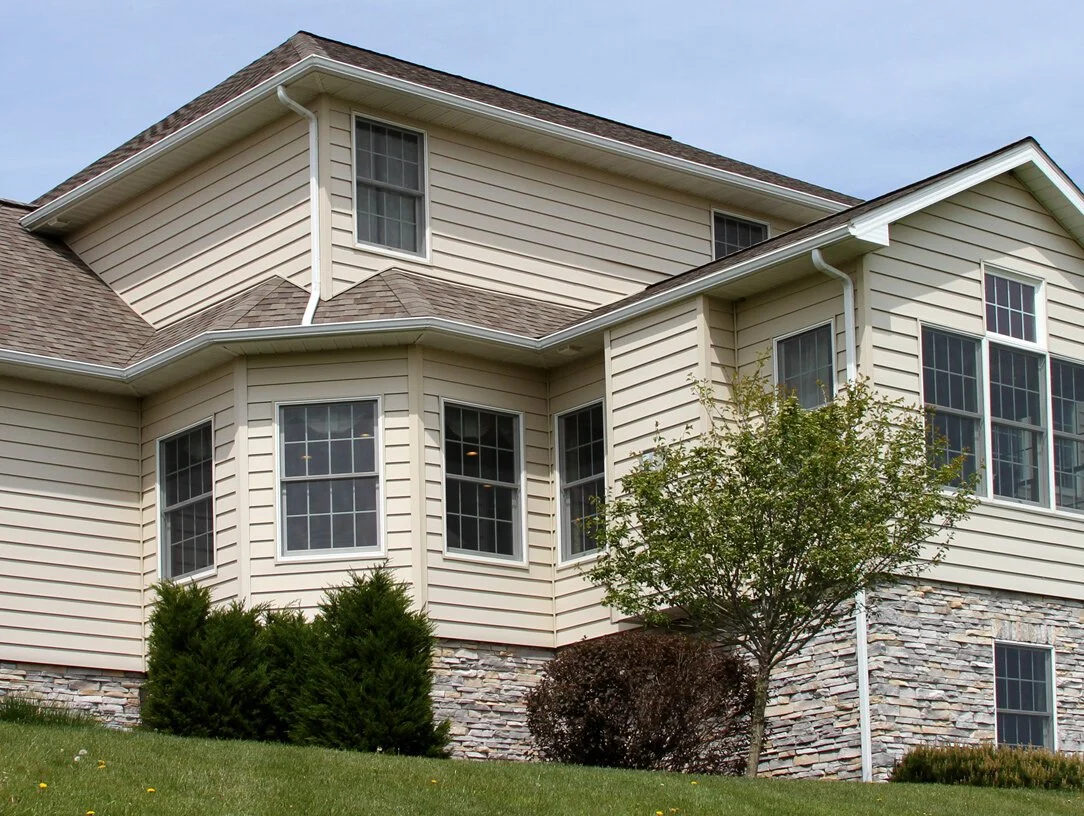
South and west-facing walls take a beating from the sun. Surface temperatures on dark siding can hit 160°F on a July afternoon. That kind of heat causes vinyl to soften and warp. It causes fiber cement paint to fade and chalk.
If you've got a brick Colonial in Grosse Pointe Farms with a south-facing gable, you need to think about heat exposure. If you're in a wooded lot in Lake Orion with heavy shade, it's less of a concern.
Vinyl Siding Performance in Michigan Climate
Vinyl siding is extruded PVC — the same plastic used in plumbing pipes. It's waterproof, won't rot, and doesn't need paint. It's also the most popular siding choice in Southeast Michigan, and for good reason: it's affordable, low-maintenance, and performs well in our climate when installed correctly.
Thermal Expansion: The Vinyl Siding Wild Card
Vinyl expands and contracts more than any other common siding material. A 12-foot vinyl panel can grow or shrink by up to 1/2 inch between summer and winter. That's why proper installation technique matters so much.
We see this mistake constantly: contractors who nail vinyl panels tight to the wall. The panel can't move, so it buckles in the heat or pulls the fasteners through in the cold. A proper vinyl installation leaves 1/32" between the nail head and the panel, allowing the siding to slide back and forth as temperatures change.
When vinyl is installed right — with proper expansion gaps, correct nailing, and quality fasteners — it handles Michigan's temperature swings without issue. We've got vinyl siding jobs in Clinton Township that we installed 20 years ago that still look great.
Cold Weather Brittleness
Vinyl gets brittle in extreme cold. Below about 0°F, it can crack if you hit it hard — a ladder leaning against the house, a branch falling during an ice storm, a careless snow shovel.
This isn't a dealbreaker. It's just something to be aware of. Higher-quality vinyl formulations (like CertainTeed's premium lines) include impact modifiers that reduce brittleness. Cheap vinyl from the big-box store? That stuff cracks easier.
Moisture Resistance: Vinyl's Biggest Advantage
Vinyl doesn't absorb water. Period. You can leave it submerged in a bucket for a year and it won't swell, rot, or degrade. In a climate where moisture is constant, that's a huge advantage.
This is why vinyl works so well on homes with gutter problems in Detroit or ice dam issues. Even if water gets behind the siding (and it will — no siding system is perfectly sealed), vinyl won't be damaged by it. The water drains down the drainage plane behind the siding and exits at the bottom.
Real-World Example: We replaced siding on a 1960s ranch in Warren last year. The old vinyl had been on there for 30 years. The siding itself was fine — no rot, no warping. The only reason they replaced it was cosmetic. The house had terrible attic insulation, which caused ice dams every winter. Water had been running behind that siding for decades. If it had been wood or fiber cement, the whole wall would have rotted out.
Longevity and Appearance
Good vinyl siding lasts 30-40 years in Michigan. The color is baked into the material, so it won't peel or flake like paint. It will fade over time — especially on south-facing walls — but modern vinyl fades much more evenly than the vinyl from the 1980s.
The downside? Vinyl looks like vinyl. It's gotten better — textured finishes, varied profiles, realistic wood grain — but it still doesn't have the depth and shadow lines of fiber cement or real wood. If curb appeal is your top priority, that matters.
Fiber Cement Siding in Michigan Conditions
Fiber cement — James Hardie is the big name, but LP SmartSide and CertainTeed also make quality products — is a composite of cement, sand, and cellulose fibers. It's dense, heavy, and tough. It looks like real wood siding but won't rot or burn.
Fiber cement has become the premium choice for siding projects in Detroit and the surrounding suburbs, especially on higher-end homes in Bloomfield Hills and Rochester Hills. But it's not a magic bullet. Michigan weather exposes its weaknesses.
Dimensional Stability: Fiber Cement's Strength
Fiber cement barely moves with temperature changes. Its coefficient of thermal expansion is much lower than vinyl. A 12-foot fiber cement plank might expand or contract 1/16 inch over the course of a year — compared to 1/2 inch for vinyl.
That dimensional stability means fiber cement holds paint better, maintains tighter seams, and looks crisp and clean for decades. It's why architects spec it for high-end projects.
Moisture Absorption: The Achilles Heel
Here's the problem: fiber cement absorbs water. Not a lot — James Hardie's HardiePlank absorbs less than 5% of its weight when fully saturated — but enough to matter in Michigan's freeze-thaw cycles.
When water gets into fiber cement and then freezes, it expands. Do that 60 times a winter, and you get micro-cracking along the edges and at fastener holes. Over time, those cracks grow. Paint starts to peel at the cracks. Water infiltration gets worse. The cycle accelerates.
This is why proper installation is critical with fiber cement. You need:
- Factory-primed or pre-finished planks (field-cut edges must be sealed)
- Proper clearance from grade, roof lines, and horizontal surfaces (6-8 inches minimum)
- High-quality caulking at all seams and penetrations
- Correct fastener type and placement (stainless steel or hot-dipped galvanized nails, never roofing nails)
- A continuous drainage plane behind the siding (housewrap or building paper)
We see fiber cement failures in Southeast Michigan almost always trace back to installation mistakes. A contractor who treats fiber cement like vinyl — nailing it through the face, skipping the edge sealing, not leaving proper clearances — creates a siding system that won't last 10 years.
Paint and Maintenance
Fiber cement requires paint. Even pre-finished fiber cement (like James Hardie's ColorPlus) will need repainting eventually — usually in 15-20 years in Michigan's climate.
The good news: fiber cement holds paint extremely well. A proper paint job with high-quality acrylic latex (we use Sherwin-Williams exterior coatings exclusively) can last 15-20 years on fiber cement. The same paint on wood siding might last 7-10 years.
The bad news: painting fiber cement isn't cheap. You're looking at $3-5 per square foot for a quality repaint, including prep work. On a 2,000-square-foot siding job, that's $6,000-10,000 every 15-20 years.
Durability and Impact Resistance
Fiber cement is tough. It won't dent from hail. It won't crack if you lean a ladder against it (unlike cold vinyl). It's rated for 130+ mph wind zones, which is overkill for Southeast Michigan but speaks to its structural integrity.
Woodpeckers won't drill into it. Carpenter bees can't nest in it. It won't support mold or mildew growth (though dirt and organic matter on the surface can, just like any siding).
For homes in areas with heavy tree coverage — where falling branches are a concern — fiber cement's toughness is a real advantage.
Cost Reality for Southeast Michigan Homeowners
Let's talk numbers. These are real-world costs for quality installations in Macomb, Oakland, and St. Clair counties as of 2026.
Vinyl Siding Costs
Material and labor for quality vinyl siding runs $6-12 per square foot installed, depending on the profile, brand, and complexity of the job.
- Basic vinyl (CertainTeed Monogram, standard colors): $6-8/sq ft
- Premium vinyl (CertainTeed Restoration Millwork, deep textures, custom colors): $9-12/sq ft
For a typical 2,000-square-foot siding job (which usually covers about 1,600 square feet of actual wall area after subtracting windows and doors), you're looking at $9,600-19,200 total.
Maintenance costs over 30 years: $500-1,000 (occasional cleaning, maybe replacing a damaged panel or two).
Fiber Cement Siding Costs
Fiber cement runs $12-18 per square foot installed for quality work.
- James Hardie HardiePlank (primed, needs painting): $12-14/sq ft
- James Hardie ColorPlus (pre-finished): $15-18/sq ft
Same 2,000-square-foot job: $19,200-28,800 total.
Maintenance costs over 30 years: $8,000-12,000 (repainting at year 15-20, plus caulking/touch-ups).
Total Cost of Ownership
Over 30 years:
- Vinyl: $10,000-20,000 total (installation + minimal maintenance)
- Fiber cement: $27,000-40,000 total (installation + repainting)
Fiber cement costs roughly 2-2.5x more than vinyl when you factor in the repaint.
Is it worth it? That depends on your goals. If you're planning to sell in 5-10 years and want maximum curb appeal, fiber cement can boost resale value — especially on higher-end homes. If you're staying in the house for 30 years and want the lowest total cost, vinyl makes more sense.
Budget Tip: If you love the look of fiber cement but can't swing the full cost, consider using it on the front of the house (where curb appeal matters) and vinyl on the sides and back. We do hybrid installations like this all the time in Metro Detroit. You get the visual impact where it counts and save $5,000-8,000 on the project.
Which Material Works Best for Your Michigan Home
There's no universal "best" answer. The right choice depends on your home's architecture, exposure, and your priorities.
Choose Vinyl If:
- Budget is your top concern. Vinyl delivers solid performance at half the cost of fiber cement.
- You have moisture issues. Homes with chronic ice dams, poor drainage, or high humidity are better served by vinyl's complete moisture resistance.
- You want zero maintenance. Vinyl never needs painting. Rinse it with a hose every couple years and you're done.
- Your home is a 1960s-80s ranch or Colonial. These homes were designed with vinyl in mind. It fits the aesthetic.
- You're in a heavily wooded area. Less UV exposure means vinyl will fade more slowly. The brittleness issue is less of a concern when there's no extreme cold exposure.
Choose Fiber Cement If:
- Curb appeal is critical. You're selling soon, or you just want the best-looking house on the block. Fiber cement delivers.
- You have a historic or high-end home. Fiber cement's authentic wood-look profiles work better on Craftsman bungalows, Victorian homes, and upscale new construction.
- You're willing to invest in long-term value. Fiber cement lasts 50+ years if maintained. It's a buy-it-for-life material.
- You have excellent drainage and roof systems. Fiber cement performs best when water management is dialed in. If your gutters, roof, and grading are solid, fiber cement will thrive.
- You want fire resistance. Fiber cement is non-combustible. In areas with wildfire risk (not common in Southeast Michigan, but relevant for some rural properties), it's a smart choice.

Architectural Style Matters
Certain home styles just look better with one material or the other:
- Brick Colonials (common in Grosse Pointe, Troy, Birmingham): Fiber cement on gables and trim, or quality vinyl with architectural details. Avoid cheap vinyl — it clashes with brick.
- 1960s-80s Ranches (all over Macomb and Oakland counties): Vinyl works great. It's period-appropriate and cost-effective.
- Craftsman/Bungalow styles: Fiber cement, hands down. The shadow lines and texture are critical to the aesthetic.
- Modern farmhouse (popular in new construction): Fiber cement board-and-batten or shiplap profiles. Vinyl versions exist but don't have the same depth.
Signs Your Siding Is Failing in Michigan Weather
Whether you have vinyl or fiber cement, here's what to watch for. These are the red flags that mean it's time to call a contractor.
Warping or Buckling
Vinyl that's wavy or buckled between fasteners was installed too tight. It can't move with temperature changes, so it deforms. This happens most often on south and west-facing walls.
If you catch it early (within a year or two of installation), it's a warranty issue. If it's been 10+ years, you're looking at a re-side.
Cracking or Splitting
Fiber cement cracks usually start at the bottom edges or around fastener holes. They're hairline at first, then widen over freeze-thaw cycles.
A few small cracks can be repaired with caulk and paint. Widespread cracking means the siding is at the end of its life or was installed incorrectly.
Vinyl cracks are less common but happen in extreme cold or from impact. Individual panels can be replaced without disturbing the rest of the wall.
Moisture Behind the Siding
If you see water stains on interior walls, peeling paint inside the house, or mold growth, water is getting behind your siding and into the wall cavity.
This isn't always a siding failure — it could be a window installation problem, a roof leak, or failed flashing. But it needs to be diagnosed and fixed before the wall sheathing rots out.
Pulling Away from the House
Siding that's pulling away from the wall — gaps at corners, J-channel separating from trim, panels lifting at the bottom — indicates fastener failure or structural movement.
This is more common on older homes with settling foundations or on additions that weren't built to the same standards as the main house.
Fading and Chalking
All siding fades over time. Vinyl fades from UV exposure. Fiber cement paint fades and chalks (develops a powdery surface residue).
Fading is cosmetic, not structural. If you can live with it, you don't need to replace the siding. If it bothers you, vinyl can be painted (though it won't hold paint as well as fiber cement), and fiber cement can be repainted.
When to Call a Contractor: If you see any of the above issues, get a professional assessment. We offer free inspections throughout Southeast Michigan. We'll tell you if it's a simple repair, a partial replacement, or if you need a full re-side. No pressure, no sales pitch — just straight answers from someone who's been doing this since 1988.
Other Services from NEXT Exteriors
Beyond siding installation, NEXT Exteriors provides comprehensive exterior services in Detroit and throughout Southeast Michigan. Our licensed crews handle everything from professional roofing and energy-efficient window replacement to attic and wall insulation upgrades. We install seamless gutter systems to protect your foundation and offer exterior painting services using premium Sherwin-Williams products. Every project is backed by our 35+ years of experience and our commitment to changing contractor culture in Michigan.
Ready to Get Started?
NEXT Exteriors has been protecting Michigan homes since 1988. Get a free, no-pressure estimate from a team that shows up on time and does the job right.
Get Your Free QuoteOr call us: (844) 770-6398
Frequently Asked Questions
Vinyl can become brittle in extreme cold (below 0°F) and crack from hard impacts, but it doesn't crack from temperature changes alone. Quality vinyl with impact modifiers performs well in Michigan winters. We've seen 20-30 year old vinyl installations in Macomb and Oakland counties with zero cracking. The key is using premium-grade vinyl and avoiding impacts during cold snaps.
Properly installed and maintained fiber cement lasts 50+ years in Michigan. James Hardie offers a 30-year non-prorated warranty on their products. The limiting factor is usually the paint, which needs refreshing every 15-20 years. If you stay on top of maintenance — caulking, paint touch-ups, keeping clearances from grade — fiber cement will outlast you.
Yes, but it's not ideal. Vinyl can be painted with 100% acrylic latex paint formulated for vinyl (like Sherwin-Williams VinylSafe). The paint will last 7-10 years in Michigan's climate — less than on fiber cement or wood. The bigger issue: if the vinyl is faded, it's old. Painting might buy you 5-10 more years, but you're better off replacing it if the siding is 25+ years old.
Fiber cement typically adds more to resale value on homes over $400,000, especially in higher-end markets like Bloomfield Hills, Rochester Hills, and Grosse Pointe. For mid-range homes ($200,000-400,000), quality vinyl delivers better ROI because buyers in that price range are more cost-conscious. According to Remodeling Magazine's Cost vs. Value Report, vinyl siding recoups about 69% of its cost at resale in the Detroit metro, while fiber cement recoups about 71% — not a huge difference.
Factory-primed fiber cement should be painted after installation but before exposure to weather. Pre-finished fiber cement (like James Hardie ColorPlus) comes painted from the factory and doesn't need additional coating. We strongly recommend pre-finished fiber cement for Michigan installations — field-applied paint rarely performs as well as factory finishes, especially on cut edges and fastener holes where moisture infiltration is most likely.
Vinyl. Ice dams cause water to back up under shingles and run down behind siding. Vinyl won't be damaged by this water — it's completely waterproof and won't rot or swell. Fiber cement can absorb moisture and develop freeze-thaw damage if repeatedly exposed to ice dam runoff. That said, the real solution is fixing the ice dam problem (usually inadequate attic insulation and ventilation), not just choosing siding that can survive it. We can help with both.
For a typical 2,000-square-foot home (about 1,600 sq ft of actual siding area after subtracting windows and doors), expect to pay $9,600-19,200 for quality vinyl siding or $19,200-28,800 for fiber cement, including materials and professional installation. Prices vary based on siding profile, trim complexity, and whether you're replacing old siding or building new. These are 2026 prices for Southeast Michigan. Get multiple quotes from licensed contractors and verify they're including proper moisture barriers, flashing, and trim work — not just slapping siding over old sheathing.