

Your Trusted Storm Restoration Contractor in Harrison Township
After a storm hits Harrison Township, you need a licensed contractor who responds fast and does it right. NEXT Exteriors has restored 500+ Michigan homes since 1988.

When severe weather rolls through Harrison Township—whether it's a summer thunderstorm with straight-line winds, a hail event that shreds shingles, or the kind of ice storm that pulls gutters clean off the fascia—you need a contractor who's seen it all before and knows exactly what to do next.
NEXT Exteriors has been restoring Michigan homes after storm damage since 1988. We're based in Mount Clemens, just down the road from Harrison Township, and we've worked on hundreds of storm restoration projects across Macomb County. We know the local building codes, we know how Michigan weather beats up exterior materials, and we know how to work with insurance adjusters to get your claim approved without the runaround.
This isn't about upselling you on a full roof replacement when a repair will do. It's about getting your home weathertight, structurally sound, and looking right again—fast. When you're dealing with Detroit roofing services after a storm, you need someone who shows up when they say they will, documents everything properly for insurance, and has the crew capacity to get the work done before the next weather event hits.
What Storm Damage Looks Like in Harrison Township
Harrison Township sits right on Lake St. Clair, which means you get the lake-effect weather patterns that can turn a routine thunderstorm into something that tears shingles off, cracks siding, and sends tree limbs through windows. Here's what we typically see after storms roll through:
Roof Damage from Wind, Hail, and Ice
Wind damage is the most common. When you get sustained winds over 50 mph—which happens several times a year in this area—architectural shingles can lift, crease, or tear completely off. The damage often starts at the ridge, the eaves, or around penetrations like chimneys and vents where the wind gets under the shingles.
Hail is less frequent but more destructive. A quarter-sized hailstone hitting at terminal velocity will bruise an asphalt shingle, cracking the granules and exposing the mat underneath. You might not see it from the ground, but that shingle's integrity is compromised. Within a year or two, those bruises turn into leaks.
Ice dams aren't technically storm damage, but they show up after heavy snowfall and freeze-thaw cycles. Water backs up under the shingles at the eave line, seeps into the decking, and causes rot. If you've had ice dams multiple winters in a row, the problem isn't your roof—it's your attic insulation and ventilation, which we cover in our top-rated insulation contractor services.

Siding Impact from Debris and Severe Weather
Vinyl siding can crack from hail or flying debris. Fiber cement siding is more impact-resistant, but high winds can still rip it off if it wasn't installed correctly in the first place. We see a lot of older vinyl siding jobs where the nails were overdriven or the panels weren't properly locked together—those are the first to fail in a windstorm.
If you've got wood trim or engineered wood siding, water intrusion after storm damage leads to rot fast. A crack in the siding or a missing piece of trim means water gets behind the barrier, soaks into the sheathing, and you've got a bigger problem than cosmetic damage. Our team handles exterior siding repair across Metro Detroit, and we've seen what happens when small storm damage gets ignored.
Gutter and Fascia Problems
Heavy ice buildup or a tree limb coming down will rip gutters right off the fascia. Sometimes the fascia board itself splits or rots out, especially if the gutter's been leaking for a while before the storm. Seamless gutters in Detroit, MI are built to handle Michigan weather, but nothing's indestructible when a 40-foot oak branch lands on it.
We also see downspouts that get crushed or disconnected, which means all that roof runoff is dumping right at your foundation instead of being carried away. That's how you end up with basement water issues on top of your storm damage.
Window Damage from Wind-Driven Rain
Wind-driven rain can force water past window seals, especially on older single-pane or poorly installed double-hung windows. If the flashing around the window wasn't done right, water gets into the wall cavity. You might not notice until you see staining on the interior drywall or smell mildew.
Broken glass from hail or debris is obvious, but frame damage is sneakier. A hard impact can crack the frame or knock it out of square, which means the window won't seal properly even after you replace the glass. Our Detroit window experts know how to assess whether a window can be repaired or needs full replacement.
The Insurance Claims Process: What Harrison Township Homeowners Need to Know
Most storm damage is covered under your homeowner's insurance policy, but getting the claim approved and paid out properly requires documentation and persistence. Here's how the process works and where NEXT Exteriors fits in.
Documenting Damage Properly
Take photos and videos of everything. Get close-ups of specific damage—cracked shingles, dented siding, broken glass—and wide shots that show the full scope. Include date stamps if your phone allows it. The more documentation you have, the harder it is for an adjuster to lowball the estimate.
We'll do a full inspection and provide a detailed damage report. This includes measurements, material specifications, and a scope of work that meets Michigan building code. Insurance companies respect documentation from a licensed contractor with credentials like our CertainTeed Master Shingle Applicator certification—it carries weight.
Working with Adjusters
Your insurance company will send an adjuster to inspect the damage. You want to be there, and ideally, you want your contractor there too. Adjusters work for the insurance company, not for you. Their job is to minimize the payout. Our job is to make sure every bit of legitimate damage gets documented and included in the claim.
We've worked with dozens of adjusters across Macomb County. We know what they look for, we know what they try to exclude, and we know how to push back when they miss something. If the adjuster says a damaged section of roof is "cosmetic" or "pre-existing," we'll explain exactly why that's wrong and provide the evidence to prove it.
Pro tip: Don't sign anything or accept a settlement until your contractor has reviewed the adjuster's estimate. We've seen too many homeowners accept a payout that covers half the actual repair cost because they didn't know what questions to ask.
Understanding Your Policy
Most policies cover "sudden and accidental" damage—storms, hail, wind, falling trees. They don't cover gradual wear and tear or damage from lack of maintenance. If your roof was already 20 years old and failing, the insurance company might depreciate the payout or deny the claim entirely.
Replacement Cost Value (RCV) policies pay to replace damaged materials with new materials of similar quality. Actual Cash Value (ACV) policies factor in depreciation, so you get less. Know which one you have before you file the claim.
Your deductible matters. If the total damage is $8,000 and your deductible is $2,500, you're paying the first $2,500 out of pocket. We'll give you an honest assessment of whether it makes sense to file a claim or just pay for the repair yourself to avoid a rate increase.
Why Response Time Matters After Storm Damage
The biggest mistake Harrison Township homeowners make after a storm? Waiting. They think the damage isn't that bad, or they're busy, or they assume it can wait until spring. By the time they call, what was a $3,000 repair is now a $15,000 restoration because water got into the structure.
Secondary Damage Risks
A missing shingle or a cracked piece of siding is an entry point for water. One rain event and you've got water in the decking, the wall cavity, or the attic. In Michigan's humidity, mold starts growing within 48 hours. Rot follows. What started as a simple shingle replacement becomes a full decking tear-off and mold remediation project.
We've seen it dozens of times: homeowner waits three months to call, we get up on the roof, and the decking is soft in a 10-foot radius around the original damage. That's not covered by insurance anymore because it's "secondary damage due to lack of timely repair." You're paying out of pocket for something that could've been a $500 fix.
Emergency Tarping and Temporary Protection
If the damage is severe—big section of shingles gone, siding ripped off, window blown out—we can do emergency tarping to keep water out until the full repair gets scheduled. Most insurance policies cover the cost of emergency mitigation. It's a temporary fix, but it buys you time without letting the damage get worse.
We keep tarps, plywood, and fasteners on the trucks specifically for this. Call us after a storm, and if you need emergency protection, we'll get someone out same-day or next-day depending on the backlog.
Scheduling Restoration Before the Backlog Hits
After a major storm event, every contractor in Southeast Michigan gets slammed with calls. If you wait two weeks to reach out, you're looking at a six-week wait for the work to start. The contractors who show up the next day offering to start immediately? Those are the storm chasers with no local reputation and no accountability. They'll take your deposit and disappear, or they'll do substandard work and you'll never see them again.
NEXT Exteriors has been in Mount Clemens for 35 years. We're not going anywhere. We'll give you a realistic timeline, and we'll show up when we say we will. If the backlog is three weeks, we'll tell you it's three weeks—and we'll get the tarping done in the meantime so your home is protected.

What Sets NEXT Exteriors Apart for Storm Restoration
There are a lot of contractors who'll take your storm damage call. Here's why Harrison Township homeowners keep coming back to NEXT Exteriors—and why insurance adjusters and realtors recommend us.
35+ Years of Experience, Licensed and Insured
We've been doing this since 1988 under Premier Builder Inc. We hold a Michigan Residential Builder's License, we're fully insured, and we've completed over 500 projects across Southeast Michigan. Storm restoration isn't new to us—we've seen every type of damage Michigan weather can throw at a house.
CertainTeed Master Shingle Applicator Credential
This is the highest credential a roofing contractor can earn from CertainTeed, one of the top shingle manufacturers in North America. It means we've met strict installation standards, passed third-party inspections, and maintained a track record of quality work. It also means we can offer extended warranties that other contractors can't.
When you're filing an insurance claim for roof damage, having a CertainTeed Master Shingle Applicator doing the work adds credibility to the claim. Adjusters know we're not cutting corners.
Direct Manufacturer Relationships
We're certified installers for CertainTeed, GAF, Owens Corning, James Hardie, and LP SmartSide. That means we get access to materials faster, we know the products inside and out, and we can offer manufacturer-backed warranties. When there's a material shortage after a big storm—which happens—we're higher up the priority list than non-certified contractors.
For projects involving vinyl siding vs. fiber cement in Michigan weather, we can walk you through the pros and cons of each material based on real-world performance, not just what's in the brochure.
A+ BBB Rating and 5-Star Reviews
We've held an A+ rating with the Better Business Bureau since 2006. We average 5.0 stars across 87+ reviews on Google, Facebook, and other platforms. That doesn't happen by accident—it happens by showing up on time, doing clean work, and standing behind what we install.
Check our reviews. You'll see the same themes over and over: clear communication, fair pricing, crews that respect your property, and work that gets done right the first time. When you're dealing with storm damage and insurance claims, you need a contractor you can trust. Our reputation speaks for itself.
Common Storm Restoration Services in Harrison Township
Storm damage rarely affects just one part of your home's exterior. A severe weather event usually hits multiple systems—roof, siding, gutters, windows. Here's what we typically handle on storm restoration projects.
Emergency Roof Repair and Replacement
If the damage is localized—say, 20 shingles blown off in one section—we can often repair it without replacing the whole roof. We'll match the existing shingles as closely as possible, replace any damaged decking, and make sure the repair blends in.
If the damage is widespread or the roof was already near the end of its lifespan, a full replacement makes more sense. We'll walk you through the options: architectural shingles (CertainTeed Landmark, GAF Timberline HDZ, Owens Corning Duration), designer shingles for a higher-end look, or impact-resistant shingles if you want better hail protection going forward.
Our Detroit roofing services cover everything from emergency tarping to full tear-offs and new installations, all done to Michigan building code and manufacturer specs.
Siding Repair and Replacement
Cracked, dented, or missing siding gets replaced section by section. If you've got vinyl siding, we'll try to match the profile and color—though if it's an older product line, exact matches can be tough. Sometimes it makes sense to replace a full wall section to avoid a patchwork look.
For fiber cement or engineered wood siding, storm damage is often a good opportunity to upgrade. James Hardie fiber cement is more impact-resistant than vinyl and holds up better to Michigan freeze-thaw cycles. LP SmartSide engineered wood gives you the look of real wood with better durability and a 50-year warranty.
We also handle the trim work—fascia, soffit, corner boards, window trim. If the storm damaged your siding, there's a good chance it damaged the trim too. We make sure everything gets addressed so you're not calling us back in six months for a secondary repair. For more on this, see our guide to soffit and fascia installation in Metro Detroit.
Gutter System Restoration
Damaged gutters get replaced with seamless aluminum gutters custom-formed on-site to fit your roofline. We install heavy-duty hangers every 24 inches, not the cheap spike-and-ferrule system that fails in the first ice storm. Downspouts get properly sized and positioned to carry water at least 6 feet away from the foundation.
If the fascia board is rotted or split, we replace that first. A new gutter hung on bad fascia is just going to fail again. We do it right the first time. Our seamless gutter systems guide for Metro Detroit covers what makes a quality installation.
Window Replacement
Broken glass is straightforward—we replace the pane or the sash depending on the damage. Frame damage or seal failure means the whole window needs to go. We install double-hung, casement, sliding, and bay/bow windows from manufacturers like Pella, Andersen, and Marvin.
For storm restoration, we focus on impact resistance and energy efficiency. Low-E glass, argon fill, and insulated frames make a huge difference in Michigan winters. If you're replacing windows anyway, it's worth upgrading to something that'll perform better long-term. Check out our breakdown of double-pane vs. triple-pane windows in Michigan to see what makes sense for your home.
Full Exterior Restoration Projects
Sometimes the storm hits so hard that it makes sense to do a full exterior overhaul—new roof, new siding, new gutters, new windows. If your home is 20+ years old and multiple systems are at the end of their lifespan anyway, bundling everything into one project can save you money and give you a cohesive look.
We'll coordinate the whole project, pull the permits, schedule inspections, and manage the timeline so you're not dealing with three different contractors. One point of contact, one warranty, one team responsible for the outcome. That's how our exterior services in Detroit are structured—simple, accountable, and built to last.

What Storm Restoration Actually Costs in Harrison Township
The question every homeowner asks: "What's this going to cost me?" The answer depends on the scope of damage, what materials you choose, and how much your insurance covers. Here's what we typically see.
Insurance Coverage vs. Out-of-Pocket
If the damage is clearly storm-related and your policy is in good standing, insurance should cover most of it minus your deductible. A typical deductible in Southeast Michigan is $1,000 to $2,500. So if your total damage is $12,000, you're paying $2,500 and insurance pays $9,500.
If the adjuster finds pre-existing damage or depreciation issues, the payout might be lower. We'll review the adjuster's estimate line by line and push back on anything that's inaccurate. We've gotten claims increased by $3,000 to $8,000 just by providing better documentation and challenging low-ball estimates.
Typical Project Ranges
Here are ballpark numbers for common storm restoration work in Harrison Township. These are rough ranges—every project is different, and we'll give you an exact quote after the inspection.
- Roof repair (localized damage): $800 to $2,500 depending on the size of the damaged area and whether decking needs replacement.
- Full roof replacement (architectural shingles): $8,000 to $18,000 for a typical 1,800 to 2,500 square foot home. Premium shingles or complex rooflines cost more.
- Siding repair (section replacement): $1,200 to $3,500 depending on material and how much needs to be replaced.
- Full siding replacement (vinyl): $10,000 to $20,000 for a typical home. Fiber cement runs $15,000 to $30,000.
- Gutter replacement: $1,500 to $3,500 for seamless aluminum gutters and downspouts on a typical home.
- Window replacement (per window): $500 to $1,200 depending on size, style, and features.
For a comprehensive look at window costs, see our post on what window replacement actually costs in Michigan.
Factors That Affect Pricing
Material choice is the biggest variable. Architectural shingles cost more than 3-tab, fiber cement costs more than vinyl, triple-pane windows cost more than double-pane. We'll explain the performance differences so you can decide what's worth the upgrade.
Complexity matters. A simple gable roof is cheaper to replace than a multi-level hip roof with valleys, dormers, and skylights. A two-story home costs more than a ranch because of the labor and equipment required.
Timing can affect cost too. If we're slammed with storm work and material costs are up because of supply chain issues, prices go up. If you're flexible on timing and can wait until the backlog clears, you might save a bit—but that only works if the damage isn't getting worse while you wait.
When to Call a Storm Restoration Contractor
Some damage is obvious—half your shingles are in the yard, your siding's cracked, your gutter's hanging by a thread. Other damage is subtle. Here's when to pick up the phone and call NEXT Exteriors.
Immediate Red Flags
- Missing or damaged shingles: Even a few missing shingles are an entry point for water. Don't wait.
- Visible cracks or holes in siding: Water gets in, rot starts, and the repair cost multiplies.
- Gutters pulling away from the house: This usually means fascia damage too. Get it fixed before the next rain.
- Broken windows or cracked glass: Obvious security and weatherproofing issue.
- Water stains on interior ceilings or walls: This means water's already getting in. The damage is happening right now.
Signs of Hidden Damage
- Granules in the gutters: Asphalt shingles shed granules when they're damaged or aging. A handful is normal. A pile means you've got problems.
- Shingles that look bruised or dented: Hail damage isn't always obvious from the ground. Get a professional inspection.
- Loose or warped siding panels: This can be wind damage or improper installation. Either way, it needs fixing.
- Sagging gutters or standing water in the gutter trough: Means the hangers failed or the pitch is wrong. Water isn't draining properly.
- Drafts around windows: Could be seal failure or frame damage from a storm. Worth checking out.
Don't wait checklist: If you've had a major storm in the last 48 hours and you see any of the red flags above, call us for an inspection. Even if you're not sure there's damage, a free inspection gives you peace of mind—and documentation if you need to file a claim later.
For homeowners wondering whether their home needs broader updates, our post on 5 signs your home needs new siding this spring covers what to look for beyond just storm damage.
Ready to Get Started?
NEXT Exteriors has been protecting Michigan homes since 1988. Whether you're dealing with storm damage, planning an upgrade, or just need an honest assessment, we'll give you a free, no-pressure estimate from a team that shows up on time and does the job right.
Get Your Free QuoteOr call us: (844) 770-6398
Frequently Asked Questions
Most homeowner's insurance policies in Michigan cover "sudden and accidental" damage from storms, including wind, hail, falling trees, and ice. What's not covered: gradual wear and tear, lack of maintenance, or pre-existing damage. Your deductible applies, and the payout depends on whether you have Replacement Cost Value (RCV) or Actual Cash Value (ACV) coverage. We'll help you document the damage properly and work with your adjuster to maximize the claim.
It depends on the scope. A simple roof repair might take one day. A full roof replacement takes 2-4 days for a typical home. Siding replacement can take 3-7 days depending on the size of the house and the material. If you're doing multiple systems—roof, siding, gutters—expect 1-2 weeks total. After a major storm event, there's usually a backlog, so the timeline from your first call to project completion might be 3-6 weeks. We'll give you a realistic schedule upfront and keep you updated throughout.
If the damage is localized and your roof is less than 15 years old, a repair usually makes sense. If the damage is widespread, your roof is over 20 years old, or you've had multiple repairs in the past few years, replacement is the smarter move. We'll give you an honest assessment based on the condition of the entire roof, not just the damaged section. Sometimes insurance will only cover a repair, but if the roof's failing anyway, it's worth considering an upgrade and paying the difference out of pocket.
This happens more often than it should. Adjusters sometimes miss damage, use outdated pricing, or classify legitimate damage as "pre-existing." We'll review the adjuster's estimate line by line, document anything that was missed, and provide a supplemental estimate with photos and measurements. Most insurance companies will revise the payout when presented with solid evidence from a licensed contractor. If they still won't budge, you have the right to request a re-inspection or file a dispute. We've been through this process dozens of times and know how to advocate for our clients.
We'll do our best. If your siding is a current product line from a major manufacturer, matching is usually straightforward. If it's an older or discontinued product, we might not be able to get an exact match. In that case, we'll show you the closest alternatives and discuss options like replacing a full wall section so the color transition is less noticeable. For fiber cement or engineered wood, paint-matching is easier since we can get custom colors from Sherwin-Williams through our Southeast Michigan painting professionals services.
Yes. If you've got significant roof damage or exposed areas after a storm, we can get a crew out for emergency tarping, usually same-day or next-day depending on the volume of calls. We use heavy-duty tarps and secure them properly so they'll hold until the full repair gets done. Most insurance policies cover emergency mitigation costs, so you're not paying out of pocket for this. It's a temporary fix, but it prevents secondary water damage while we schedule the permanent repair.
We've been doing this since 1988, we're locally based in Mount Clemens, and we're not going anywhere. We hold a Michigan Residential Builder's License, we're a CertainTeed Master Shingle Applicator, and we've got an A+ BBB rating with 5-star reviews. We know how to work with insurance adjusters, we show up when we say we will, and we stand behind our work with real warranties. You're not getting a fly-by-night storm chaser—you're getting a contractor with 35 years of roots in this community and a reputation we've earned one project at a time.
Hail Damage: Repair or Replace Your Roof in Michigan?
After hail damage, should you repair a few shingles or replace the whole roof? A Michigan roofing contractor explains what insurance covers and when replacement makes sense.

You're standing in your driveway in Sterling Heights after a summer storm, looking at what might be hail damage on your roof. Your neighbor three houses down just got a full replacement covered by insurance. Another neighbor patched a few shingles and called it good. You're wondering which path makes sense for your home.
After 35 years handling Detroit roofing services and working with insurance adjusters across Southeast Michigan, I can tell you this: the answer isn't always obvious from the ground. The decision between spot repair and full replacement depends on factors most homeowners don't know to look for—and making the wrong call can cost you thousands or void your warranty entirely.
Here's what actually matters when you're evaluating hail damage, based on what we see on Michigan roofs every storm season.
How Hail Actually Damages Asphalt Shingles
Hail doesn't just knock holes in your roof like you might expect. The damage is more insidious than that.
When a hailstone hits an asphalt shingle—especially the architectural shingles common on Michigan homes—it compresses the mat and fractures the asphalt coating. You'll see this as a dark spot where the protective granules have been knocked loose. That's the visible part. What you can't see from the ground is the bruising underneath: micro-fractures in the fiberglass mat that compromise the shingle's structural integrity.
On a CertainTeed Landmark or GAF Timberline shingle (the two most common architectural shingles we install), hail damage typically shows up as:
- Granule loss: Shiny black spots where the colored ceramic granules have been knocked off, exposing the asphalt beneath
- Bruising: Soft spots you can feel by pressing on the shingle—this indicates the mat underneath is compromised
- Cracking: Visible splits in the shingle surface, often radiating from the impact point
- Broken seal tabs: The adhesive strips that keep shingles flat can fail after impact, leading to wind uplift later
The real problem develops over time. A bruised shingle loses its flexibility. When Michigan's freeze-thaw cycles hit—and we get dozens every winter—those micro-fractures expand. Water seeps in. The damage spreads. What looked like minor cosmetic damage in July becomes a leak by February.

We also see damage to components most homeowners don't think about: ridge caps get dented, valleys collect impact damage (because they're lower-slope and take more direct hits), and metal flashing around chimneys and vents gets dimpled. On homes with seamless gutters in Detroit, MI, you'll often see corresponding dents in the gutter edges—a good indicator that the roof took similar impacts.
When Spot Repairs Make Sense (And When They Don't)
Let's be direct: spot repairs are a gamble. Sometimes they work fine. Other times they're throwing good money after bad.
Here's when a partial repair makes sense:
Your roof is less than 5 years old and the damage is isolated to one slope (say, the south-facing side that took the brunt of the storm). If you've got a 2022 roof with 10-12 damaged shingles concentrated in one area, replacing those shingles maintains your warranty and gets you back to full protection without the cost of a complete tear-off.
The shingles are still being manufactured in the same color. This matters more than most people realize. If your roof is a discontinued color—and manufacturers change their lines every few years—the patch will be visibly mismatched. We've seen homeowners in Bloomfield Hills spend $800 on a repair that looks like a checkerboard from the street because the new shingles don't match the weathered originals.
The damage is truly minimal—fewer than 10 shingles on a standard ranch, and no damage to underlayment or decking. If a licensed contractor inspects and confirms the substrate is intact, a repair can work.
Here's when it doesn't make sense:
Your roof is over 15 years old. Even if the hail only damaged 20% of the shingles, you're patching a roof that's already two-thirds through its lifespan. The undamaged shingles are brittle, the sealant strips are degrading, and you're likely to see failures in other areas within 2-3 years. We've written about when to repair versus replace in detail, but age is the biggest factor.
The damage is scattered across multiple slopes. If the adjuster finds hits on the front, back, and both sides of your roof, you're looking at widespread impact. Even if each individual area seems small, the cumulative effect means the entire roof system took a beating. Patching scattered damage is like fixing random shingles on a roof that's already compromised—you haven't solved the underlying problem.
You can't match the shingles. Period. A mismatched repair tanks your curb appeal and signals to future buyers that the roof has been patched. When we see this on pre-sale inspections, it's a red flag that often kills deals or forces price reductions.
The Warranty Issue Nobody Mentions: Most manufacturer warranties—including CertainTeed's and GAF's—require that repairs use the same product line and be installed by certified contractors. If you patch with a different shingle or use a handyman instead of a licensed roofer, you've voided the warranty on the entire roof. We've seen this happen to homeowners in Troy who saved $400 on the repair and lost a $15,000 warranty claim two years later when the roof failed.
What Insurance Companies Look For
Insurance adjusters use a specific methodology to determine if your damage qualifies for repair or replacement. Understanding this process helps you know what to expect when you file a claim.
The standard approach is called the "test square" method. The adjuster selects a 10-foot by 10-foot section (100 square feet) on the slope that appears most damaged. They count every impact—dents, bruises, granule loss, cracks. If they find 8 or more hits in that test square, most insurance companies will approve a full replacement for that slope. If multiple slopes meet this threshold, you get a full roof replacement.
Here's what they're documenting:
- Impact density: How many hits per square foot
- Impact size: Measured in fractions of an inch (quarter-sized, half-dollar, etc.)
- Functional vs. cosmetic damage: Does the damage affect the shingle's ability to shed water, or is it just aesthetic?
- Collateral damage: Dents in vents, damaged flashing, gutter impacts
They'll also check your attic for water stains or damage to the underlayment—evidence that the hail penetrated through the shingle layer. This is especially important on older roofs where the underlayment may have already been degraded.
One thing we tell homeowners: don't wait to file your claim. Michigan insurance policies typically give you one year from the date of loss to file, but the sooner you document the damage, the better. We've worked with adjusters who visited a roof six months after a hail storm and couldn't definitively attribute damage because the shingles had weathered, freeze-thaw cycles had caused additional cracking, and the evidence was muddied.
If you're in Sterling Heights, Royal Oak, or anywhere in Macomb County and you've had a recent hail storm, schedule a professional hail damage roof inspection before you call your insurance company. A licensed contractor can document the damage properly and give you a realistic assessment of what the adjuster is likely to find. This prevents the awkward situation where you file a claim for what you think is major damage, the adjuster finds minimal impacts, and now you've got a claim on your record with no payout.
The Hidden Cost of Partial Repairs
Let's talk about what a spot repair actually costs you beyond the invoice.
Shortened remaining lifespan. When you patch 15 shingles on a 12-year-old roof, you haven't extended the life of the roof—you've just maintained it at its current degraded state. The patched shingles might last another 8-10 years (matching the original roof's remaining life), but the repair itself doesn't reset the clock. Meanwhile, you've spent $600-$1,200 on a fix that bought you nothing extra.
Mismatched appearance. Even when contractors can source the same product line, new shingles are brighter, cleaner, and more uniform than shingles that have been on a Michigan roof for a decade. The color difference fades somewhat over 1-2 years, but it's noticeable. On a prominent slope—your front-facing roof on a Colonial in Grosse Pointe Farms, for example—this matters.
Warranty complications. Most manufacturer warranties are prorated. If you've got a 30-year CertainTeed shingle that's 12 years old, you're already 40% through the warranty period. A repair doesn't restart that clock. And if the repair isn't done by a CertainTeed Master Shingle Applicator (like NEXT Exteriors), you may void the remaining coverage entirely. We've seen this cost homeowners the difference between a $3,000 insurance payout and a $12,000 out-of-pocket expense when the roof failed prematurely.
Difficulty selling your home. When buyers see a patched roof during a home inspection, they ask questions. How old is the roof? Why was it patched? Is there underlying damage? Even a perfectly executed repair raises red flags. We've worked with realtors across Southeast Michigan who've had deals stall because a $900 patch job made buyers nervous about a $15,000 roof replacement they'd have to do in 3-5 years.
Compare that to a full replacement. If insurance covers it (and after significant hail damage, they often do), you get:
- A brand-new roof with a fresh 30-50 year warranty
- Uniform appearance that boosts curb appeal
- Peace of mind that you won't be dealing with leaks or failures for decades
- Increased home value (a new roof typically returns 60-70% of its cost in resale value)
- The opportunity to upgrade to impact-resistant shingles that may qualify you for an insurance discount
This is why we always run the numbers with homeowners. If your out-of-pocket cost for a full replacement (after insurance) is $2,500 and a repair costs $1,000, the extra $1,500 buys you a roof that'll last 25+ years instead of 5-8. That's a no-brainer.
Michigan-Specific Considerations After Hail
Hail damage doesn't exist in a vacuum. In Michigan, what happens after the storm is just as important as the impact itself.
Freeze-thaw cycles accelerate damage. A bruised shingle with micro-fractures is vulnerable to water infiltration. When that water freezes—and it will, dozens of times between November and March—it expands. The cracks widen. The damage spreads. We've seen roofs that looked fine in August develop widespread failures by February because the hail damage created entry points for moisture.
This is especially true on north-facing slopes and in shaded areas where snow and ice linger. If your roof in Lake Orion or Shelby Township has mature trees overhead, those areas stay wet longer and go through more freeze-thaw cycles than sunny, exposed sections.
Ice dams exploit weakened shingles. Michigan's ice dam problem is well-documented. When your attic is under-insulated (and most are—we see this constantly when we handle insulation services in Southeast Michigan), heat escapes through the roof deck, melts snow, and creates ice dams at the eaves. That ice forces water back up under the shingles.
On an intact roof, properly installed ice-and-water barrier at the eaves prevents leaks. But on a roof with hail damage? Those compromised shingles are the weak point. Water finds the cracks and bruises, seeps through, and you've got stains on your ceiling by January.
Wind uplift on damaged shingles. Hail impacts can break the sealant bond between shingle layers—the adhesive strip that keeps them flat against the roof deck. Once that bond is broken, Michigan's wind (we get sustained 30+ mph gusts regularly, especially near the lakes) can catch the edge of a shingle and peel it back. We see this every spring: homeowners who had hail damage in July find lifted or missing shingles after a March windstorm.
The Michigan building code requires shingles to be rated for 110 mph wind, but that assumes they're properly sealed and undamaged. Hail compromises that rating.
The Timing Problem: Most hail storms in Southeast Michigan happen May through August. If you patch the damage in September and think you're good, you're missing the bigger picture. That roof is about to go through a Michigan winter—the real test. We recommend having a licensed contractor inspect again in early spring to catch any secondary damage before it becomes a leak.
How NEXT Exteriors Assesses Hail Damage
When a homeowner calls us after a hail storm, we follow a specific process designed to give them accurate information—not a sales pitch.
Step 1: Visual inspection from the ground. We start by looking at collateral indicators. Are the gutters dented? Is the siding dinged? Are there granules in the downspouts? These signs tell us the storm had enough energy to cause roof damage before we ever climb a ladder.
Step 2: Roof surface inspection. We get on the roof with a camera and document every slope. We're looking for the density and severity of impacts, checking for bruising (by feel—you can't always see it), and examining ridge caps, valleys, and flashing. We take dozens of photos with close-ups of individual impacts and wide shots showing the distribution of damage.
Step 3: Attic inspection. We check for water stains, damaged underlayment, and any signs that moisture has penetrated the roof deck. This is critical for determining if the damage is purely cosmetic or if it's already causing leaks.
Step 4: Written assessment. We provide a detailed report with photos, our professional opinion on repair vs. replacement, and an estimate for both options. If we think insurance will cover it, we say so. If we think a repair makes sense, we say that too. Our job isn't to sell you the biggest project—it's to give you the information you need to make the right call.
Step 5: Insurance coordination. If you decide to file a claim, we can be present during the adjuster's inspection. We speak their language—we know what they're looking for, how they measure impacts, and what documentation they need. As a CertainTeed Master Shingle Applicator (the highest credential in roofing), our assessments carry weight with adjusters. We're not a storm chaser trying to inflate a claim—we're a 35-year-old Michigan company with an A+ BBB rating and a reputation to protect.
We've worked with every major insurance carrier in Southeast Michigan. We know State Farm's process, how Auto-Owners handles hail claims, what Allstate requires for documentation. This experience means fewer delays, fewer disputes, and a smoother path to getting your roof fixed or replaced.
And here's something we do that most contractors don't: if we inspect your roof and find that the damage doesn't meet the threshold for a claim—or if a repair genuinely makes more sense than replacement—we'll tell you. We've walked away from projects because the homeowner was better served by a $400 patch than a $12,000 replacement. That's not good short-term business, but it's how you stay in business for 35 years in the same community.
When to Call a Professional
You should contact a licensed roofing contractor for an inspection if:
- You know a hail storm hit your area with stones larger than 1 inch (check local weather reports or ask neighbors)
- You see visible damage to gutters, siding, or outdoor fixtures—if hail dented your AC condenser, it hit your roof too
- You find shingle granules in your gutters or downspouts after a storm
- Your neighbors are getting roof inspections or filing claims—hail doesn't skip houses
- You're planning to sell your home in the next 1-2 years—unrepaired hail damage will show up on a buyer's inspection and complicate the sale
Don't wait for a leak. By the time water is dripping into your living room, the damage has spread from the shingles to the underlayment to the decking. What could have been a covered insurance claim becomes a more expensive repair with potential mold remediation.
And be cautious of door-knockers. After every major hail storm in Metro Detroit, we see a flood of out-of-state "storm chasers"—contractors with no local presence who knock on doors, offer free inspections, and push for insurance claims whether the damage warrants it or not. These guys disappear when the work is done (or when problems arise). They're not licensed in Michigan, they're not accountable to local building codes, and they're not going to be here in five years when your roof fails.
Work with a Michigan-licensed contractor who's been in the community for decades. Check their BBB rating. Ask for references. Verify they're a certified installer for the products they're recommending. NEXT Exteriors has been serving Southeast Michigan since 1988—we're not going anywhere, and we stand behind every roof we install.
Get a Professional Hail Damage Assessment
NEXT Exteriors has been protecting Michigan homes since 1988. Our CertainTeed Master Shingle Applicators will inspect your roof, document any damage, and give you an honest assessment—not a sales pitch. We'll work directly with your insurance adjuster to make sure you get the coverage you deserve.
Get Your Free InspectionOr call us: (844) 770-6398
Beyond roofing, NEXT Exteriors offers comprehensive exterior services in Detroit and throughout Southeast Michigan. Whether you need house siding in Detroit, window replacement in Detroit, or exterior painting in Southeast Michigan, we bring the same old-school values and honest work to every project. No gimmicks, no pushy sales—just straight answers and quality craftsmanship.
Frequently Asked Questions About Hail Damage and Roof Repair
Look for dark spots on shingles where granules have been knocked off, dents in metal vents or flashing, and granules collecting in your gutters. Check for dents on your siding, gutters, or outdoor AC unit—if hail damaged these, it likely damaged your roof too. The most reliable method is to have a licensed roofing contractor perform a professional inspection, as much of the damage isn't visible from the ground.
Most homeowners insurance policies in Michigan cover hail damage as a weather-related peril, but coverage depends on the severity and extent of damage. Insurance adjusters typically use the "test square" method—if they find 8 or more impacts in a 10x10 foot section, they'll usually approve replacement for that slope. You'll need to file a claim within your policy's timeframe (typically one year from the storm date) and pay your deductible. Working with a licensed contractor who can document damage properly increases your chances of claim approval.
Spot repairs for minor hail damage typically range from $400-$1,200 depending on the number of shingles damaged and accessibility. A full roof replacement in Southeast Michigan averages $8,000-$18,000 for a typical 2,000 square foot home, but if insurance covers the damage, your out-of-pocket cost is just your deductible (usually $500-$2,500). The actual cost depends on your roof size, pitch, number of layers to remove, and the shingle quality you choose. Get a detailed written estimate that breaks down materials and labor separately.
You can replace individual shingles if the damage is minimal (fewer than 10 shingles), the roof is less than 10 years old, and you can match the existing shingle color and style. However, partial repairs on older roofs (15+ years) or when damage is widespread across multiple slopes usually don't make financial sense. The patched areas may not match in appearance, you won't extend the roof's overall lifespan, and you risk voiding manufacturer warranties if the repair isn't done by a certified installer. A licensed contractor can assess whether spot repair is viable or if replacement is the better long-term investment.
Most Michigan homeowners insurance policies require you to file a claim within one year of the date of loss (the storm date). However, it's better to file sooner rather than later. The longer you wait, the harder it becomes to definitively attribute damage to a specific storm—Michigan's freeze-thaw cycles, additional weather events, and normal aging can muddy the evidence. Schedule a professional inspection within 30-60 days of a known hail storm to document damage while it's fresh and clearly storm-related.
Functional damage affects the shingle's ability to protect your home from water—this includes bruising that compromises the fiberglass mat, cracks that allow moisture penetration, or broken sealant strips that lead to wind uplift. Cosmetic damage is purely aesthetic, like minor granule loss that doesn't expose the asphalt underneath. Insurance companies typically only cover functional damage. In Michigan's climate, what starts as cosmetic damage often becomes functional within 1-2 winters due to freeze-thaw cycles, which is why timely assessment and repair matter.
Get a professional inspection from a licensed Michigan roofing contractor before filing your insurance claim. A contractor can assess the damage, document it with photos, and give you a realistic expectation of what the adjuster will find. This prevents filing claims for minimal damage (which gets recorded on your insurance history with no payout) and ensures you have proper documentation when you do file. A reputable contractor can also be present during the adjuster's inspection to advocate for accurate damage assessment. Just avoid "storm chasers" who push you to file claims regardless of actual damage—work with established local contractors with verifiable credentials and references.
Hail Damage Insurance Claims in Royal Oak: Expert Help
Navigate hail damage insurance claims in Royal Oak with NEXT Exteriors. We document damage, work with adjusters, and restore your home—no hassle, no shortcuts.

If you're a Royal Oak homeowner who just sat through a severe Michigan thunderstorm—the kind where hail the size of golf balls hammers your roof and siding for ten minutes straight—you're probably wondering what happens next. You've got damage. You've got insurance. And you've got a nagging suspicion that navigating the claim process is going to be more complicated than it should be.
You're not wrong. Hail damage insurance claims get denied, delayed, or underpaid all the time—not because homeowners don't deserve coverage, but because the documentation is incomplete, the damage is poorly explained, or the adjuster misses critical details during the inspection. That's where we come in.
NEXT Exteriors has been working with Royal Oak homeowners and their insurance companies since 1988. We've seen every storm Southeast Michigan can throw at us, and we've helped hundreds of families through the claims process—from the initial inspection to the final shingle installation. This isn't a sales pitch. It's a practical walkthrough of how hail damage claims actually work in Michigan, what you need to know to protect your investment, and how a licensed contractor can make the difference between a fair settlement and a frustrating fight.
We're going to cover the claim process step-by-step, explain what insurance adjusters look for (and what they often miss), and show you exactly how our Detroit roofing services team documents damage in a way that gets claims approved. Let's get into it.
Understanding Hail Damage to Michigan Homes
Hail doesn't just dent your car. It compromises the structural integrity of your roof, siding, gutters, and windows—often in ways that aren't immediately obvious from the ground. Understanding what hail does to different materials is the first step in building a solid insurance claim.
How Hail Impacts Roofing Materials
Asphalt shingles—the most common roofing material in Royal Oak—are designed to handle wind, rain, and temperature swings. But they're not invincible. When hail strikes a shingle, it can crack the protective granules on the surface, exposing the underlying fiberglass mat to UV radiation and moisture. Over time, this leads to accelerated aging, granule loss, and eventual leaks.
Here's what we look for during a professional roof inspection in Michigan:
- Bruising: Dark spots where hail has compressed the shingle, displacing granules and weakening the mat beneath. This is often missed by untrained eyes.
- Granule loss: Bare patches where the protective ceramic coating has been knocked off. Check your gutters—excessive granules washing down is a red flag.
- Cracked or split shingles: Direct hits from large hail (1.5 inches or larger) can fracture shingles outright, especially on older roofs.
- Exposed fiberglass mat: The white or tan underlayer visible where the asphalt layer has been penetrated. This is immediate evidence of functional damage.
Metal roofing—increasingly popular in Oakland County—holds up better than asphalt, but it's not immune. Hail leaves dents that compromise the finish and can lead to rust over time. Insurance companies often classify metal roof dents as "cosmetic," but that's not always accurate. We document every impact and argue for proper coverage.

Siding Damage Patterns
Vinyl siding is lightweight and affordable, but it's also the most vulnerable to hail. Impact from hail can crack panels, dent the surface, or knock off corner caps and J-channels. The damage is often concentrated on south- and west-facing walls—the direction most Michigan storms approach from.
Fiber cement siding (like James Hardie) is far more impact-resistant, but it's not indestructible. Large hail can chip edges, crack panels, or damage the factory finish. We've worked extensively with house siding in Detroit and know exactly how to document fiber cement damage in a way that insurance adjusters recognize as legitimate.
Engineered wood siding (LP SmartSide) sits somewhere in the middle. It's tougher than vinyl but more vulnerable than fiber cement. Hail can dent the surface, split seams, or damage trim boards. The key is documenting the extent of damage across the entire elevation—not just the obvious hits.
Gutters, Windows, and Hidden Damage
Seamless aluminum gutters are a common casualty of hail storms. Dents along the top edge, cracked downspouts, and damaged gutter guards are all claimable—but adjusters sometimes overlook them. Our team at seamless gutters in Detroit, MI knows how to measure and photograph gutter damage so it's included in your settlement.
Window damage is less common but still possible. Hail can crack glass, dent aluminum frames, puncture screens, and damage trim boards around the opening. If you notice any of these issues after a storm, document them immediately with photos and include them in your claim.
The hidden damage is what worries us most. Hail can loosen flashing around chimneys and vents, crack ridge caps, or damage roof penetrations in ways that won't show up until the next heavy rain. That's why a thorough inspection from a licensed contractor is non-negotiable.
The Insurance Claim Process in Royal Oak
Filing a hail damage insurance claim in Michigan isn't rocket science, but it does require precision, patience, and a clear understanding of how insurance companies operate. Here's the process, start to finish, with no fluff.
Step 1: Document the Storm Date
The first thing your insurance company will ask is: when did the storm happen? You need an exact date. Check the National Weather Service records for Royal Oak. If you can show that a verified hail event occurred on a specific date, it strengthens your claim immediately. We keep a log of major storm events in Southeast Michigan and can cross-reference your damage with known weather patterns.
Step 2: Perform a Preliminary Inspection
From the ground, look for obvious signs of damage. Don't get on the roof yourself—that's a safety risk and can void your insurance coverage if you cause additional damage. Take photos of anything visible: dented gutters, cracked siding, granules in the downspouts, broken window screens.
This initial documentation serves two purposes: it gives you a baseline for your claim, and it helps your contractor (that's us) prepare for a more detailed inspection.
Step 3: Contact Your Insurance Company
Call your homeowner's insurance provider within 24 to 48 hours of the storm. Provide your policy number, the storm date, and a brief description of the damage. Ask about your deductible, your coverage limits, and whether you have replacement cost value (RCV) or actual cash value (ACV) coverage. These details matter—a lot.
Your insurance company will assign an adjuster and schedule an inspection. This is where things get tricky. Adjusters work for the insurance company, not for you. Their job is to assess damage accurately, but they're also incentivized to minimize payouts. That's not a conspiracy theory—it's basic economics.
Step 4: Schedule a Professional Contractor Inspection
Before the adjuster shows up, get your own inspection from a licensed Michigan contractor. NEXT Exteriors offers free storm damage inspections for Royal Oak homeowners. We climb on the roof, measure the damage, photograph every impact, and prepare a detailed scope of work.
This isn't about gaming the system. It's about making sure nothing gets missed. We've seen adjusters overlook entire elevations of siding damage, undercount the number of damaged shingles, or classify functional damage as cosmetic. When we're on-site during the adjuster's visit, we can point out what they might miss and advocate for proper coverage.
Our experience with storm damage roof repair in Metro Detroit means we know exactly what adjusters are trained to look for—and what they're trained to downplay.
Step 5: Meet the Adjuster On-Site
When the adjuster arrives, be present. If possible, have your contractor there too. Walk the property together. Point out the damage. Ask questions. Take notes.
The adjuster will measure the damaged areas, count impacted shingles or siding panels, and document everything with photos. They'll also look for pre-existing damage—wear and tear that predates the storm. This is where things can get contentious. An adjuster might claim that granule loss is "normal aging" rather than hail damage. A good contractor can counter that argument with evidence.
Step 6: Review the Adjuster's Estimate
Within a week or two, you'll receive the adjuster's estimate. This is a line-item breakdown of what the insurance company is willing to pay for repairs. Compare it carefully with your contractor's estimate. Look for:
- Missing items (e.g., gutters, downspouts, trim boards)
- Underestimated quantities (e.g., only half the roof is covered when the whole thing is damaged)
- Depreciation (if you have ACV coverage, the payout is reduced based on the age of your roof)
- Code upgrade exclusions (Michigan building codes often require upgrades that insurance companies don't automatically cover)
If the estimate is too low, don't panic. You have options.
Step 7: Negotiate or Appeal
You're not stuck with the adjuster's first offer. If the estimate doesn't match the actual damage, you can request a re-inspection, provide additional documentation, or hire a public adjuster to represent your interests. Public adjusters work for you, not the insurance company, and they take a percentage of the final settlement.
We've worked with public adjusters on complex claims, and they can be worth the cost—especially if the insurance company is stonewalling. But in many cases, a detailed contractor's report and a polite but firm conversation with the adjuster is enough to get the settlement adjusted.
Step 8: Accept the Settlement and Begin Repairs
Once you've agreed on a settlement, the insurance company will issue a check. If you have a mortgage, the check will likely be made out to both you and your lender. You'll need to endorse it and deposit it into an escrow account or get the lender's approval to release the funds.
Now you can select your contractor and schedule the work. Choose someone licensed, insured, and experienced in insurance restoration. NEXT Exteriors coordinates directly with your insurance company, handles all the paperwork, and makes sure the work meets Michigan building codes.
How NEXT Exteriors Supports Your Claim
We're not a public adjuster. We're not an insurance agent. We're a licensed Michigan contractor with 35 years of experience navigating the insurance claim process on behalf of homeowners. Here's exactly how we help.
Free Storm Damage Inspection
After a major storm in Royal Oak, we offer free inspections for homeowners who suspect damage. We climb on the roof, inspect all four elevations of siding, check gutters and downspouts, and examine windows and trim. We document everything with high-resolution photos, measurements, and detailed notes.
This inspection serves as your baseline. If the adjuster's estimate doesn't match what we found, we have the evidence to back up a dispute.
Professional Documentation
Insurance companies respond to data, not emotions. We provide:
- Photo documentation: Close-up shots of every impact, wide-angle shots showing the extent of damage, and annotated images highlighting specific problem areas.
- Measurements: Square footage calculations for roof and siding, linear footage for gutters, counts of damaged shingles or panels.
- Material specifications: We identify the exact products installed on your home (e.g., CertainTeed Landmark shingles, James Hardie ColorPlus siding) so the replacement estimate is accurate.
- Code compliance notes: Michigan building codes change over time. If your roof was installed before 2015, it might not meet current wind rating or ventilation requirements. We document code upgrades that should be covered under your policy.
On-Site Adjuster Meetings
When the adjuster visits your property, we can be there too. We walk the roof together, point out damage, and answer technical questions. Adjusters respect contractors who know their stuff—and we've been doing this long enough to speak their language.
This isn't about being confrontational. It's about making sure the adjuster has all the information they need to write an accurate estimate. If they miss something, we politely point it out. If they classify functional damage as cosmetic, we explain why that's incorrect.
Scope of Work Preparation
Once the claim is approved, we prepare a detailed scope of work that matches the insurance estimate. This document outlines every task, every material, and every labor hour required to restore your home. It's the blueprint for the project—and it's what we use to hold ourselves accountable.
We also coordinate with your insurance company to handle any supplemental claims. Sometimes damage that wasn't visible during the initial inspection becomes apparent once we start tearing off the old roof or siding. If that happens, we document it, notify the adjuster, and get approval for the additional work before proceeding.
Code Upgrade Advocacy
Michigan building codes require certain upgrades when you replace a roof or siding. For example, if your roof was installed before the current wind rating standards, you'll need to upgrade to shingles rated for 130 mph winds. If your attic ventilation doesn't meet current code, you'll need to add ridge vents or soffit vents.
These upgrades aren't optional—they're required by law. But insurance companies don't always cover them automatically. We advocate for code upgrade coverage as part of your claim. In many cases, we can get the insurance company to pay for the upgrades, or at least split the cost.
Our work with top-rated insulation contractor in Detroit services also means we can identify opportunities to improve your home's energy efficiency during the restoration process—often at little or no additional cost.
What Royal Oak Homeowners Need to Know
There are a few Michigan-specific details about hail damage claims that every homeowner should understand before filing.
Michigan's Statute of Limitations
In Michigan, you generally have one year from the date of the storm to file a property damage claim. After that, the insurance company can legally deny your claim—even if the damage is legitimate. Don't wait. If you suspect hail damage, file the claim as soon as possible.
Replacement Cost Value vs. Actual Cash Value
Most homeowner's policies in Michigan offer replacement cost value (RCV) coverage, which pays to replace your roof or siding with new materials of similar quality. But some older policies only offer actual cash value (ACV), which factors in depreciation.
Here's the difference: if your 15-year-old roof is damaged, RCV coverage pays for a new roof. ACV coverage pays for a new roof minus 15 years of depreciation—which could cut your payout in half. Check your policy. If you have ACV coverage, you might still get a fair settlement, but you'll need to be prepared to cover the depreciation out of pocket.
When to Involve a Public Adjuster
If your claim is denied, if the settlement is significantly lower than your contractor's estimate, or if the insurance company is dragging its feet, it might be time to hire a public adjuster. They charge 10-15% of the final settlement, but they can often negotiate a higher payout that more than covers their fee.
We've worked with several reputable public adjusters in Southeast Michigan and can provide referrals if needed.
Contractor Selection Timing
You don't have to hire a contractor before filing your claim. In fact, it's often better to get the claim approved first, then select your contractor. But having a contractor inspect the damage before the adjuster arrives is smart. It gives you leverage during the negotiation.
Once the claim is approved, choose your contractor carefully. Look for someone who:
- Is licensed and insured in Michigan
- Has experience with insurance restoration work
- Offers a written warranty on labor and materials
- Communicates clearly and responds promptly
- Has verifiable references and a solid reputation in your community
NEXT Exteriors checks all those boxes. We're a CertainTeed Master Shingle Applicator, BBB A+ accredited since 2006, and we've completed over 500 projects in Southeast Michigan. Our exterior services in Detroit cover everything from roofing and siding to windows, gutters, and insulation—so you're working with one team for the entire restoration.
Signs of Hail Damage You Shouldn't Ignore
Not all hail damage is obvious. Here's what to look for after a storm—and when to call a professional.
Roof Indicators
- Granule loss in gutters: After a storm, check your gutters and downspouts. If you see excessive granules (they look like coarse sand), your shingles have been compromised.
- Shiny spots on shingles: Hail impacts can knock off the granules and expose the asphalt layer beneath, creating shiny or dark spots visible from the ground.
- Dents on metal roof vents or flashing: If the metal components on your roof are dented, the shingles around them are likely damaged too.
- Cracked or missing shingles: Obvious, but worth mentioning. If you can see broken shingles from the ground, there's almost certainly more damage on the rest of the roof.
Siding Indicators
- Dents or cracks in vinyl siding: Walk around your house and look closely at the siding, especially on the south and west sides. Hail leaves small, round dents or linear cracks.
- Chipped edges on fiber cement siding: James Hardie and other fiber cement products are tough, but hail can chip the edges of panels or damage the factory finish.
- Loose or missing trim boards: Hail can knock off corner caps, J-channels, or trim boards. If you see gaps or loose pieces, get it inspected.
Gutter and Window Indicators
- Dents along the top edge of gutters: This is one of the easiest signs to spot. Walk the perimeter of your house and look at the gutter edges.
- Cracked or punctured window screens: Hail can tear screens or dent aluminum frames. Check every window.
- Broken glass or cracked trim: Less common, but it happens. If you notice any cracks in window glass or damage to the trim boards around the opening, document it.
If you see any of these signs, don't wait. Schedule a free inspection with NEXT Exteriors. We'll give you an honest assessment—and if there's no claimable damage, we'll tell you that too. Our goal is to help Royal Oak homeowners make informed decisions, not to sell unnecessary work.
Cost Reality: What Insurance Covers (and What It Doesn't)
Let's talk money. Hail damage claims can range from a few thousand dollars for minor siding repairs to $20,000 or more for a full roof and siding replacement. Understanding what your insurance covers—and what you'll pay out of pocket—helps you budget and plan.
Typical Coverage for Roof Replacement
If your roof is totaled by hail (meaning the damage is extensive enough that repair isn't practical), your insurance company will typically cover the cost of a full replacement. That includes:
- Tear-off of the old shingles
- Disposal of debris
- New underlayment (synthetic or felt)
- New shingles (matching the style and quality of your existing roof)
- New flashing, ridge caps, and starter strips
- Labor for installation
For a typical 2,000-square-foot home in Royal Oak, that's usually $10,000 to $15,000, depending on the shingle quality and roof complexity. If you upgrade to a premium product like CertainTeed's Landmark Pro or GAF's Timberline HDZ, the cost goes up—but so does the lifespan and warranty.
Our guide to roof replacement costs in Metro Detroit breaks down the numbers in detail if you want a deeper dive.
Deductible Structures in Michigan
Most Michigan homeowner's policies have a deductible of $500 to $2,500. This is the amount you pay out of pocket before insurance kicks in. If your claim is approved for $12,000 and your deductible is $1,000, you'll receive $11,000 from the insurance company.
Some policies have percentage-based deductibles (e.g., 1% or 2% of your home's insured value). For a $300,000 home with a 2% deductible, you'd pay $6,000 out of pocket. That's a big number, so make sure you understand your deductible before filing a claim.
Code Upgrade Costs
Michigan building codes change periodically, and when you replace a roof or siding, you're required to meet current standards. Common code upgrades include:
- Wind-rated shingles: Older roofs might not meet the current 130 mph wind rating. Upgrading to compliant shingles can add $500 to $1,500 to the project.
- Attic ventilation: Proper ventilation is required to prevent ice dams and extend shingle life. Adding ridge vents or soffit vents can cost $800 to $2,000.
- Drip edge: Some older roofs don't have drip edge flashing along the eaves. Installing it is now required and costs $200 to $500.
Many insurance policies include "ordinance or law" coverage that pays for code upgrades. But it's not automatic—you have to ask for it. We advocate for this coverage during the claim process.
Cosmetic vs. Functional Damage
Insurance companies sometimes classify damage as "cosmetic" to reduce payouts. For example, dents in vinyl siding might be called cosmetic if they don't affect the siding's ability to protect the house. But here's the thing: cosmetic damage can reduce your home's value, and in many cases, it's a precursor to functional failure.
We push back on cosmetic classifications when appropriate. If the damage is visible, measurable, and affects your home's appearance or resale value, it should be covered.
What Insurance Doesn't Cover
Be realistic about what your policy excludes:
- Pre-existing damage: Wear and tear, aging, or damage that predates the storm isn't covered.
- Neglect: If you ignored obvious damage for years and it got worse, the insurance company can deny the claim.
- Upgrades beyond code requirements: If you want to upgrade from architectural shingles to designer shingles, or from vinyl siding to James Hardie, you'll pay the difference out of pocket.
- Interior damage from delayed repairs: If hail damage causes a leak and you don't fix it promptly, the resulting water damage might not be covered.
The bottom line: file your claim quickly, document everything, and work with a contractor who understands the insurance process. That's how you maximize your settlement and minimize your out-of-pocket costs.
Ready to Get Started?
NEXT Exteriors has been protecting Michigan homes since 1988. If you've experienced hail damage in Royal Oak or anywhere in Southeast Michigan, we'll inspect your property, document the damage, and work with your insurance company to get you a fair settlement. No pressure. No gimmicks. Just honest work from a team that shows up on time and does the job right.
Get Your Free Storm Damage InspectionOr call us: (844) 770-6398
Beyond roofing and siding, we also offer comprehensive Detroit window experts services for homeowners looking to replace damaged or outdated windows after storm events. Our Southeast Michigan painting professionals can also handle exterior painting projects if your home's finish was damaged by hail or needs a refresh after repairs. For more information about our full range of services, visit our Our Story page or browse our project gallery.
Frequently Asked Questions
In Michigan, you generally have one year from the date of the storm to file a property damage claim with your homeowner's insurance. After that, the insurance company can legally deny your claim. Some policies have shorter timeframes, so check your policy documents and file as soon as you suspect damage.
It depends on the extent of the damage. If hail has impacted a significant portion of your roof (typically 30% or more), most insurance companies will approve a full replacement because partial repairs would result in mismatched shingles and reduced lifespan. The adjuster will make this determination during the inspection. Having a licensed contractor present to document the full scope of damage increases the likelihood of a complete replacement approval.
Replacement Cost Value (RCV) coverage pays to replace your damaged roof or siding with new materials of similar quality, without deducting for depreciation. Actual Cash Value (ACV) coverage factors in the age and condition of your roof, reducing the payout based on depreciation. For example, if your 15-year-old roof is damaged, RCV pays for a new roof, while ACV pays for a new roof minus 15 years of depreciation. Most Michigan homeowners have RCV coverage, but it's worth checking your policy to be sure.
In most cases, a detailed inspection and documentation from a licensed contractor is enough to get a fair settlement. However, if your claim is denied, if the insurance company's estimate is significantly lower than your contractor's assessment, or if the adjuster is unresponsive, hiring a public adjuster can be worth the cost. They work for you (not the insurance company) and typically charge 10-15% of the final settlement. We can provide referrals to reputable public adjusters in Southeast Michigan if needed.
Yes. Your insurance company cannot require you to use a specific contractor. You have the right to choose any licensed, insured contractor you trust. Some insurance companies have "preferred contractor" networks, but you're under no obligation to use them. Choose a contractor based on their experience, reputation, and ability to deliver quality work—not based on the insurance company's recommendation.
This is common. Adjusters sometimes miss damage, undercount quantities, or use lower material costs in their estimates. If there's a significant discrepancy, your contractor can provide additional documentation, request a re-inspection, or meet with the adjuster to discuss the differences. In most cases, a professional, well-documented contractor's estimate will persuade the insurance company to adjust the settlement. If not, you can escalate the dispute or involve a public adjuster.
It's possible, but not guaranteed. Weather-related claims (like hail damage) are generally treated differently than claims for preventable damage (like a kitchen fire). Many insurance companies won't raise your rates for a single storm claim, especially if it's part of a widespread weather event affecting multiple homes in your area. However, policies vary, so it's worth asking your insurance agent before filing. In most cases, the cost of repairs far exceeds any potential premium increase, making the claim worthwhile.
The Michigan Homeowner's Guide to a Stress-Free Hail Damage Claim
Navigate your Michigan hail damage insurance claim with confidence. Learn what adjusters look for, how to document storm damage, and when to call a licensed contractor.
The afternoon sky turned green over Sterling Heights. Twenty minutes later, golf ball-sized hail pounded roofs across Macomb County. Your neighbor's already got a tarp on their roof. Your gutters are dented. And now you're staring at your insurance policy wondering where to start.
We've guided hundreds of Michigan homeowners through this exact situation over the past 35 years. Here's what most people don't realize: the difference between a smooth claim and a nightmare usually comes down to what you do in the first 48 hours after the storm.
This isn't about gaming the system. It's about documenting legitimate damage thoroughly, understanding what your policy actually covers, and working with professionals who know how Michigan insurance adjusters operate. Whether you're in Troy, Rochester Hills, or Clinton Township, the process is the same — but the stakes are high.
Understanding Hail Damage to Your Michigan Home
Not all hail damage looks dramatic. In fact, the most expensive damage is often invisible from the ground — which is exactly why insurance companies sometimes miss it during initial inspections.
How Hail Impacts Different Roofing Materials
Asphalt shingles — the most common roofing material in Southeast Michigan — show hail damage in specific patterns. Look for dark spots where hail has knocked off the protective granules, exposing the black asphalt mat underneath. These aren't just cosmetic. Once the granules are gone, UV rays degrade the shingle rapidly, and water can penetrate the mat.
On architectural shingles like CertainTeed Landmark or GAF Timberline HDZ, you'll see circular bruising where the hail compressed the fiberglass mat. The shingle might not be cracked, but the internal structure is compromised. This is where a professional roofing inspection in Southeast Michigan becomes critical — adjusters sometimes dismiss this damage as "functional" when it's actually a warranty-voiding defect.
Metal roofing shows obvious denting, especially on standing seam panels. The good news: metal roofs often survive hail better than asphalt. The bad news: once dented, the aesthetic damage can't be ignored, and insurance typically covers replacement.
Michigan-Specific Context: Our summer severe weather season (May through August) brings frequent hailstorms, especially in the I-94 corridor from Detroit through Macomb County. The National Weather Service Detroit office reports an average of 15-20 significant hail events per year across Southeast Michigan, with the largest stones typically occurring in June and July.
Siding Damage Patterns
Vinyl siding cracks on impact with hail over 1 inch in diameter. Look for spiderweb cracks, punctures, and pieces that have broken off entirely. The damage is usually concentrated on south and west-facing walls — the direction most Michigan storms approach from.
Fiber cement siding like James Hardie takes hail better than vinyl, but it's not invincible. Large hail (1.5 inches or bigger) can chip the surface or create impact craters. These need repair not just for appearance, but because exposed substrate absorbs moisture during our freeze-thaw cycles.
Engineered wood siding such as LP SmartSide shows similar damage patterns to fiber cement. The key difference: if the protective coating is breached, moisture intrusion happens faster. Our article on LP SmartSide vs. James Hardie in Michigan conditions explains why documentation of any coating damage is essential for your claim.
Windows, Gutters, and Secondary Damage
Windows rarely shatter from hail unless the stones are exceptionally large (2+ inches), but screens get shredded. Check for small cracks in the glass, damaged muntins (the grids between panes), and bent window trim. If you've got older single-pane windows, this might be the opportunity to upgrade to energy-efficient replacements through your claim — more on that later.
Gutters and downspouts dent easily. Seamless aluminum gutters show obvious dimpling on the top edge and front face. These dents aren't just ugly — they create low spots where water pools instead of flowing to downspouts. In Michigan's freeze-thaw climate, that standing water turns to ice, which expands and cracks the gutter seams. We see this progression constantly in our seamless gutter installations across Detroit.
Don't forget soffit, fascia, and roof vents. Hail damages aluminum soffit panels, cracks plastic roof vents, and dents ridge caps. Insurance adjusters sometimes overlook these "minor" items, but they add up to thousands of dollars in legitimate repairs.
The Insurance Claim Process: Step-by-Step
Here's the timeline that works, based on handling hundreds of storm damage claims across Oakland, Macomb, and St. Clair counties.
Immediate Post-Storm Actions (First 24 Hours)
If the damage is severe enough to allow water intrusion — missing shingles, broken windows, punctured siding — your first priority is emergency mitigation. Tarp any openings. Document everything with photos before you make temporary repairs. Your policy requires you to prevent further damage, but you need proof of the original condition.
Check your neighbors. If three houses on your street have visible damage, that establishes a pattern that strengthens everyone's claim. Insurance companies track "storm events" by date and location. When multiple claims come from the same neighborhood on the same date, it's harder for them to argue the damage was pre-existing.
Collect any hailstones you can find before they melt. Put them in your freezer. Take photos with a ruler or coin for scale. Adjusters want to know hail size because it correlates directly to damage severity. Stones over 1 inch typically damage asphalt shingles. Over 1.75 inches, and you're looking at siding damage too.
Getting a Professional Inspection (Days 1-3)
Before you call your insurance company, get a licensed contractor to inspect your property. This is not optional if you want your claim to succeed.
Why? Because insurance adjusters work for the insurance company. Their job is to assess damage accurately, but they're also under pressure to control claim costs. A good adjuster will catch everything. A mediocre one will miss damage, especially on hard-to-access areas of the roof.
A licensed Michigan contractor with storm damage experience knows what to look for. They'll document damage the adjuster might miss. They'll provide a detailed estimate that becomes your baseline for negotiations. And when the adjuster comes out, your contractor can be there to walk them through the damage.
At NEXT Exteriors, we've been doing this since 1988. Our inspectors are trained to identify hail damage patterns, photograph everything with proper lighting and angles, and create documentation that holds up under adjuster scrutiny. We're not public adjusters — we don't charge a percentage of your claim. We're contractors who want to make sure the scope of work is complete before we start the job.
Red Flag Warning: If someone knocks on your door the day after a storm offering a "free roof inspection" and they're from out of state, be very cautious. Storm chasers follow severe weather, sign homeowners to contracts with inflated prices, do substandard work, and disappear before warranty issues surface. Always verify Michigan licensing, local references, and BBB accreditation. Our 35-year track record in Southeast Michigan is your protection against fly-by-night operators.
Filing Your Claim (Days 2-5)
Once you have your contractor's assessment, call your insurance company. You'll need your policy number, the date of the storm, and a preliminary description of the damage. They'll assign a claim number and schedule an adjuster inspection.
Most Michigan insurance companies send an adjuster within 5-10 business days, though this can stretch to 2-3 weeks after major regional storms when they're swamped with claims.
Be honest and thorough. Don't exaggerate damage — that's fraud. But don't downplay it either. Stick to facts: "We had golf ball-sized hail on June 15th. Our contractor found granule loss across the entire south-facing roof slope, dented gutters, and cracked siding on the west wall."
The Adjuster Inspection
This is the most critical moment in your claim. The adjuster will inspect your property, measure damaged areas, and write an estimate for repairs. Their estimate determines your payout.
Schedule the inspection when your contractor can be present. This isn't confrontational — it's collaborative. Your contractor points out damage, the adjuster documents it, and everyone agrees on the scope. When this works well, claims get approved faster with fewer disputes.
The adjuster will get on your roof (weather permitting). They'll photograph damage, measure roof slopes and square footage, and note the type and condition of materials. They'll inspect siding, gutters, windows, and other exterior components.
Ask questions. "Are you documenting the granule loss on the north slope?" "Did you note the cracked ridge cap shingles?" "What about the dented downspouts?" Make sure everything your contractor found gets into the adjuster's report.
The adjuster will usually provide a preliminary assessment on-site, but the official estimate comes later — typically within 5-7 days.
Working with Contractors During Claims
The contractor you choose makes or breaks your claim experience. Here's what separates legitimate Michigan contractors from the storm chasers who give our industry a bad name.
What to Look For in a Storm Damage Contractor
Start with licensing. In Michigan, any contractor doing work over $600 must have a Residential Builder's License issued by the Department of Licensing and Regulatory Affairs (LARA). This isn't optional. Unlicensed contractors can't pull permits, which means your repairs won't pass inspection, which means your insurance company can deny future claims on that work.
NEXT Exteriors holds a Michigan Residential Builder's License and has maintained it continuously since 1988. We also carry general liability insurance and workers' compensation — if someone gets hurt on your property during repairs, you're protected.
Look for manufacturer certifications that matter. We're a CertainTeed Master Shingle Applicator — the highest credential CertainTeed offers. That means we've met strict installation standards, completed ongoing training, and have a track record of quality work. It also means we can offer enhanced warranties that transfer to future homeowners, which protects your investment and your home's resale value.
Check BBB accreditation and ratings. We've held an A+ rating with the Better Business Bureau since 2006. That's 20 years of verified customer satisfaction and ethical business practices. Storm chasers don't stick around long enough to build that kind of record.
How Contractors Work with Insurance Companies
Your contractor's estimate and the adjuster's estimate will rarely match exactly. This is normal. Adjusters use software like Xactimate that pulls pricing from regional databases. Contractors price based on actual material costs, labor rates, and project complexity.
When there's a gap, your contractor writes a "supplement" — a detailed explanation of why certain items are necessary or why the adjuster's pricing doesn't reflect current market conditions. Good contractors know how to write supplements that adjusters approve. We've done this hundreds of times.
For example: the adjuster might price your roof replacement using standard architectural shingles. But if your current roof has CertainTeed Landmark Premium shingles (a higher-grade product), we'll supplement for the upgrade to maintain your home's original spec. Most insurance policies cover "like kind and quality" replacements, which means you shouldn't have to downgrade.
Similarly, if your roof replacement project in Metro Detroit requires additional ventilation to meet current Michigan building code, that's a legitimate supplement. Code upgrades are often covered under your policy's "ordinance or law" provision.
Understanding Estimates vs. Supplements
The initial insurance estimate is rarely the final number. As work progresses, contractors often discover hidden damage — rotted roof decking under the shingles, water-damaged wall sheathing behind the siding, corroded flashing that needs replacement.
This is why you want a contractor who's good at supplements. We document the additional damage with photos and detailed notes, submit the supplement to your adjuster, and get approval before proceeding. This protects you from surprise costs and ensures your insurance company pays for all legitimate repairs.
One common supplement: attic insulation. If hail damaged your roof and we need to replace shingles, we're already in your attic. If we find inadequate insulation (common in older Michigan homes), and if code requires us to bring it up to current R-values when we do the roof work, that's a covered expense. Many homeowners don't realize their claim can include insulation upgrades that reduce energy bills for years to come.
Documentation That Strengthens Your Claim
Insurance companies approve claims based on evidence. The more thorough your documentation, the faster and smoother your claim process.
Photo and Video Best Practices
Take photos of everything, from multiple angles, in good lighting. Wide shots establish context. Close-ups show specific damage. Include a reference object (ruler, coin, your hand) to show scale.
For roof damage, photograph from the ground if you can safely get a clear view. Don't climb on your roof — that's dangerous and unnecessary. Your contractor will get the detailed roof photos during their inspection.
For siding, gutters, and windows, walk the perimeter of your house. Photograph each wall section. Focus on areas with obvious damage, but also document areas that look fine — this establishes that you're not exaggerating or claiming pre-existing damage.
Videos work well for showing the extent of damage across large areas. A 2-minute walk-around video of your house, narrating what you're seeing, can be powerful evidence.
Date-stamp everything. Most smartphones embed date and location data in photos automatically, but verify this is enabled. If your insurance company questions when the damage occurred, metadata proves it happened on the storm date.
Weather Reports and Hail Size Verification
The National Weather Service archives storm reports by date and location. After a significant hail event, they publish preliminary reports listing hail size, time, and affected areas. Screenshot these reports and include them with your claim documentation.
Local news coverage also helps. If WXYZ or WDIV ran stories about the storm, save the video clips or articles. This third-party verification strengthens your claim — you're not just saying there was a hailstorm, you're proving it with independent sources.
If you collected hailstones, photograph them with a ruler before they melt. Even better: freeze a few and keep them until the adjuster visit. Physical evidence is hard to dispute.
Creating a Damage Inventory
Make a written list of every damaged item you've identified:
- Roof: number of damaged shingles, ridge caps, roof vents
- Siding: number of cracked or broken panels by wall section
- Gutters: linear feet of dented gutter, number of damaged downspouts
- Windows: number of cracked panes, damaged screens, bent frames
- Other: damaged soffit, fascia, shutters, exterior lights, etc.
This inventory doesn't need to be perfect — your contractor will provide the detailed measurements. But it shows you've done your homework and aren't just filing a claim hoping for the best.

Common Mistakes Michigan Homeowners Make
We've seen these errors cost homeowners thousands of dollars. Avoid them.
Filing Too Quickly Without Full Assessment
The worst thing you can do is call your insurance company immediately after the storm, before you know the full extent of damage. Why? Because once you file a claim, the adjuster inspection happens quickly. If they come out before you've identified all the damage, you're stuck arguing for supplements later — which is much harder than getting it right the first time.
Take 2-3 days to get a professional inspection. Let your contractor assess everything thoroughly. Then file with complete information.
Accepting Lowball Settlements
Insurance companies sometimes offer quick settlements that sound good until you compare them to actual repair costs. "We'll send you a check for $8,500 for your roof." But when you get contractor estimates, the real cost is $14,000.
Don't accept the first offer if it doesn't match your contractor's detailed estimate. Push back. Provide your contractor's line-item breakdown. Request a re-inspection if necessary. You have rights under your policy — use them.
Not Understanding Depreciation vs. Replacement Cost
Most homeowner policies are "Replacement Cost Value" (RCV), not "Actual Cash Value" (ACV). This matters enormously.
With RCV coverage, the insurance company pays the full cost to replace your damaged roof with a new one. With ACV coverage, they depreciate the value based on age. If your roof was 15 years old, they might only pay 50% of replacement cost.
Here's the catch: even with RCV policies, insurance companies often issue two checks. The first check is the depreciated value (ACV). The second check — the "recoverable depreciation" — comes after you complete the repairs and submit proof of payment.
Many homeowners don't realize this. They get the first check, think that's the total payout, and try to find a contractor who'll do the work for that amount. Then they end up with substandard repairs because they didn't wait for the full payment.
Read your policy. Understand the payment structure. Don't start work until you know exactly how much you're getting and when.
Missing Damage to Secondary Structures
Your detached garage, shed, deck railings, and outdoor structures are covered under most policies. Don't forget to document damage to these items during your initial assessment.
We've had homeowners focus entirely on their house, get the claim approved, and then realize their garage roof was destroyed too. Adding that to the claim later is possible, but it requires a second adjuster visit and delays everything.
Waiting Too Long to File
Most Michigan homeowner policies require you to file claims within one year of the damage date. Some policies have shorter windows. Check your specific policy.
Don't wait months to file because you're "too busy" or "not sure if it's worth it." Storm damage doesn't improve with time — it gets worse. Water infiltrates damaged shingles during the next rain. Cracked siding allows moisture into your wall cavities. Dented gutters overflow and damage your foundation.
File promptly. Even if you're not ready to schedule repairs immediately, getting the claim filed and approved locks in your coverage.
What Happens After Approval
Your claim is approved. The checks are coming. Now what?
Choosing Materials That Match or Upgrade
Your insurance company will specify materials in their estimate — usually the closest match to what you currently have. But you're not locked into those exact products.
If your current roof is standard 3-tab shingles and you want to upgrade to architectural shingles, you can — you just pay the difference. If the adjuster specified one brand but you prefer another (say, you want CertainTeed instead of GAF), most insurance companies allow substitutions of equal or greater quality.
Work with your contractor on material selection. At NEXT Exteriors, we help homeowners understand the performance differences between products. For Michigan homes, we typically recommend architectural shingles with Class 4 impact resistance (the highest rating) for hail protection. Products like CertainTeed Landmark Impact Resistant or GAF Timberline HDZ with LayerLock technology perform exceptionally well in our climate.
For siding, if your damaged vinyl siding is discontinued (common with older homes), the insurance company should cover replacement of all siding on the affected wall to ensure color match. This is your opportunity to consider upgrading to fiber cement like James Hardie in Bloomfield Hills or engineered wood like LP SmartSide — both of which handle Michigan weather better than vinyl and come with longer warranties.
Understanding Code Upgrades and Coverage
Michigan building codes change over time. If your house was built in 1985, the roof ventilation requirements were different than today's standards. When we replace your storm-damaged roof, we have to bring it up to current code.
Most insurance policies include "Ordinance or Law" coverage that pays for these code-required upgrades. This might include:
- Additional roof ventilation (ridge vents, soffit vents)
- Ice and water shield in valleys and eaves (required in Michigan's snow belt)
- Upgraded flashing around chimneys and skylights
- Drip edge installation (now required by code, wasn't always)
These aren't optional — they're code requirements. Your contractor should identify them during the estimate phase and include them in the supplement if the adjuster missed them.
Project Timeline and Contractor Scheduling
After a major storm that damages hundreds of homes across Southeast Michigan, contractors get busy fast. If you wait weeks to schedule your project, you might be looking at a 2-3 month wait.
We recommend scheduling your project as soon as your claim is approved, even if the insurance checks haven't arrived yet. Most reputable contractors don't require payment until work is complete, so there's no financial risk to getting on the schedule early.
Typical timeline for a full roof replacement: 1-3 days for an average-sized home, depending on weather and complexity. Siding replacement takes longer — usually 1-2 weeks for a full house. Window replacement in Detroit can be done in 1-2 days if it's just a few units, or 3-5 days for a whole-house window upgrade.
Weather delays are common in Michigan. We can't install shingles in rain or when temperatures drop below 40°F (the sealant won't activate). We can't paint in high humidity or when rain is forecast within 24 hours. Build some flexibility into your expectations.
Final Inspection and Claim Closure
Once repairs are complete, your contractor should walk you through the finished work. Check everything. Ask questions. Make sure you're satisfied before you sign off.
Your insurance company may require a final inspection before releasing the recoverable depreciation payment. Some companies send an adjuster back out. Others just need photos and proof of payment (your contractor's invoice marked "Paid in Full").
Submit your final paperwork promptly. The sooner the insurance company gets proof of completed repairs, the sooner you get your final check.
Keep all documentation: the original claim, adjuster reports, contractor estimates, material invoices, payment receipts, warranty documents. If you sell your house in five years and the buyer's inspector questions the roof, you'll have proof it was properly replaced by a licensed contractor with manufacturer-backed warranties.
Need Help with Your Storm Damage Claim?
NEXT Exteriors has guided hundreds of Michigan homeowners through the insurance claim process since 1988. We'll inspect your property, document all damage, work directly with your adjuster, and handle repairs with the quality and professionalism you deserve. No pressure, no gimmicks — just honest work and fair pricing.
Get Your Free Storm Damage AssessmentOr call us directly: (844) 770-6398
Other Services from NEXT Exteriors
Beyond storm damage restoration, we're Southeast Michigan's go-to contractor for all exterior services in Detroit and surrounding communities. Whether you need siding installation in Detroit, exterior painting with Sherwin-Williams, or energy-saving upgrades, we bring the same attention to detail and old-school work ethic to every project. Check out our project gallery to see the quality we deliver across Macomb, Oakland, and St. Clair counties.
Frequently Asked Questions About Hail Damage Claims in Michigan
Most Michigan homeowner insurance policies require you to file claims within one year of the damage date. However, some policies have shorter windows — 180 days is common for certain carriers. Check your specific policy documents or call your insurance agent to confirm your deadline. That said, don't wait unnecessarily. Storm damage worsens over time, and filing promptly protects your home and preserves your coverage.
It depends on your carrier and claim history. In Michigan, weather-related claims (hail, wind, ice dams) are generally treated differently than liability claims (fire, theft). Many insurance companies won't raise rates for a single storm damage claim, especially if it's part of a widespread weather event affecting multiple policyholders. However, if you've filed multiple claims in recent years, you might see rate increases or even non-renewal. The best approach: file legitimate claims for significant damage, but don't file for minor cosmetic issues that cost less than your deductible.
This is common and usually resolvable. Insurance adjusters use pricing software like Xactimate, which sometimes lags behind actual market costs — especially after major storms when demand spikes. Your contractor should write a detailed supplement explaining the discrepancies: missing items, incorrect measurements, outdated pricing, or necessary code upgrades. Reputable contractors like NEXT Exteriors have years of experience negotiating supplements with Michigan insurance companies. Most adjusters will approve legitimate supplements when presented with proper documentation. If your adjuster refuses, you have the right to request a re-inspection or involve your insurance company's claims supervisor.
Absolutely not. You have the legal right to choose any licensed contractor you want. Insurance companies often provide lists of "preferred contractors" or "direct repair programs," but these are suggestions, not requirements. In fact, using a contractor who works exclusively with insurance companies can create conflicts of interest — are they working for you or the insurance company? Choose a contractor based on licensing, local reputation, manufacturer certifications, and warranty offerings. NEXT Exteriors works with all major Michigan insurance carriers but our loyalty is to the homeowner, not the insurance company.
ACV (Actual Cash Value) pays the depreciated value of your damaged materials based on age and condition. If your 15-year-old roof gets destroyed, ACV might only pay 40-50% of replacement cost. RCV (Replacement Cost Value) pays the full cost to replace damaged materials with new ones, regardless of age. Most Michigan homeowners have RCV policies, but even then, insurance companies typically issue two payments: the depreciated amount upfront, and the "recoverable depreciation" after you complete repairs and submit proof of payment. Always verify your coverage type before filing a claim, and don't start repairs until you understand the full payment structure.
Yes, but you'll pay the difference. Insurance covers "like kind and quality" replacement — materials comparable to what you had before the damage. If your old roof was standard architectural shingles and you want to upgrade to impact-resistant shingles with a 50-year warranty, the insurance company pays for the standard shingles and you cover the upgrade cost. Same for siding: if you had vinyl and want to upgrade to James Hardie fiber cement, you pay the difference. However, if your damaged materials are discontinued or no longer available, insurance should cover the cost of the current equivalent — which might be an upgrade at no extra cost to you. Work with your contractor to understand your options and pricing.
Don't give up. Claim denials in Michigan can be appealed. First, get the denial reason in writing. Common reasons include: "damage is pre-existing," "damage doesn't meet policy threshold," or "damage is cosmetic only." If you disagree, gather additional evidence: a second contractor inspection, weather service reports proving the storm date, photos showing the damage is consistent with recent hail impact. Submit a formal appeal to your insurance company with this documentation. If that fails, you can file a complaint with the Michigan Department of Insurance and Financial Services (DIFS), or consult a public adjuster or attorney who specializes in insurance claims. Many denials get overturned with proper documentation and persistence.
Leaking Roof in Roseville After a Storm? What to Do Now
Discovered a roof leak after a storm in Roseville? Learn the immediate steps to take, how to minimize damage, and when to call a licensed Michigan roofing contractor.
You're sitting in your living room in Roseville when you notice it—a dark water stain spreading across your ceiling, or worse, an actual drip hitting the carpet. The storm that just blew through Macomb County was intense, but you didn't expect this. Now you've got a leaking roof, it's still raining outside, and you're not sure what to do first.
Here's the reality: the first hour after discovering a roof leak is critical. What you do right now determines whether you're dealing with a simple repair or thousands of dollars in secondary water damage to ceilings, insulation, and walls. After 35 years of responding to storm damage calls across Southeast Michigan, we've seen both outcomes—and the difference usually comes down to how homeowners react in those first critical minutes.
This guide walks you through exactly what to do when you discover a roof leak after a storm in Roseville, from immediate damage control to working with insurance and getting professional Detroit roofing services on-site fast.
What to Do in the First 30 Minutes
Time matters. Water doesn't wait, and neither should you. Here's your immediate action plan:
Contain the Water
Grab every bucket, pot, and large container you can find. Place them directly under the drip. If water is running down a wall or spreading across the ceiling, use towels or old blankets to channel it toward your collection point. The goal is to keep water from soaking into drywall, carpet, or hardwood floors—every minute of exposure increases the damage.
If you have plastic sheeting or tarps, drape them over furniture you can't move. Water stains on upholstery are one thing; mold growth from prolonged moisture is another entirely, and Michigan's humidity makes that happen fast.
Document Everything
Pull out your phone and start recording. Take photos and video of:
- The active leak (water dripping, stains spreading)
- Ceiling damage (stains, sagging drywall, peeling paint)
- Any visible exterior damage you can see from the ground (missing shingles, damaged flashing)
- Water-damaged belongings
- The date and time (your phone's metadata captures this, but verbal confirmation in videos helps)
This documentation is critical for insurance claims. Most homeowner policies in Michigan cover sudden storm damage, but you need proof. Adjusters want to see the damage in its immediate state—not after you've cleaned up and made repairs.
Protect Your Belongings
Move everything you can away from the leak zone. Electronics, important documents, family photos—get them to a dry room. If furniture is too heavy to move, at least cover it with plastic. Water damage to personal property often isn't fully covered by insurance, especially if you didn't take reasonable steps to protect it.
Safety Check
If water is dripping near electrical outlets, light fixtures, or ceiling fans, turn off the circuit breaker for that room. Water and electricity don't mix, and the last thing you need during a storm emergency is an electrical hazard.
If you notice ceiling drywall sagging or bulging with trapped water, stay out of that room. A waterlogged ceiling can collapse without warning, especially in older Roseville homes with plaster ceilings.
Real Talk: Don't panic, but don't wait either. We've responded to emergency calls in Roseville where homeowners lost an entire upstairs bedroom ceiling because they "waited to see if it would stop" after the rain quit. Water trapped in insulation and drywall keeps spreading even after the storm passes.
How to Locate the Source of the Leak
Here's something most homeowners don't realize: where you see water inside is almost never where it's entering the roof. Water travels. It runs down rafters, along roof decking, and across attic insulation before it finally drips through your ceiling—sometimes 10 or 15 feet away from the actual entry point.
Check Your Attic (If Safe)
If you can safely access your attic during or right after the storm, grab a flashlight and take a look. You're searching for:
- Wet insulation: If your blown-in or batt insulation is soaked, you're close to the source
- Water stains on rafters or roof decking: Follow the stain upward—water flows down, so the entry point is higher
- Visible daylight: If you can see sky through your roof deck, you've found your problem
- Dripping or pooling water: Active leaks during rain show you exactly where the breach is
In many Roseville homes—especially the 1950s and 1960s brick Colonials common in the area—attic access is limited. If you can't safely get up there, don't force it. A professional roofer has the equipment and experience to trace leaks properly.
Common Leak Entry Points After Storms
Based on hundreds of storm damage inspections across Macomb County, here's where we typically find the breach:
- Roof valleys: Where two roof planes meet, water concentrates. If the valley flashing is compromised or debris-clogged, water backs up under the shingles
- Chimney flashing: The metal flashing around chimneys takes a beating in Michigan weather. Wind-driven rain finds every gap in deteriorated flashing
- Plumbing vents and skylights: Any roof penetration is a potential leak point, especially if the boot seal or flashing has cracked from freeze-thaw cycles
- Shingle blow-offs: High winds tear off shingles, leaving exposed roof deck. Even a few missing shingles can let in significant water
- Eaves and soffits: Wind-driven rain can push water up under the eaves, especially if your seamless gutters in Detroit, MI are clogged and overflowing
Temporary Emergency Fixes (Until the Contractor Arrives)
Let's be clear: we're talking about temporary measures to prevent additional damage until a licensed contractor can properly assess and repair your roof. These are not permanent solutions, and some should only be attempted if you can do so safely.
Interior Containment
If water is dripping from a ceiling light fixture or pooled in a sagging section of drywall, you need to relieve the pressure. Carefully poke a small hole in the lowest point of the bulge with a screwdriver or nail, then place a bucket underneath. Yes, this creates a hole in your ceiling—but a controlled small hole is far better than a sudden collapse of waterlogged drywall.
Exterior Tarping (Call a Professional)
Here's where we need to have a serious conversation: do not climb on your roof during or immediately after a storm. Wet shingles are slick, and Michigan storms often bring gusty winds that persist after the rain stops. Every year, we hear about homeowners injured trying to tarp their own roofs.
That said, if you have storm damage and need immediate protection, call a professional for emergency tarping. NEXT Exteriors and other reputable contractors offer emergency response specifically for this situation. A properly installed tarp, secured with wood battens (not just weighted down), can protect your home until permanent repairs are scheduled.
If you absolutely must attempt tarping yourself—and we strongly recommend against it—here are the critical safety rules:
- Wait until the storm has completely passed and winds have died down
- Use a safety harness anchored to a secure point
- Have someone on the ground to assist and call for help if needed
- Wear rubber-soled shoes with good tread
- Extend the tarp at least 4 feet beyond the damaged area in all directions
- Secure the tarp with wood battens screwed into roof decking—never rely on bricks or weights alone
Contractor Truth: We've repaired more roofs damaged by improper DIY tarping than we can count. Tarps screwed directly through shingles without proper sealing create new leak points. Weighted tarps blow off in the next storm. If your roof needs tarping, call a professional. Most insurance policies cover emergency mitigation costs.
What NOT to Do
In the stress of dealing with a leak, homeowners sometimes make things worse. Avoid these common mistakes:
- Don't use roofing cement or caulk as a "quick fix": These products need dry surfaces to adhere properly. Applying them to wet shingles or flashing during active rain just wastes product and creates a mess
- Don't cover the leak with plastic from the inside: Trapping moisture between the plastic and your ceiling creates ideal conditions for mold growth
- Don't ignore small leaks: "It's just a few drops" turns into "the whole ceiling collapsed" faster than you'd think, especially with Michigan's heavy rain events
- Don't delay calling your insurance company: Most policies require prompt notification of damage. Waiting weeks to file a claim can result in denial
What Causes Roof Leaks During Michigan Storms
Understanding why your roof leaked helps you prevent future problems and makes conversations with contractors and insurance adjusters more productive. Michigan storms are particularly hard on roofs for several reasons.
Wind-Driven Rain Mechanics
Normal rain falls straight down. Storm rain doesn't. When you've got 40+ mph wind gusts—common during severe thunderstorms and nor'easters in Southeast Michigan—rain hits your roof at an angle, sometimes nearly horizontal. This wind-driven rain can:
- Push water up under shingle edges that would normally shed water effectively
- Force water through tiny gaps in flashing that stay dry during calm rain
- Overwhelm your roof's drainage capacity, causing temporary ponding in valleys
- Drive water into soffit vents and ridge vents not designed for lateral water intrusion
This is why a roof that's been fine for years suddenly leaks during a major storm. The storm exposed a vulnerability that normal rain never tested. If you're dealing with this scenario, our guide on roof leaks in winter and common causes in Metro Detroit covers similar diagnostic approaches.
Compromised Flashing
Flashing—the metal strips that seal roof joints and penetrations—is often the weak link. In Michigan, we deal with extreme temperature swings that cause expansion and contraction. Over time, this movement:
- Cracks the sealant between flashing and shingles
- Loosens nails holding the flashing in place
- Causes metal fatigue in the flashing itself, especially aluminum flashing common in older installations
Chimney flashing is particularly vulnerable. The constant heating and cooling of the chimney, combined with Michigan's freeze-thaw cycles, deteriorates both the flashing and the mortar it's embedded in. During a heavy storm, water finds these gaps. For more on this specific issue, check out our article on aluminum vs. copper flashing for roof repairs.
Shingle Blow-Offs and Wind Damage
Asphalt shingles are rated for specific wind speeds—typically 110 mph for standard architectural shingles, up to 130 mph for high-wind rated products from manufacturers like CertainTeed and GAF. But those ratings assume proper installation and shingles in good condition.
As shingles age, they become more vulnerable to wind damage:
- Granule loss exposes the asphalt layer, which becomes brittle in UV exposure
- Thermal cycling causes shingles to curl at the edges, creating wind lift points
- Sealant strips that bond shingles together lose effectiveness after 15-20 years
A 60 mph gust—not unusual during severe thunderstorms in Roseville—can tear off compromised shingles that would have held firm when new. Once shingles are gone, the underlayment is your only protection, and most underlayment isn't designed to handle direct rain exposure for long.
Ice Dam Remnants and Spring Storms
If you dealt with ice dams this past winter, you might be seeing the consequences now. Ice dams force water up under shingles, where it can damage the roof deck and underlayment. Even after the ice melts, that damage remains—you just don't see it until the next heavy rain.
Spring storms in Michigan often bring the first indication that winter ice dams compromised your roof. Water finds the same path it took when dammed up by ice, except now there's no ice to melt—just a permanent breach in your roof's weather barrier.
Aging Roof Vulnerabilities
Here's the hard truth: if your roof is 15+ years old, storm damage is more likely and more severe. Michigan's climate is brutal on roofing materials. The combination of:
- Intense summer heat (roof surface temperatures exceeding 160°F)
- Harsh winter cold (below zero temperatures for extended periods)
- Freeze-thaw cycles (sometimes multiple times per week in spring and fall)
- Heavy snow loads
- UV exposure during long summer days
...means that a 20-year-old roof in Roseville has weathered conditions that would age a roof in Georgia or Arizona much less. If you're dealing with storm damage on an older roof, it's worth having a conversation about whether repair or replacement makes more sense. We'll cover that decision later in this article.
When to File an Insurance Claim
Not every roof leak justifies an insurance claim, but storm damage usually does. Here's how to navigate the process based on what we've learned working with insurance adjusters across Macomb County for three decades.
Storm Damage vs. Wear and Tear
Insurance covers sudden, accidental damage—not gradual deterioration. The key question adjusters ask: "Did the storm cause this damage, or was the roof already failing?"
Clear storm damage includes:
- Missing shingles you can directly attribute to wind
- Punctures from fallen tree limbs
- Hail damage (dents in shingles, granule loss in a pattern)
- Torn or lifted flashing from wind
Wear and tear (not typically covered) includes:
- Granule loss from age
- Curling shingles from thermal cycling over years
- Deteriorated flashing from decades of exposure
- Leaks from improper installation that finally manifested
The gray area is when a storm exposes or worsens existing problems. For example, a 20-year-old roof with some granule loss might hold up fine in normal rain, but a severe storm with wind-driven rain causes leaks. Is that storm damage or age-related failure?
This is where having a reputable contractor document the damage helps. NEXT Exteriors provides detailed inspection reports that clearly identify storm-related damage versus pre-existing conditions. This documentation helps adjusters make fair determinations.
Documentation Requirements
When you call your insurance company to report storm damage, they'll ask specific questions. Be prepared with:
- Date and time of the storm: "Last Tuesday during the severe thunderstorm warnings" is less helpful than "May 15, 2026, approximately 3-5 PM"
- Type of damage observed: Missing shingles, leaks, visible exterior damage
- Photos and video: The documentation you took immediately after discovering the leak
- Immediate mitigation steps: What you did to prevent further damage (tarping, water extraction, etc.)
Most insurers will send an adjuster to inspect the damage. This usually happens within a few days to a week, depending on how widespread the storm damage is in your area. After major storms, adjusters get backlogged—be patient but persistent in following up.
Working with Adjusters
Insurance adjusters aren't the enemy, but they work for the insurance company, not for you. Their job is to determine coverage and estimate repair costs based on the policy terms. Here's how to work effectively with them:
Be present during the inspection: Walk the adjuster through what happened, show them the interior damage, and point out any exterior damage you've noticed from the ground. Don't embellish, but don't downplay either.
Get your own professional assessment: Having a licensed contractor inspect the damage independently gives you a second opinion. If there's a significant discrepancy between the adjuster's estimate and your contractor's assessment, you have grounds to negotiate.
Understand depreciation: Many policies include "actual cash value" coverage that depreciates your roof based on age. A 15-year-old roof might only receive 50% of replacement cost initially, with the remaining depreciation paid after repairs are completed. Know your policy terms before you're surprised by the payout.
Document everything in writing: Get the adjuster's estimate in writing. Get your contractor's estimate in writing. Keep copies of all correspondence with the insurance company.
How NEXT Exteriors Helps: We work directly with insurance adjusters and can be present during their inspection if you'd like. Our detailed estimates often identify damage that adjusters miss on initial inspection—not because adjusters are incompetent, but because they're looking at dozens of roofs per week and might not catch every detail. We've helped countless Roseville homeowners get fair settlements by providing thorough documentation.
When NOT to File a Claim
Filing an insurance claim goes on your record, and multiple claims can affect your premiums or insurability. If the damage is minor and the repair cost is close to your deductible, it might make sense to pay out of pocket.
For example: You have a $1,500 deductible, and the repair estimate is $1,800. Filing a claim for a $300 net benefit might not be worth the potential premium increase or claim history mark.
Discuss this with your contractor before filing. A good contractor will give you an honest assessment of whether insurance involvement makes sense for your specific situation.
Signs Your Roof Needs Replacement (Not Just Repair)
Storm damage sometimes forces a decision you've been putting off: is it time to replace the whole roof, or can you get by with repairs? Here's how to think through that decision based on what we see every day in Southeast Michigan.
Multiple Leak Points
If the storm caused leaks in several different areas of your roof, that's often a sign of systemic failure rather than isolated damage. Repairing three or four separate leak points might cost 40-50% of a full replacement—and you're still left with an aging roof that will likely develop new problems within a few years.
Age Considerations for Michigan Roofs
Asphalt shingles in Michigan typically last 20-25 years, depending on the product quality and installation. If your roof is:
- 15-18 years old: Borderline territory. Repairs might buy you 3-5 more years, but you're likely looking at replacement soon anyway. Consider whether investing in repairs makes sense or if replacement now is more cost-effective
- 20+ years old: Replacement is almost always the better choice. Even if you repair the storm damage, the rest of the roof is at the end of its service life
- 25+ years old: You're on borrowed time. The storm just accelerated the inevitable
For more context on shingle longevity in Michigan weather, our article on architectural vs. 3-tab shingles for Michigan weather breaks down expected lifespans and performance differences.
Widespread Granule Loss and Shingle Curling
Walk around your house and look at the shingles from the ground (or check your gutters for granule accumulation). If you see:
- Large bare spots where granules have worn away
- Shingle edges curling upward or downward
- Cracking or brittleness visible from the ground
- Inconsistent color (some shingles much lighter than others, indicating severe granule loss)
...your roof is failing from age, and storm damage is just the final straw. Replacing a few damaged shingles won't address the underlying deterioration across the entire roof surface.
Interior Damage Beyond Simple Water Stains
If the leak caused significant interior damage—soaked insulation, damaged drywall, potential mold growth—the cost of interior repairs starts to add up quickly. When you're already facing $3,000-$5,000 in interior restoration, spending another $2,000 on temporary roof repairs (knowing you'll need replacement in 2-3 years anyway) often doesn't make financial sense.
A full roof replacement now, covered partially by insurance, might be the smarter investment—especially if you're planning to stay in the home long-term.
Cost-Benefit Analysis: Repair vs. Replace
Here's a rough framework we use when advising Roseville homeowners:
Consider repair if:
- Your roof is less than 12 years old
- Damage is isolated to one area (one valley, one section of ridge, etc.)
- The rest of the roof shows no significant wear
- Repair costs are less than 25% of replacement cost
Consider replacement if:
- Your roof is 18+ years old
- Multiple areas are damaged
- You see widespread aging indicators (granule loss, curling, etc.)
- Repair costs exceed 30% of replacement cost
- You've had multiple repairs in recent years
A reputable contractor will walk you through this analysis honestly. We've talked homeowners out of full replacements when repairs made more sense, and we've recommended replacement when homeowners wanted to "just patch it." Our job is to give you the information to make the right decision for your situation, not to sell you the most expensive option.
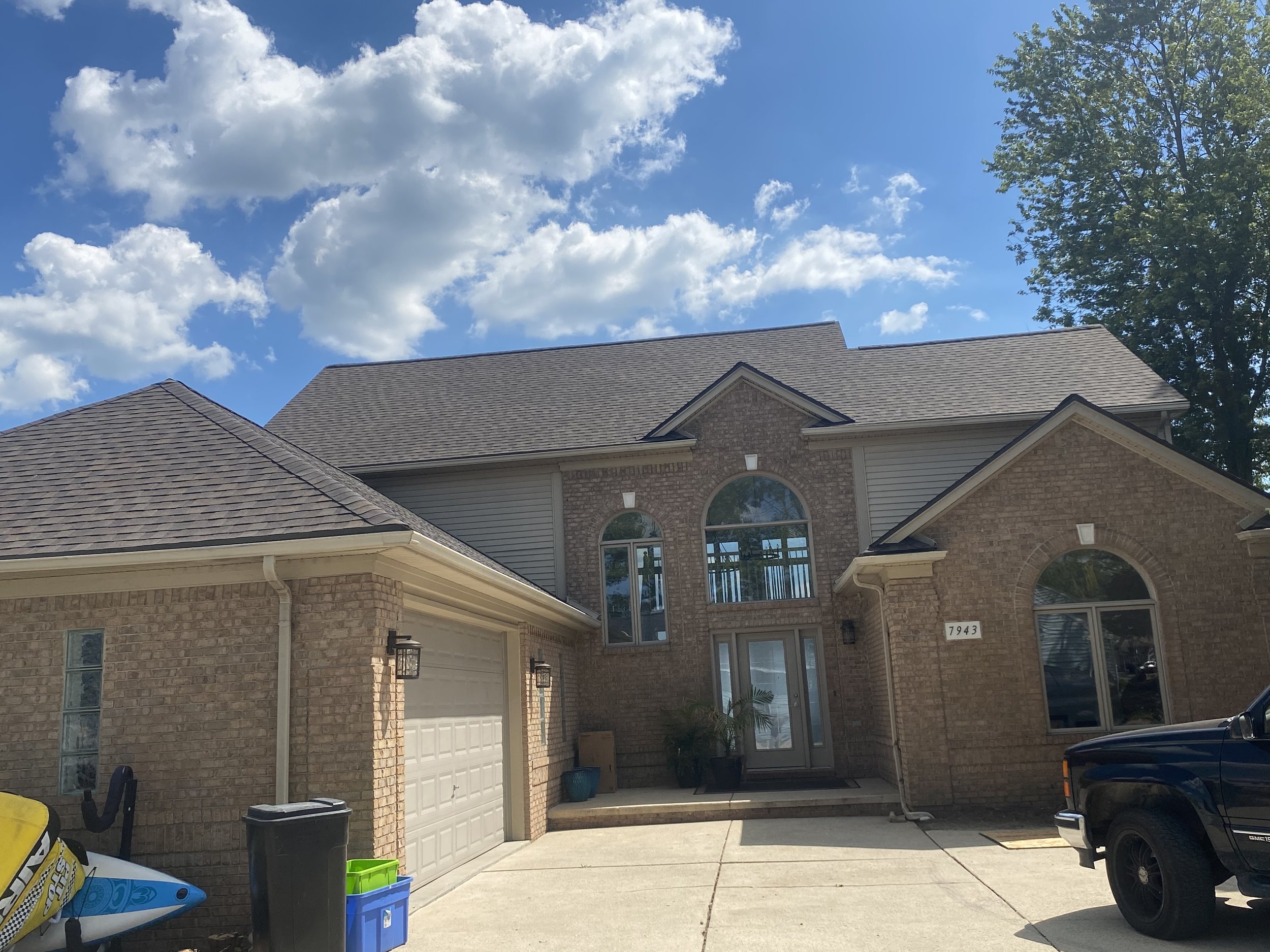
Material Upgrade Opportunities
If you do decide on replacement, consider upgrading to higher-performance materials. After dealing with storm damage, many homeowners opt for:
- Impact-resistant shingles: Class 4 IR shingles from CertainTeed, GAF, or Owens Corning offer better hail and impact resistance. Some insurance companies offer premium discounts for IR shingles
- Higher wind ratings: Upgrading from 110 mph to 130 mph wind-rated shingles provides better storm protection—relevant given Michigan's severe weather patterns
- Upgraded underlayment: Synthetic underlayment offers better water resistance and longevity than traditional felt paper
- Enhanced ventilation: Proper attic ventilation extends shingle life and prevents ice dams. If your current roof lacks adequate ridge and soffit vents, replacement is the time to address it
These upgrades add cost, but they also add value and protection. Discuss options with your contractor based on your budget and priorities. For homeowners also considering other exterior improvements, our comprehensive overview of exterior services in Detroit covers how roofing integrates with siding, windows, and other systems.
Beyond Roofing: Related Exterior Services
Storm damage rarely affects just your roof. High winds, heavy rain, and hail can impact multiple exterior systems simultaneously. While addressing your roof leak, it's worth inspecting:
Siding: Wind-driven rain can get behind damaged or improperly installed siding, causing hidden water damage to your home's sheathing and framing. If you notice loose siding, cracks, or warping after the storm, have it inspected. NEXT Exteriors specializes in both vinyl and fiber cement siding—check out our work as a house siding company in Detroit. For deeper insight into material performance, our comparison of vinyl siding vs. fiber cement in Michigan weather explains how different materials hold up to our climate.
Windows: Severe storms can compromise window seals, crack glass, or damage frames. If you're noticing drafts, condensation between panes, or visible damage, our team of Detroit window experts can assess whether repair or replacement makes sense. Understanding when condensation signals a problem versus normal behavior is covered in our guide on condensation on windows and replacement signs.
Gutters: Clogged or damaged gutters contribute to roof leaks by causing water to back up under shingles. After a storm, check that your gutters are still securely attached, properly sloped, and free of debris. Our seamless gutters in Detroit, MI service includes inspection and repair of storm-damaged gutter systems.
Insulation: If water penetrated your attic, your insulation may be compromised. Wet insulation loses R-value and can promote mold growth. Our top-rated insulation contractor services in Detroit include attic insulation replacement and moisture remediation. For homeowners considering insulation upgrades, our breakdown of blown-in attic insulation costs in Royal Oak, MI provides realistic pricing expectations.
Exterior Paint: While less urgent than structural issues, storm damage can strip paint, expose bare wood, and accelerate deterioration. If you're already addressing roof and siding damage, it might be the right time to consider exterior painting. As exclusive Sherwin-Williams partners, our Southeast Michigan painting professionals can restore your home's appearance and protection.
The advantage of working with a full-service exterior contractor like NEXT Exteriors is that we can assess and address all storm-related damage in a coordinated way, rather than having separate contractors for each system. This often results in better pricing, faster completion, and more cohesive results.
Storm Damage? We're Here to Help
NEXT Exteriors has been responding to emergency roof leaks and storm damage across Macomb County since 1988. We offer free inspections, work directly with insurance companies, and provide honest assessments—whether that means a simple repair or a full replacement.
Our crews are standing by for emergency response in Roseville, Sterling Heights, Clinton Township, and throughout Southeast Michigan.
Get Your Free Storm Damage InspectionOr call us now: (844) 770-6398
Frequently Asked Questions About Storm Roof Leaks in Roseville
Call within 24 hours if possible, and definitely within 48 hours. Quick professional assessment prevents secondary damage and establishes a clear timeline for insurance purposes. If you're dealing with active water intrusion that you can't contain, call immediately for emergency service—most reputable contractors offer emergency tarping and temporary repairs to prevent further damage while scheduling a full inspection.
Most Michigan homeowner policies cover sudden storm damage, but not gradual wear and tear. If a storm directly caused damage (wind-torn shingles, hail impact, tree limb puncture), you're likely covered subject to your deductible. If the storm exposed pre-existing deterioration from age, coverage may be partial or denied. This is why documentation and professional assessment are critical—they help establish that the storm caused new damage rather than just revealing old problems.
It depends on your roof's age and overall condition. If your roof is less than 12 years old and damage is isolated, targeted repairs often make sense. If your roof is 18+ years old, has widespread aging signs (granule loss, curling shingles), or sustained damage in multiple areas, replacement is usually the better long-term investment. A reputable contractor will assess both options honestly and explain the cost-benefit of each approach for your specific situation.
Emergency tarping typically costs $300-$800 depending on roof accessibility, damage extent, and tarp size needed. Most homeowner insurance policies cover emergency mitigation costs like tarping as part of your claim, so you're usually only out your deductible. Get the service done by a licensed contractor who will document the work properly for insurance—DIY tarping often isn't covered and can create additional damage if done incorrectly.
Storm damage is sudden and event-specific: missing shingles after high winds, punctures from fallen branches, or leaks that started during or immediately after a severe weather event. Aging-related leaks develop gradually from deteriorated flashing, worn shingles, or compromised underlayment—they might show up during a storm, but the underlying cause is years of wear. Insurance covers the former but not the latter, which is why professional documentation of storm-related damage is important for claims.
Simple repairs (replacing a few shingles, resealing flashing) can often be completed in a few hours to one day. More extensive repairs involving multiple areas, valley work, or chimney flashing might take 2-3 days. Full roof replacement typically takes 1-3 days for an average Roseville home, depending on size, complexity, and weather. After major storms, expect scheduling delays as contractors work through a backlog of emergency calls—another reason to call quickly after discovering damage.
It's often not worth it if the repair cost is only slightly above your deductible. For example, with a $1,500 deductible and a $1,800 repair, you'd net $300 but have a claim on your record that could affect future premiums or insurability. However, if there's hidden damage discovered during repairs that significantly increases the cost, having an open claim is beneficial. Discuss this with both your contractor and insurance agent before deciding. Some contractors offer free inspections that can help you make an informed decision before filing.