

Vinyl Siding Maintenance: A Guide for Michigan Weather

I've been installing and repairing siding across Southeast Michigan since 1988, and I can tell you this: vinyl siding is one of the most durable, low-maintenance exterior options you can put on a Michigan home. But "low-maintenance" doesn't mean "no maintenance." Michigan's weather — those brutal freeze-thaw cycles, lake-effect snow dumps, summer UV hammering, and wind-driven rainstorms — puts stress on every exterior surface. Vinyl siding holds up remarkably well, but only if you understand what it needs and when.
This isn't a generic siding maintenance article pulled from some national home improvement site. This is what we've learned from 35+ years of working on homes in Sterling Heights, Royal Oak, Grosse Pointe Farms, and across Macomb, Oakland, and St. Clair counties. We've seen what happens when homeowners stay on top of maintenance — and what happens when they don't. If you want your vinyl siding to last 30+ years and keep protecting your home, here's what you need to know.
Why Michigan Weather Is Uniquely Hard on Vinyl Siding
Vinyl siding is engineered to expand and contract with temperature changes. That's how it survives. But Michigan throws temperature swings at your siding that most other climates don't see. We regularly go from -10°F winter nights to 35°F afternoons during January thaws, then back down again. That's a 45-degree swing in 12 hours. Vinyl expands and contracts with every cycle.
Here's what that does: if your siding wasn't installed with proper expansion gaps (we'll get to that later), those panels can buckle, warp, or crack. If the nails were driven too tight, the panels can't move freely, and you'll see rippling or pulling away from the house. This is why house siding in Detroit and across Southeast Michigan needs to be installed by someone who understands building science, not just someone who can swing a hammer.
Michigan-Specific Siding Stressors:
- Freeze-thaw cycles: We average 60-80 freeze-thaw cycles per winter in Southeast Michigan. Each cycle causes expansion and contraction.
- Lake-effect snow and ice: Heavy snow loads against siding, ice buildup at the foundation line, and ice dams can force water behind panels.
- Summer UV exposure: Michigan summers hit 85-95°F regularly. UV radiation breaks down lower-quality vinyl over time, causing fading and brittleness.
- Wind-driven rain: Our spring and fall storms bring sustained winds that drive rain horizontally into siding seams. Proper installation and caulking are critical.
We've also got the humidity factor. Michigan summers are humid. That moisture gets trapped behind siding if there's no proper ventilation or if the house wrap was installed incorrectly. Mold and mildew love that environment. That's why you'll see green or black streaks on north-facing siding or shaded areas — it's not the siding failing, it's organic growth feeding on moisture and dirt.

Spring Maintenance Checklist (Post-Winter Recovery)
Spring is when you find out how your siding held up through winter. As soon as the snow melts and temperatures stay consistently above freezing, walk the perimeter of your house and do a visual inspection. Here's what you're looking for:
Inspect for Winter Damage
Check every side of the house, starting at the foundation and working up. Look for:
- Cracked or broken panels: Usually caused by impact (falling ice, tree branches) or extreme cold making brittle vinyl snap.
- Warped or buckled panels: Sign of improper installation or moisture infiltration behind the siding.
- Loose panels: If you can lift a panel edge away from the house, it's not locked in properly. Wind will get behind it and cause more damage.
- Gaps around windows and doors: Caulk shrinks and cracks in cold weather. Any gap is a water entry point.
If you find any of these issues, don't wait. Water getting behind your siding will rot the sheathing, ruin insulation, and create mold problems inside your walls. That's when a small repair turns into a $5,000+ problem. Our siding repair vs replacement guide for Southeast Michigan walks through when you can fix a few panels and when you're looking at a bigger project.
Clean Mold and Mildew
Michigan's spring humidity kicks mold growth into high gear. You'll see it on north-facing walls, under eaves, and anywhere that doesn't get direct sun. Here's how to clean it properly:
What you need:
- Garden hose with spray nozzle
- Soft-bristle brush (never use wire brushes — they scratch vinyl)
- Bucket with cleaning solution: 70% water, 30% white vinegar (or use a commercial vinyl siding cleaner)
Process:
- Rinse the siding with your hose to remove loose dirt and debris.
- Dip your brush in the cleaning solution and scrub the siding in a circular motion, working from bottom to top. (Yes, bottom to top — if you start at the top, dirty water runs down and stains the clean sections.)
- Rinse thoroughly with the hose, working from top to bottom this time.
- Let it air dry. Don't wipe it — you'll just smear dirt around.
If you've got stubborn mold that won't come off with vinegar, you can use a 1:10 bleach-to-water solution. But be careful — bleach can damage plants and landscaping. Cover anything near the foundation before you spray.
Pro Tip: If mold keeps coming back in the same spots year after year, that's a sign of a moisture problem behind the siding. You might have a roof leak, failed flashing, or inadequate attic ventilation. Our top-rated insulation contractor team in Detroit can assess whether poor ventilation or insulation is contributing to moisture buildup.
Check Caulk and Trim
Walk around the house and inspect every seam where siding meets trim, windows, doors, or corners. Caulk is your first line of defense against water infiltration. If it's cracked, shrunk, or missing, scrape out the old caulk and replace it with a high-quality exterior-grade siliconized acrylic caulk. Don't use cheap latex caulk — it won't last a Michigan winter.
Pay special attention to:
- Window and door frames
- J-channel around openings
- Corner posts
- Where siding meets the soffit or fascia
If you're noticing extensive caulk failure, that's often a sign the original installation cut corners. We see this a lot on homes where the previous contractor used the cheapest materials and rushed the job. Sometimes the best fix is a professional exterior trim repair and full replacement to address underlying issues.
Summer and Fall Maintenance Tasks
Power Washing: Do It Right or Don't Do It
A lot of homeowners think power washing vinyl siding is a quick, easy way to make it look new again. And it can be — if you do it correctly. But I've seen too many DIY power washing jobs that forced water behind the siding, soaked the insulation, and created mold problems inside the walls.
Power washing rules for vinyl siding:
- Use low pressure: 1,500 PSI or lower. Anything higher can crack panels or force water behind them.
- Spray at a downward angle: Never aim the spray upward or directly at panel seams. Water should run down and off the siding, not up and behind it.
- Keep the nozzle at least 12 inches away: Too close and you'll damage the vinyl surface.
- Work in sections: Wet a section, scrub if needed, rinse, move on. Don't let cleaning solution dry on the siding.
If you're not comfortable with a power washer, hire someone who knows what they're doing. A professional cleaning costs $200-400 for most homes in Sterling Heights or Royal Oak — a lot less than repairing water damage.
Inspect for Fading and UV Damage
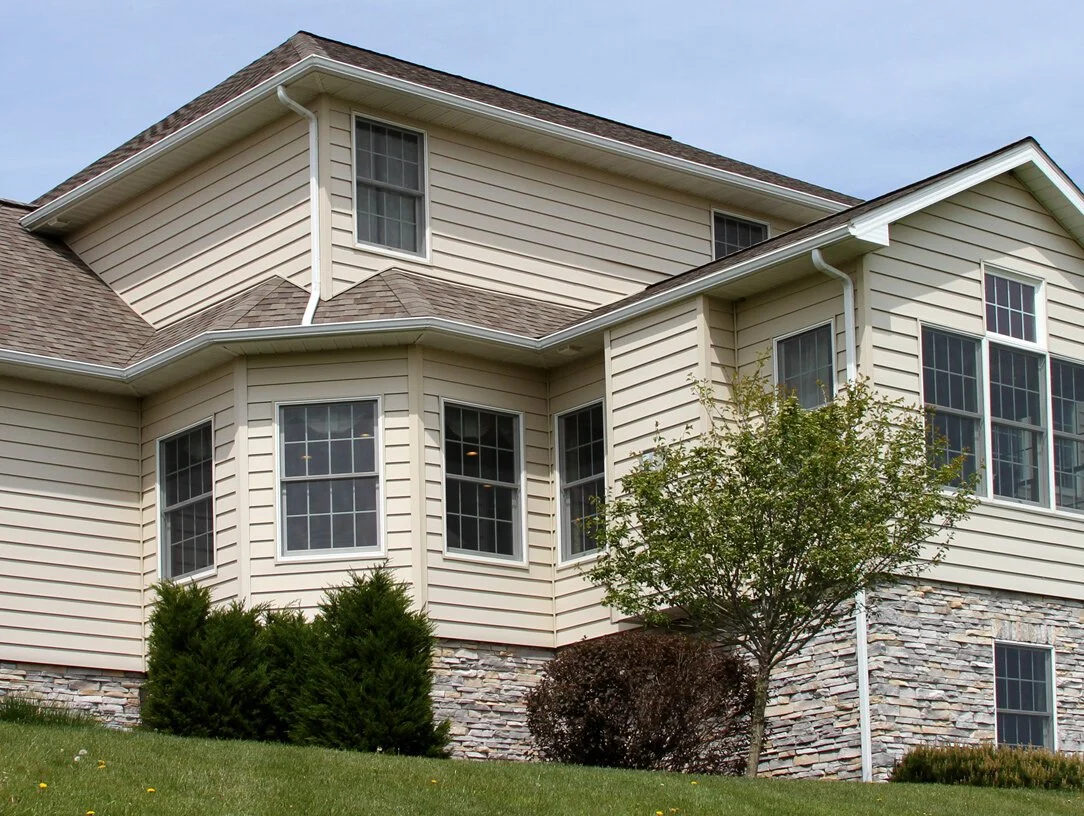
Summer is when UV exposure does its work. Walk around your house in full daylight and look at the south- and west-facing walls. If you're seeing significant fading or chalky residue when you rub the siding, that's UV degradation. Lower-quality vinyl will fade faster — usually within 10-15 years. Higher-quality vinyl with UV inhibitors (like CertainTeed Cedar Impressions or premium GAF siding) can last 30+ years without noticeable fading.
Fading isn't just cosmetic. As vinyl breaks down from UV exposure, it becomes brittle. Brittle vinyl cracks more easily in cold weather. If your siding is 20+ years old and showing significant fading, it's worth having a professional assess whether you're approaching replacement time. Our article on what fade resistance means for siding explains the science behind UV damage and how material quality matters.
Gutter Maintenance Connection
Your gutters and siding work as a system. If your gutters are clogged, overflowing water runs down your siding, saturates the soil at the foundation, and can seep behind the bottom courses of siding. That's how you get rot in the rim joist and bottom wall plates.
Clean your gutters at least twice a year — once in late spring after trees finish dropping seeds and pollen, and once in late fall after the leaves come down. While you're up there, check that downspouts are directing water at least 6 feet away from the foundation. If water pools near your foundation, it's going to find a way into your basement or crawl space.
We cover this in detail in our guide to ice dams and gutter damage in Michigan winters, but the short version is: gutters and siding are partners. Neglect one and you'll pay for it with the other.
If your gutters are old, sagging, or constantly clogging, consider upgrading to seamless gutters in Detroit, MI. They're custom-fit to your roofline, have fewer seams (fewer leak points), and handle Michigan's heavy rain and snow loads better than sectional gutters.
Prepare for Winter
Before the first freeze, do a final walk-around. Make sure:
- All repairs from spring are complete
- Caulk is in good shape
- Gutters are clean and downspouts are clear
- No debris (leaves, branches) is trapped behind siding or in corners
- Outdoor faucets are drained and covered (leaking faucets freeze and burst, and water runs down your siding)
This is also a good time to check your attic insulation and ventilation. Ice dams form when warm air from your attic melts snow on the roof, and that meltwater refreezes at the eaves. Ice dams push water under shingles and behind siding. Proper attic insulation and ventilation prevent ice dams. If you've had ice dam problems in the past, talk to our Detroit insulation contractor team about adding insulation or improving attic airflow.
When to Call a Professional: Signs Your Siding Needs Repair
Most vinyl siding maintenance is DIY-friendly. But there are times when you need to call a licensed contractor. Here's when:
Warping and Buckling
If you see panels that are wavy, buckled, or pulling away from the house, that's a structural issue. It usually means one of three things:
- The siding was nailed too tight during installation (panels can't expand and contract)
- There's moisture behind the siding causing the sheathing to swell
- The house has settled and shifted, pulling the siding out of alignment
You can't fix this with caulk or cleaning. The panels need to be removed, the underlying issue addressed, and new panels installed correctly. This is why choosing a best house siding company in Detroit with actual building science knowledge matters — not just the cheapest bid.
Cracks and Holes
Small cracks (under 2 inches) can sometimes be patched with vinyl siding repair kits. But if you've got multiple cracks, large holes, or cracks that keep reappearing, you're better off replacing the damaged panels. Vinyl siding panels are designed to overlap and interlock. If one panel is compromised, it's not protecting the ones around it.
We keep common siding profiles and colors in stock for quick repairs. If your siding is 15+ years old, though, the color might not match perfectly — vinyl fades over time. Sometimes a repair stands out more than you'd like. That's when homeowners start thinking about full replacement.
Water Infiltration Signs
If you see any of these, you've got water getting behind your siding:
- Peeling paint on interior walls near exterior walls
- Musty smell in rooms along exterior walls
- Visible mold or mildew inside the house
- Soft or spongy spots when you press on the siding
- Staining or discoloration on the siding that doesn't wash off
Water behind siding is an emergency. It rots wood framing, destroys insulation, and creates health hazards from mold. Don't wait. Call a licensed contractor immediately. We've seen situations where homeowners ignored these signs for a year or two, and what should have been a $2,000 siding repair turned into a $15,000 wall reconstruction.
Real Example from a Sterling Heights Project: We had a homeowner call us because they noticed a musty smell in their master bedroom. Turned out a poorly installed window was leaking water into the wall cavity every time it rained. The siding looked fine from the outside, but when we removed a few panels, the OSB sheathing was black with mold and the studs were starting to rot. We had to replace 40 square feet of sheathing, treat for mold, and reinstall siding. Total cost: $4,200. If they'd called when they first noticed the smell (about 6 months earlier), it would have been a $600 window flashing repair.
Persistent Mold Growth
If you're cleaning mold off your siding every spring and it keeps coming back in the same spots, that's not a siding problem — it's a moisture problem. Mold needs moisture to grow. If it's growing on your siding, moisture is coming from somewhere: a roof leak, failed flashing, clogged gutters, or poor attic ventilation.
A professional can diagnose the source. Sometimes it's as simple as extending a downspout. Sometimes it's a bigger issue like inadequate attic insulation letting warm, moist air condense on the underside of your roof deck. Either way, you need to fix the source, not just keep scrubbing the symptom.

Cost Reality: Maintenance vs. Replacement
Let's talk numbers. Michigan homeowners are practical people. You want to know what things cost and whether you're spending money wisely.
Annual Maintenance Costs
If you do the work yourself:
- Cleaning supplies (vinegar, brushes, hose attachments): $30-50/year
- Caulk and touch-up materials: $20-40/year
- Total DIY annual maintenance: $50-90
If you hire professionals:
- Professional cleaning (power washing): $200-400 for a typical 2,000 sq ft home
- Caulking and minor repairs: $150-300
- Annual inspection: Often free if you're a past customer or considering future work
Repair Costs for Common Issues
Based on what we charge in Southeast Michigan (prices as of 2026):
- Replace 1-3 damaged panels: $200-400 (depends on accessibility and whether we have matching material in stock)
- Re-caulk all windows and doors: $300-500
- Replace corner posts or J-channel: $400-800
- Repair water damage (replace sheathing, treat mold, reinstall siding): $1,500-5,000+ depending on extent of damage
Compare that to full siding replacement: $8,000-18,000 for a typical 2,000 sq ft Michigan home, depending on material choice (standard vinyl vs. premium insulated vinyl vs. fiber cement). Our detailed breakdown of siding replacement cost in Michigan for 2026 covers what drives pricing and where you can save money without compromising quality.
When Replacement Makes More Financial Sense
Here's the decision matrix we walk homeowners through:
Consider replacement if:
- Your siding is 25+ years old and showing widespread fading, brittleness, or cracking
- You're facing repair costs over $3,000-4,000 (at that point, you're paying 25-40% of replacement cost for a partial fix)
- You're planning to sell in the next 2-3 years (new siding has strong ROI for resale — typically 70-80% return in Southeast Michigan)
- Your energy bills are high and you have no insulation behind your siding (upgrading to insulated vinyl or fiber cement with proper house wrap can cut heating costs 15-25%)
- You're tired of constant maintenance and want a more durable material like fiber cement
Stick with repairs if:
- Your siding is less than 15 years old and damage is localized
- The underlying structure (sheathing, framing) is in good shape
- You're not planning to sell soon and the siding is still doing its job (keeping water out)
- You're on a tight budget and need to spread costs over time
We've seen homeowners agonize over this decision. Our approach: we'll give you an honest assessment. If your siding has 10 more good years in it, we'll tell you that and recommend repairs. If it's time to replace, we'll explain why and show you options at different price points. We've been doing this since 1988 — we're not here to upsell you. We're here to protect your home.
If you're weighing repair vs replacement, our exterior siding repair guide for Metro Detroit walks through the decision process in detail.
How Proper Installation Reduces Maintenance Needs
Here's something most homeowners don't realize: 80% of siding problems we fix are caused by improper installation, not material failure. Vinyl siding is engineered to last 30-40 years in Michigan's climate — if it's installed correctly.
The Critical Details Most Contractors Skip
Nailing technique: Vinyl siding panels have elongated nail slots, not round holes. That's intentional. The panel needs to move as it expands and contracts. The nail should be centered in the slot and driven so the head sits 1/32" away from the nailing flange — not tight against it. If you nail it tight, the panel can't move, and it will buckle or crack.
We've seen entire houses where every panel was nailed too tight. The homeowner called us because their 5-year-old siding was rippling and warping. We had to remove and reinstall the entire job. That's a $12,000 mistake that could have been avoided if the original contractor understood basic building science.
Expansion gaps: Vinyl siding expands and contracts up to 1/2" over a 12-foot length when temperatures swing from 0°F to 100°F. (And yes, we see those temperature ranges in Michigan — it's not uncommon to have -5°F in January and 95°F in July.) Every panel needs a 1/4" gap where it meets trim, J-channel, or corner posts. No gap means the panel has nowhere to expand, so it buckles.
House wrap and flashing: Siding is your second line of defense against water. The first line is the weather-resistant barrier (house wrap like Tyvek) and proper flashing around windows, doors, and penetrations. If the house wrap is installed wrong — tears, gaps, improper overlaps — water will get behind your siding and you'll have rot and mold problems no matter how good the siding is.
We see this constantly on new construction and quick-flip renovations. The crew slaps up house wrap without taping seams, doesn't flash the windows properly, and rushes the siding installation. Two years later, the homeowner is dealing with water damage.
What We Do Differently: Every NEXT Exteriors siding job includes a full inspection of the existing sheathing and structure before we install anything. If we find rot, we replace it. If the house wrap is damaged, we replace it. We tape every seam, flash every opening, and install siding with proper expansion gaps and nailing technique. It takes longer. It costs a bit more. But your siding will last 30+ years instead of needing repairs in 5.
Quality Materials vs. Builder-Grade Vinyl
Not all vinyl siding is created equal. Builder-grade vinyl (the stuff used on most new construction and low-bid jobs) is thin (.040"-.042"), has minimal UV inhibitors, and starts fading and chalking within 10-15 years. Premium vinyl (like CertainTeed Monogram or GAF WeatherSide) is thicker (.044"-.046"), has better UV protection, and includes fade-resistant pigments that keep their color 25+ years.
The price difference? About 20-30% more for premium vinyl. The lifespan difference? 10-15 extra years of performance. For a typical Michigan home, that's the difference between replacing your siding at year 20 vs. year 35. The math is pretty clear.
We also install fiber cement siding (James Hardie, LP SmartSide) for homeowners who want even more durability. Fiber cement doesn't expand and contract like vinyl, resists impact damage better, and holds paint longer. It costs more upfront, but for a forever home, it's worth considering. Our comparison of LP SmartSide vs James Hardie siding for Michigan homes breaks down the pros and cons of each.
If you're in the research phase and want to understand why fiber cement often outperforms vinyl in Michigan's climate, read our article on why fiber cement siding in Metro Detroit outperforms vinyl.

Why Credentials Matter
NEXT Exteriors is a CertainTeed Master Shingle Applicator — the highest credential in roofing. We've also completed manufacturer training for siding installation from CertainTeed, GAF, James Hardie, and LP. That training covers installation standards, material handling, and building science principles that most contractors never learn.
We're not saying this to brag. We're saying it because credentials matter. A contractor who's been trained by the manufacturer knows how the product is engineered to perform. They know the warranty requirements. They know the details that prevent callbacks and failures.
When you hire a contractor for siding (or roofing, windows, or any exterior work), ask about their credentials. Are they manufacturer-certified? Do they carry a Michigan Residential Builder's License? Are they BBB accredited? Do they have liability insurance and workers' comp? If the answer to any of those is "no," keep looking.
We've been serving Southeast Michigan since 1988, we hold a Michigan Residential Builder's License, and we've maintained an A+ BBB rating since 2006. We're not the cheapest option — but we're the option that does it right the first time. And when it comes to protecting your home from Michigan weather, that's what matters.
Ready to Get Started?
NEXT Exteriors has been protecting Michigan homes since 1988. Whether you need a maintenance inspection, siding repair, or full replacement, we'll give you an honest assessment and a fair price. No pressure, no gimmicks — just straight talk from a team that's been doing this for 35+ years.
Get Your Free QuoteOr call us: (844) 770-6398
Frequently Asked Questions
At minimum, clean your vinyl siding once a year — ideally in spring after winter weather has passed. If you have a lot of trees near your house or live in a humid area, you might need to clean it twice a year (spring and fall) to prevent mold and mildew buildup. North-facing walls and shaded areas typically need more frequent cleaning because they stay damp longer.
You can power wash vinyl siding safely if you follow the right technique: use 1,500 PSI or lower, spray at a downward angle (never upward), and keep the nozzle at least 12 inches from the siding. The biggest risk is forcing water behind the panels, which can soak insulation and cause mold. If you're not experienced with a power washer, hire a professional — the cost of a proper cleaning ($200-400) is much less than repairing water damage.
Warping and buckling are almost always caused by improper installation. The most common culprit: nails driven too tight. Vinyl siding needs to move as it expands and contracts with temperature changes. If the panels are nailed tight against the house, they can't move, so they buckle. Other causes include insufficient expansion gaps at corners and trim, or moisture behind the siding causing the sheathing to swell. This isn't something you can fix with DIY repairs — you need a professional to remove the affected panels, address the underlying issue, and reinstall correctly.
High-quality vinyl siding, properly installed, should last 30-40 years in Michigan. Builder-grade vinyl typically lasts 20-25 years before you see significant fading, brittleness, or cracking. The key factors are material quality (thickness, UV inhibitors) and installation technique (proper nailing, expansion gaps, flashing). Michigan's freeze-thaw cycles and UV exposure are hard on siding, so investing in premium materials and professional installation pays off in longevity.
If your siding is less than 15 years old and the damage is localized (a few cracked panels, isolated warping), repair is usually the right call. If your siding is 25+ years old, showing widespread fading or brittleness, or you're facing repair costs over $3,000-4,000, replacement makes more financial sense. Also consider replacement if you're planning to sell soon (new siding has strong ROI) or if you want to upgrade to a more durable material like insulated vinyl or fiber cement. A licensed contractor can assess your specific situation and give you an honest recommendation.
Mold prevention comes down to moisture control. Keep your gutters clean so water doesn't overflow onto siding. Trim trees and bushes away from the house so air can circulate and siding can dry after rain. Make sure downspouts direct water at least 6 feet away from the foundation. If you have persistent mold in the same spots every year, that's a sign of a bigger moisture problem — possibly a roof leak, failed flashing, or inadequate attic ventilation. Address the moisture source, not just the symptom.
No — one of the main benefits of vinyl siding is that the color goes all the way through the material. You never have to paint it. If your vinyl siding has faded significantly and you want to change the color, you can paint it with special vinyl-safe paint, but it's a lot of work and the paint will need maintenance (repainting every 7-10 years). For most homeowners, if your vinyl has faded to the point where you're considering painting, you're better off replacing it with new siding that will last another 30 years without maintenance.