

Exterior Trim Replacement: Wood vs. Composite vs. PVC | Metro Detroit

Your home's exterior trim isn't just decorative. It's the first line of defense against water intrusion around windows, doors, corners, and rooflines. In Southeast Michigan, where we cycle through freeze-thaw conditions 40+ times each winter, the material you choose for trim replacement determines whether you're looking at a 15-year investment or a 5-year headache.
I've been installing and replacing exterior trim across Macomb, Oakland, and St. Clair counties since 1988. The question I hear most often isn't "Do I need to replace my trim?" — homeowners can usually see the rot, splitting, or paint failure themselves. The question is: "What should I replace it with?"
Wood, composite, and PVC all have their place in Michigan. But they perform very differently in our climate, and the wrong choice costs you thousands in premature replacement. Here's what 35+ Michigan winters have taught me about each material.
Wood Trim: The Traditional Choice
Cedar and pine have been the standard for exterior trim in Michigan for over a century. Walk through any historic neighborhood in Grosse Pointe Farms or Rochester Hills and you'll see beautiful wood trim on homes built in the 1920s and 1930s — still holding up because it was properly maintained.
That's the key phrase: properly maintained.
Wood trim performs well in Michigan's climate when it's kept sealed and painted. The problem is that most homeowners don't have the time or inclination to scrape, prime, and repaint every 3-5 years. Once the paint film fails and moisture penetrates the wood grain, freeze-thaw cycles accelerate deterioration rapidly.
How Wood Trim Fails in Michigan
Wood is hygroscopic — it absorbs and releases moisture based on humidity levels. During a typical Michigan winter, your trim might go through this cycle dozens of times:
- Moisture enters through cracked paint or exposed end grain
- Temperature drops below freezing; water expands as it turns to ice
- Wood fibers separate and crack from internal pressure
- Temperature rises; ice melts, leaving larger voids for more water
- Repeat 40-60 times per winter season
This is why you see so much failed wood trim on north-facing walls and shaded areas — places where snow and ice linger longer and the freeze-thaw cycle is most aggressive.

When Wood Trim Makes Sense
I still install wood trim on specific projects:
- Historic restorations where matching original materials is required
- High-end custom homes where the homeowner values the aesthetic and commits to maintenance
- Interior-exterior transitions like covered porches where exposure is minimal
For these applications, we use clear vertical-grain cedar or Accoya (acetylated wood with superior rot resistance) and apply a high-quality primer system before the first coat of paint goes on. When you're working on a house siding project in Detroit, matching trim material to the overall exterior aesthetic matters.
Real Cost: Wood trim (cedar) runs $3.50-$6.50 per linear foot installed in Metro Detroit, depending on profile complexity and prep work required. Add $1,200-$2,400 for professional painting on a typical 2,500 sq ft home.
Composite Trim: Engineered Performance
Composite trim — engineered wood products like LP SmartSide and James Hardie fiber cement — was developed specifically to address wood's moisture vulnerability while maintaining a similar appearance and workability.
These aren't particle board. They're engineered materials designed for exterior exposure.
LP SmartSide Composite Trim
LP SmartSide uses strand-based wood with a zinc borate treatment (protects against fungal decay and termites) and a proprietary resin overlay. The material is pre-primed and accepts paint well.
Performance in Michigan climate:
- Significantly better moisture resistance than solid wood
- Expands and contracts less than wood, reducing paint failure
- Still requires painting but holds paint 2-3x longer than cedar
- Can be cut and installed with standard carpentry tools
The weak point with LP SmartSide is exposed edges and end cuts. If you don't seal cut ends with primer before installation, moisture can wick into the core. I've seen trim fail in 5 years when installers skip this step.
James Hardie Fiber Cement Trim
Fiber cement is a different animal entirely. It's made from cement, sand, and cellulose fibers — no wood content. James Hardie ColorPlus trim comes pre-finished with a baked-on coating that carries a 15-year warranty.
Performance characteristics:
- Dimensionally stable — minimal expansion/contraction with temperature swings
- Won't rot, even with prolonged water exposure
- Non-combustible (matters for insurance in some areas)
- Heavier and more brittle than wood — requires carbide blades and different installation techniques
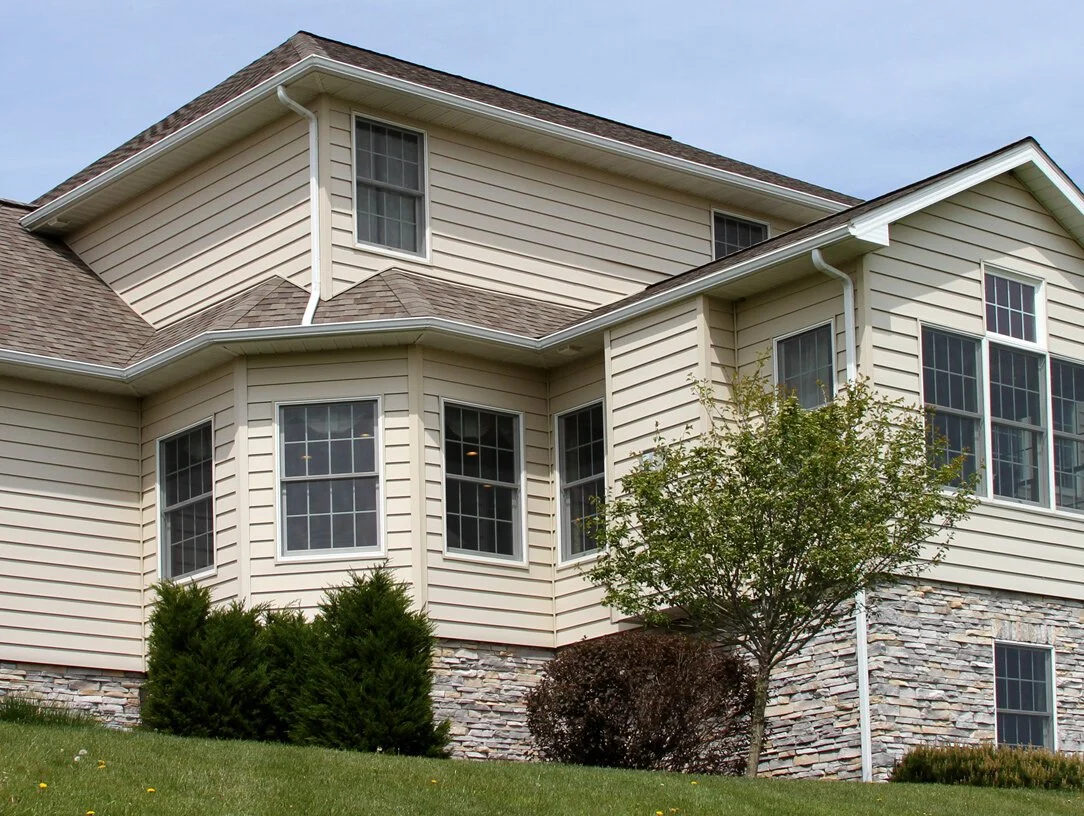
I install a lot of James Hardie trim in Sterling Heights and Troy on homes where the owner wants a "set it and forget it" solution. The material performs exceptionally well in Michigan's climate, particularly in high-moisture areas like near gutter downspouts and roof valleys.
Real Cost: LP SmartSide trim runs $4.50-$7.50 per linear foot installed. James Hardie fiber cement trim ranges from $6.50-$10.00 per linear foot installed, with pre-finished ColorPlus adding $2-3/LF to the total.
PVC Trim: The Low-Maintenance Option
Cellular PVC trim — brands like Azek, KOMA, and Versatex — is extruded plastic with a closed-cell structure. It looks like painted wood from 10 feet away, but the performance characteristics are completely different.
Why PVC Works in Michigan
PVC doesn't absorb water. At all. You can submerge it in a bucket for a year and it won't swell, rot, or delaminate. For Michigan's wet springs and freeze-thaw winters, this is a significant advantage.
Performance benefits:
- Zero moisture absorption — no rot, no fungal growth, no insect damage
- Can be ordered pre-finished or painted (paint adheres well with proper primer)
- Doesn't require painting for structural protection (only aesthetic preference)
- Cuts and routs like wood with standard tools
The downsides are real, though:
- Thermal expansion: PVC expands and contracts significantly with temperature changes. A 16-foot length can move 3/4" between a 90°F summer day and a -10°F winter night. Installation requires expansion gaps and specific fastening patterns or you'll get buckling.
- UV degradation: Unpainted white PVC will yellow over time from UV exposure. Dark colors absorb heat and can cause warping if not properly backed.
- Appearance: It looks like plastic up close because it is plastic. Some homeowners (and historic district boards) won't accept the aesthetic.
I use PVC trim extensively on vinyl and LP SmartSide siding projects where the homeowner prioritizes low maintenance. It's particularly good for water-prone areas — around replacement windows in Detroit, garage door headers, and rake boards where ice dams form.
Installation Requirements for PVC
This is where a lot of DIY jobs and inexperienced contractors fail. PVC requires specific installation techniques:
- Leave 1/8" expansion gap per 18 feet of length
- Use stainless steel trim screws in slotted holes (not tight to the substrate)
- Back long runs with a substrate material for rigidity
- Use PVC-specific adhesives (standard construction adhesive won't bond)
- Prime with an acrylic bonding primer if painting dark colors
When installed correctly, PVC trim will outlast the siding it's attached to. When installed incorrectly, you get wavy boards, split corners, and fastener pop-through within the first year.
Real Cost: Cellular PVC trim ranges from $5.50-$9.00 per linear foot installed in Metro Detroit. Pre-finished colors add $1.50-$2.50/LF. The material cost is higher, but you eliminate ongoing painting expenses.
Cost Comparison: What You'll Actually Pay
Trim replacement cost depends on linear footage, profile complexity, accessibility, and existing condition. Here's what we're seeing for full exterior trim replacement on a typical 2,500 sq ft two-story Colonial in Macomb County (approximately 450-550 linear feet of trim):
| Material | Material Cost/LF | Installed Cost/LF | Total Project Range | Lifespan (Michigan) |
|---|---|---|---|---|
| Cedar (painted) | $1.80-$3.20 | $3.50-$6.50 | $1,575-$3,575 | 15-25 years* |
| LP SmartSide | $2.40-$4.00 | $4.50-$7.50 | $2,025-$4,125 | 25-35 years |
| James Hardie (primed) | $3.50-$5.50 | $6.50-$9.50 | $2,925-$5,225 | 30-50 years |
| James Hardie (ColorPlus) | $5.00-$7.50 | $8.50-$11.50 | $3,825-$6,325 | 30-50 years |
| PVC (white) | $3.00-$5.00 | $5.50-$9.00 | $2,475-$4,950 | 40-60 years |
| PVC (pre-finished) | $4.50-$7.00 | $7.00-$11.00 | $3,150-$6,050 | 40-60 years |
*Cedar lifespan assumes repainting every 5-7 years. Without maintenance, expect 8-12 years before replacement is required.
These numbers don't include removal and disposal of existing trim (add $400-$800), fascia board replacement if rotted (common — add $1,200-$2,800), or exterior painting services for the rest of the house.
For a detailed breakdown of what drives these costs, see our guide on siding and trim costs in Metro Detroit.
Signs You Need Trim Replacement
Most homeowners wait too long to replace failing trim. By the time you see visible damage, water has often been infiltrating the wall cavity for months or years. Here's what to look for during your spring and fall exterior inspections:
Obvious Red Flags
- Soft spots or spongy texture when you press on trim boards (indicates rot)
- Cracking, splitting, or checking that goes deeper than surface level
- Paint failure — peeling, bubbling, or complete loss of adhesion
- Visible mold or mildew that returns shortly after cleaning
- Gaps between trim and siding where caulk has failed
- Warping or cupping — boards that no longer sit flat against the wall
Subtle Warning Signs
- Carpenter ant activity around window or door trim (they nest in damp wood)
- Interior water stains on drywall near windows or corners
- Drafts around windows and doors where trim should seal the opening
- Ice buildup on trim during winter (indicates moisture intrusion and poor insulation)
- Paint that won't adhere during repainting (wood surface is too degraded)
If you're seeing these issues on a home built in the 1960s-1980s in Clinton Township or Warren — common in our service area — you're likely dealing with original trim that's past its service life. The good news is that replacement is straightforward, and modern materials will significantly outperform what was originally installed.
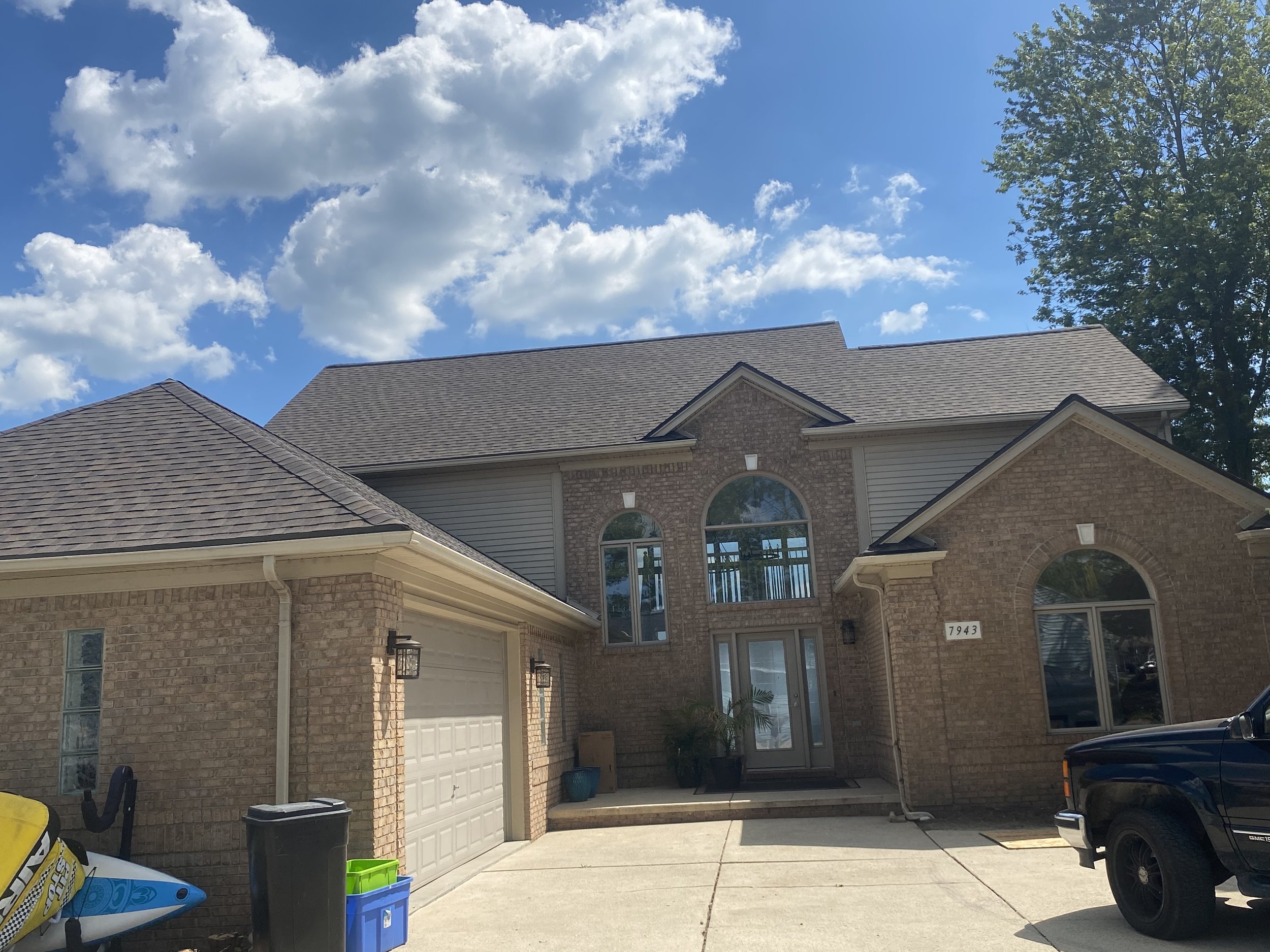
Trim failure often coincides with other exterior issues. If you're noticing problems, it's worth getting a comprehensive evaluation of your roofing system, attic insulation, and overall building envelope. Water intrusion rarely stays isolated to one component.
Why Installation Quality Matters More Than Material
I've replaced trim that failed in 3 years because it was installed incorrectly, and I've seen 40-year-old wood trim that's still solid because the original carpenter knew what they were doing. Material choice matters, but installation quality determines whether you get the performance you paid for.
Critical Installation Details
Flashing and water management: Every horizontal trim board (window sills, door heads, corner boards) needs proper flashing to direct water away from the wall cavity. We use peel-and-stick membrane flashing at all penetrations and integrate it with the water-resistive barrier behind the siding.
Fastening pattern: Each material has specific fastening requirements. Wood and composite need to be nailed through the face into solid backing. PVC requires slotted holes and shouldn't be over-tightened. Fiber cement needs to be face-nailed with specific clearances from edges. Get this wrong and you'll have splitting, buckling, or fastener pop-through.
Caulking strategy: Not every joint should be caulked. Vertical joints need room to move. Horizontal joints where water can enter should be sealed with a high-quality polyurethane or tripolymer caulk (we use Sherwin-Williams products exclusively for compatibility with our painting services in Southeast Michigan).
Substrate condition: You can't install new trim over rotted sheathing or framing and expect it to perform. Part of our trim replacement process involves inspecting and replacing damaged substrate material — often around windows and at corners where water intrusion has been ongoing.
The Michigan-Specific Considerations
Our climate adds complications that contractors from warmer regions don't deal with:
- Ice dam protection: Trim at the roofline (rake boards, fascia) needs to account for ice buildup and the weight of snow sliding off the roof. We use heavier-gauge material and add blocking for attachment points.
- Freeze-thaw movement: Foundations settle, framing moves, and siding expands/contracts. Trim installation needs to accommodate this movement without creating gaps or buckling.
- Ventilation requirements: Soffit and fascia trim must maintain proper attic ventilation. Blocking vents with poorly installed trim creates moisture problems that lead to ice dams and roofing issues.
This is why we've been a CertainTeed Master Shingle Applicator since 2006 and maintain manufacturer certifications for James Hardie and LP SmartSide. The training matters. The installation protocols matter. And when something fails prematurely, having warranty backing from both the manufacturer and the contractor matters.
Ready to Get Started?
NEXT Exteriors has been protecting Michigan homes since 1988. Get a free, no-pressure estimate from a team that shows up on time and does the job right.
Get Your Free QuoteOr call us: (844) 770-6398
Related Services from NEXT Exteriors
Trim replacement often makes sense as part of a larger exterior renovation. If you're upgrading trim, you might also benefit from our comprehensive exterior services in Detroit and surrounding communities. We frequently bundle trim replacement with soffit and fascia installation or coordinate with insulated siding upgrades to maximize your investment and minimize disruption.
Frequently Asked Questions
Not recommended. PVC trim needs a solid, flat substrate for proper installation. Installing over old trim creates an uneven surface, traps moisture between layers, and prevents proper fastening. We always remove existing trim down to the sheathing, inspect for rot or damage, make any necessary repairs, and then install new trim with proper flashing and integration with the weather barrier.
For a 2,500 sq ft two-story home in Metro Detroit, full exterior trim replacement typically takes 3-5 days with a two-person crew. This includes removal of old trim, substrate inspection and repair, installation of new trim, caulking, and cleanup. Weather delays are common in Michigan — we won't install trim in rain or when temperatures are below 40°F (adhesives and caulks won't cure properly). If we're also replacing fascia and soffit or coordinating with a siding project, add 2-4 days to the timeline.
White PVC trim doesn't require painting for protection — it won't rot whether painted or not. However, unpainted white PVC will yellow from UV exposure over 5-10 years. If you want a color other than white, or want to prevent yellowing, painting is necessary. Use an acrylic bonding primer and 100% acrylic latex paint. Dark colors (especially on south and west exposures) can cause heat buildup and warping, so we typically recommend medium tones or lighter colors for painted PVC in Michigan.
For homes in historic districts or where maintaining authentic appearance is important, clear vertical-grain cedar or Accoya wood are your best options. These materials can be milled to match original profiles and maintain the traditional aesthetic. If the historic commission allows it, James Hardie fiber cement can be an excellent compromise — it can replicate wood profiles and accepts paint identically to wood, but with far superior durability. We've worked with several historic district boards in Oakland County and can help navigate approval requirements.
Indirectly, yes. Properly installed fascia and soffit trim ensures adequate attic ventilation, which helps maintain consistent roof temperatures and reduces ice dam formation. However, trim replacement alone won't solve an ice dam problem — that requires addressing attic insulation and air sealing. If you're experiencing recurring ice dams in Sterling Heights or Shelby Township, we typically recommend a comprehensive approach that includes attic insulation upgrades, ventilation improvements, and trim/fascia replacement as part of the solution.
Press on the trim with your thumb. If it feels spongy, soft, or you can push into the surface, you have rot — that's structural damage requiring replacement. If the trim is solid but the paint is peeling or cracking, that's cosmetic and can often be addressed with proper prep and repainting. Check around windows, door frames, and corners first — these are the most common failure points. If you're seeing interior water stains, drafts, or mold growth, the damage has progressed beyond the trim into the wall cavity and needs immediate attention. We offer free inspections in Macomb, Oakland, and St. Clair counties to assess extent of damage and provide replacement recommendations.
NEXT Exteriors provides a workmanship warranty on all trim installations — typically 5 years for labor and installation defects. Material warranties vary by product: LP SmartSide offers a 5-year limited warranty with optional extended coverage; James Hardie provides a 30-year non-prorated warranty on fiber cement products and 15 years on ColorPlus finish; PVC trim manufacturers like Azek offer limited lifetime warranties against rot, splitting, and insect damage. All warranties require proper installation by a certified contractor, which is why our CertainTeed Master Shingle Applicator status and manufacturer certifications matter for your protection.