

What Does a Roof Replacement Actually Cost in Metro Detroit? (2026)
Real roof replacement costs for Southeast Michigan homes in 2026. Material breakdowns, labor rates, and what drives pricing in Macomb, Oakland, and St. Clair counties.

You've been putting it off. That roof has seen better days—maybe there's a leak in the upstairs bedroom after heavy rain, or you're seeing granules washing down the gutters, or your insurance company sent a letter after their last inspection. Now you're sitting at your kitchen table in Sterling Heights or Troy or Clinton Township, searching "roof replacement cost Metro Detroit," and getting wildly different numbers.
Here's the truth: in 2026, a complete roof replacement on a typical Southeast Michigan home runs between $8,500 and $28,000. That's a wide range, and it's not because contractors are making up numbers. It's because your 1,200-square-foot ranch in Warren has different needs than a 3,000-square-foot Colonial in Bloomfield Hills with three dormers and a steep pitch.
I've been running Detroit roofing services since 1988, and the most common question we get isn't "Can you do the work?" It's "What's this actually going to cost?" This isn't a guide full of national averages that don't mean anything to Michigan homeowners. This is what we're seeing in Macomb, Oakland, and St. Clair counties right now—real numbers, real materials, real labor costs.
We'll break down exactly what you're paying for, what drives the price up or down, and how to spot the difference between a fair estimate and someone trying to sell you a roof you don't need. No sales pitch. Just the numbers and the context you need to make a smart decision about one of the biggest investments in your home.
Average Roof Replacement Costs in Metro Detroit (2026)
Let's start with the baseline. These are the numbers we're quoting for complete tear-off and replacement jobs in Southeast Michigan as of early 2026. This includes removal of your old roof, disposal, new underlayment, ice and water shield, drip edge, ridge vent, and installation of new shingles by a Michigan-licensed contractor.
| Home Size | Roof Area (sq ft) | Architectural Shingles | Premium/Designer Shingles |
|---|---|---|---|
| Small Ranch (1,200 sq ft) | 1,400-1,600 | $8,500 - $12,000 | $11,000 - $15,500 |
| Medium Ranch/Cape Cod (1,800 sq ft) | 2,000-2,400 | $11,500 - $16,500 | $15,000 - $21,000 |
| Large Colonial (2,500 sq ft) | 2,800-3,200 | $15,500 - $22,000 | $20,000 - $28,000 |
| Large Two-Story (3,000+ sq ft) | 3,500-4,000 | $19,000 - $27,000 | $25,000 - $35,000 |
These are starting points for a straightforward job—a roof with moderate pitch, minimal penetrations (chimneys, skylights, plumbing vents), and no significant structural issues. A simple gable roof on a ranch will land on the lower end. A hip roof with valleys, dormers, and a steep pitch will push toward the higher end or beyond.
Why the roof area is bigger than your home's square footage: Your roof covers more area than your home's footprint because of pitch (slope) and overhangs. A 1,500-square-foot ranch might have 1,800 square feet of actual roof surface. We measure in "squares" (100 square feet), so that's an 18-square roof.
The material choice matters. Architectural shingles—CertainTeed Landmark, GAF Timberline HDZ, Owens Corning Duration—are the standard for Michigan homes. They're durable, they handle freeze-thaw cycles well, and they come with solid warranties. Premium or designer shingles—CertainTeed Grand Manor, Owens Corning Duration Designer—offer better wind resistance, longer warranties, and more dimensional appearance, but they add $2,000 to $6,000 to the total cost depending on roof size.
For context, NEXT Exteriors is a CertainTeed Master Shingle Applicator—the highest credential you can get in roofing. That certification isn't just a plaque on the wall; it means we've completed advanced training, maintained a track record of quality installations, and can offer extended manufacturer warranties that most contractors can't. When you're comparing bids, ask if the contractor has manufacturer certifications. It's one of the clearest signals of long-term reliability.

What Drives Roof Replacement Costs in Southeast Michigan
Roof replacement isn't a commodity. You're not buying a widget off a shelf. You're paying for materials that have to survive Michigan winters, labor from skilled crews who know how to install them correctly, and the overhead that comes with running a legitimate, licensed, insured business. Here's what actually moves the price:
Material Choice
Shingles are the most visible part of the roof, but they're not the only material cost. A quality roof system includes:
- Shingles: Architectural shingles run $90-$150 per square (100 sq ft) in material cost. Premium shingles run $150-$250 per square. That's just the shingles—not installation.
- Underlayment: Synthetic underlayment (better than felt paper for Michigan weather) adds $50-$80 per square.
- Ice and water shield: Required by Michigan code at eaves and valleys. Critical for preventing ice dam leaks. Adds $100-$200 per square where applied.
- Drip edge: Metal flashing at roof edges. Prevents water from getting under shingles and rotting fascia. $2-$4 per linear foot.
- Ridge vent: Proper attic ventilation. Prevents moisture buildup and extends shingle life. $8-$12 per linear foot installed.
We use CertainTeed, GAF, and Owens Corning because they're proven in Michigan conditions. These manufacturers have rigorous quality control, and their products are engineered for the freeze-thaw cycles, high winds, and temperature swings we see in Southeast Michigan. Cheaper shingles from unknown brands might save you $1,000 upfront, but they fail faster—and that's a costly mistake when you're talking about something that's supposed to last 25-30 years.
Roof Complexity
A simple gable roof (two slopes meeting at a ridge) is the fastest and least expensive to replace. Add valleys, hips, dormers, skylights, or a steep pitch, and the labor hours multiply. Here's why:
- Valleys: Where two roof planes meet. Require careful flashing and shingle weaving. More time, more skill, more potential for leaks if done wrong.
- Dormers: Each dormer adds complexity—more flashing, more cuts, more detail work.
- Steep pitch: Anything over 6/12 (6 inches of rise per 12 inches of run) requires additional safety equipment, slower work pace, and sometimes scaffolding. Adds 10-20% to labor costs.
- Chimneys: Require custom flashing, cricket installation (a small roof structure behind the chimney to divert water), and careful integration with the roof system.
A 2,000-square-foot ranch with a simple gable roof might take two days to complete. A 2,000-square-foot Colonial with multiple dormers, valleys, and a steep pitch might take four days. That's double the labor cost.
Tear-Off and Disposal
In Michigan, most roof replacements require a complete tear-off—removing the old shingles down to the decking. This is code in many municipalities, and it's the right way to do the job. You can't inspect the decking, install proper underlayment, or ensure a watertight roof if you're laying new shingles over old ones.
Tear-off and disposal add $1,500-$3,000 to the total cost depending on roof size and the number of existing layers. If your home has two or three layers of old shingles (common in older Michigan homes), disposal costs go up. We're hauling away literal tons of material, and landfill fees in Southeast Michigan aren't cheap.
Decking Replacement
Once we tear off the old roof, we inspect the decking (the plywood or OSB sheathing under the shingles). In Michigan homes built before the 1980s, we often find sections of decking that are rotted, warped, or damaged from years of ice dams, poor ventilation, or roof leaks.
Decking replacement costs $3-$5 per square foot. If we need to replace 200 square feet of decking, that's an additional $600-$1,000 in materials and labor. This isn't something we can quote accurately until we see the roof structure, which is why reputable contractors include a contingency in their estimates or explain that decking replacement is billed separately if needed.
Michigan Building Code and Permits
Roof replacement requires a permit in most Southeast Michigan municipalities. Permit costs range from $150 to $500 depending on the city and project scope. A licensed contractor pulls the permit, schedules inspections, and ensures the work meets Michigan building code.
Code requirements add cost but protect you. Ice and water shield at eaves and valleys, proper ventilation, wind-rated shingles, and flashing details—these aren't optional. They're what keeps your roof from failing during the first major storm.
Seasonal Demand
Roofing is seasonal in Michigan. Spring and fall are peak times—weather is cooperative, homeowners are addressing storm damage, and insurance claims spike after winter. Demand drives pricing. A roof replacement in May might cost 5-10% more than the same job in January, simply because crews are booked solid and material suppliers are running at capacity.
If you have flexibility, late fall (after the leaves drop but before snow) or early spring (March-April) can offer better availability and sometimes better pricing. But don't delay a leaking roof just to save a few hundred dollars. Water damage costs more than any seasonal discount.
Material Costs: What You're Actually Paying For
Let's talk specifics. When you're comparing estimates and one contractor is $5,000 cheaper than another, the difference often comes down to materials. Here's what quality roofing materials actually cost in 2026, and why they matter.
Architectural Shingles: The Standard
Architectural shingles (also called dimensional or laminate shingles) are the baseline for most Michigan homes. They're thicker than basic 3-tab shingles, offer better wind resistance (110-130 mph ratings), and come with 25-30 year warranties.
- CertainTeed Landmark: $95-$120 per square (material only). Proven performance in Michigan weather. 110 mph wind rating. Limited lifetime warranty. One of the most popular shingles we install.
- GAF Timberline HDZ: $100-$130 per square. LayerLock technology for better wind resistance. StainGuard algae protection. Good choice for homes with significant roof visibility.
- Owens Corning Duration: $105-$135 per square. SureNail technology improves installation strength. TruDefinition color options. Solid warranty coverage.
For a 20-square roof (2,000 sq ft), you're looking at roughly $2,000-$2,700 in shingle material cost alone. Add underlayment, ice and water shield, drip edge, ridge vent, and fasteners, and material costs hit $4,000-$5,500 before labor.
Premium Shingles: When to Upgrade
Premium or designer shingles offer better aesthetics, longer warranties, and higher wind ratings. They're a smart choice if you're in a high-visibility neighborhood, planning to stay in the home long-term, or want the best protection against Michigan's severe weather.
- CertainTeed Grand Manor: $180-$240 per square. Mimics the look of slate. Class 4 impact resistance (important for hail-prone areas). 130 mph wind rating. 50-year warranty.
- Owens Corning Duration Designer: $160-$210 per square. Dramatic color blends. Class 4 impact rating. Excellent for Colonials and larger homes.
- GAF Timberline HDZ RS (Reflective Shingles): $150-$190 per square. Cool roof technology reduces attic heat. Energy efficiency benefit in summer.
Premium shingles add $2,000-$6,000 to the total project cost depending on roof size. That's a significant jump, but if you're in Grosse Pointe Farms or Bloomfield Hills and curb appeal matters, or if you're in an area with frequent hail storms, the investment makes sense.
Underlayment and Ice & Water Shield
Underlayment is the waterproof barrier between your roof decking and shingles. In Michigan, synthetic underlayment is the standard—it's more durable than felt paper, handles temperature swings better, and doesn't tear as easily during installation.
Ice and water shield is a self-adhering membrane applied at eaves (the first 3-6 feet of roof) and in valleys. It's required by Michigan code because ice dams—caused by heat escaping through your attic—melt snow on the roof, which refreezes at the eaves and backs water under shingles. Without ice and water shield, that water leaks into your home.
We see ice dam damage every winter in Southeast Michigan. Homes with poor attic insulation in Metro Detroit are especially vulnerable. If your contractor is trying to cut costs by skipping ice and water shield or using minimal coverage, walk away. That's not a place to save money.

Ventilation: The Hidden Component
Proper attic ventilation extends the life of your roof, prevents ice dams, and reduces cooling costs in summer. Ridge vents (continuous vents along the peak of the roof) paired with soffit vents (intake vents at the eaves) create airflow that keeps your attic temperature close to outside temperature.
Ridge vent installation costs $8-$12 per linear foot. For a typical 40-foot ridge, that's $320-$480. It's a small fraction of the total project cost, but it's critical. We've seen roofs fail prematurely—shingles curling, decking warping—because the attic was a furnace in summer and a moisture trap in winter.
If your contractor isn't talking about ventilation during the estimate, that's a red flag. A good roofing contractor looks at the whole system, not just the shingles.
Labor and Installation Costs in Metro Detroit
Material costs are straightforward. Labor is where estimates diverge, and it's where homeowners get confused. Why does one contractor charge $6,000 for labor and another charge $10,000 for the same roof?
Here's what you're actually paying for when you hire a licensed, insured roofing contractor in Southeast Michigan:
Skilled Crew and Installation Quality
Roofing is physical, technical work. A quality crew knows how to handle shingles in cold weather (they get brittle below 40°F), how to flash valleys and chimneys correctly, how to install ridge vents for proper airflow, and how to work safely on steep pitches.
We run crews of 4-6 experienced installers. A typical roof replacement takes 2-4 days depending on complexity. Labor costs run $50-$75 per hour per crew member when you account for wages, payroll taxes, and benefits. For a 3-day job with a 5-person crew working 8-hour days, you're looking at $6,000-$9,000 in labor cost alone.
Cheap labor is expensive. We've repaired dozens of roofs installed by unlicensed crews who didn't know how to flash a valley, didn't use enough fasteners, or cut corners on underlayment. Those homeowners saved $2,000 upfront and spent $8,000 fixing leaks three years later.
Licensing, Insurance, and Worker's Compensation
NEXT Exteriors holds a Michigan Residential Builder's License. That's not automatic—it requires experience, testing, and ongoing compliance with state regulations. We carry general liability insurance and worker's compensation insurance. If someone gets hurt on your property, you're protected. If we damage something during the project, you're covered.
Insurance and licensing aren't free. They add 15-20% to our operating costs. But they're non-negotiable if you want to work with a legitimate contractor. Ask any contractor for proof of insurance and their Michigan builder's license number. If they hesitate, move on.
Project Management and Cleanup
A professional roofing job includes project management—scheduling, material ordering, coordinating inspections, communicating with you throughout the process. It includes daily cleanup (we use magnetic rollers to pick up nails), dumpster rental and hauling, and a final walkthrough to ensure everything meets our standards.
This isn't glamorous work, but it's what separates a professional job from a mess. We've heard horror stories from homeowners who hired cheap contractors and ended up with nails in their driveway, shingle debris in their landscaping, and no one answering the phone when they had questions.
Manufacturer Certifications and Extended Warranties
As a CertainTeed Master Shingle Applicator, we can offer extended warranties that most contractors can't. CertainTeed's SureStart PLUS warranty covers material defects and workmanship for 10 years—not just the standard 1-2 years. That's real protection, and it's only available through certified contractors.
Certification requires ongoing training, quality inspections, and a track record of successful projects. It costs us time and money to maintain, but it's worth it because it gives you confidence that the roof will be installed correctly and backed by both the manufacturer and our company.
Hidden Costs and Common Add-Ons
Here's where estimates get tricky. A base roof replacement quote might not include everything your roof actually needs. These aren't "upsells"—they're legitimate repairs or upgrades that become apparent once we start the work or that you might not realize are necessary.
Decking Replacement
We covered this earlier, but it's worth repeating: decking issues are common in Michigan homes, especially those built before 1980 or homes that have had long-term leaks. We can't quote decking replacement accurately until we tear off the old roof and inspect the structure.
Expect $3-$5 per square foot for decking replacement. A typical job might require 100-300 square feet of new decking, adding $300-$1,500 to the total cost. Reputable contractors explain this upfront and either include a contingency in the estimate or note that decking is billed separately if needed.
Fascia and Soffit Repair
Fascia (the board running along the roofline) and soffit (the underside of the roof overhang) often show damage during a roof replacement—rot from clogged gutters, woodpecker holes, or years of moisture exposure. If your seamless gutters in Detroit, MI have been overflowing or pulling away from the fascia, there's a good chance the wood underneath is compromised.
Fascia replacement costs $8-$15 per linear foot. Soffit replacement costs $6-$12 per linear foot. For a typical home, fascia and soffit repairs might add $800-$2,500 to the project. It's not optional—you can't install a new roof on rotted wood and expect it to last.
We've written about this in detail in our guide on soffit and fascia upgrades that finish siding installations. The same principles apply to roofing—these components are part of the system, and they need to be in good condition.
Chimney Flashing and Cricket Installation
Chimneys are common leak points. Proper chimney flashing requires step flashing (individual pieces of metal woven into the shingles along the chimney sides) and counter flashing (metal embedded in the chimney mortar). A cricket—a small peaked structure behind the chimney—diverts water around the chimney and prevents debris buildup.
Chimney flashing and cricket installation add $400-$800 per chimney. If your current roof doesn't have a cricket and your chimney is more than 30 inches wide, it should. This is where leaks happen, and fixing them later is more expensive than doing it right during the roof replacement.
Skylight Replacement or Resealing
Skylights have a shorter lifespan than shingles—typically 15-20 years. If your skylights are old, leaking, or showing condensation, a roof replacement is the time to replace them. Replacing skylights after the roof is done means cutting into new shingles and risking leaks.
Skylight replacement costs $800-$1,500 per skylight depending on size and type. Resealing and reflashing an existing skylight costs $200-$400. If your skylights are original to a 20-year-old roof, replacement is usually the smarter choice.
Gutter Replacement
If your gutters are sagging, leaking, or undersized, a roof replacement is the logical time to replace them. New gutters integrate cleanly with the new drip edge and ensure proper water drainage away from your home.
Seamless aluminum gutters cost $6-$12 per linear foot installed. For a typical home with 150-200 linear feet of gutter, that's $900-$2,400. Copper gutters—an upgrade for high-end homes—cost significantly more but last 50+ years. We've covered this in depth in our post on copper gutter installation in Metro Detroit.
Attic Insulation and Ventilation Upgrades
A roof replacement is an opportunity to address attic insulation and ventilation issues. Poor insulation leads to ice dams, high energy bills, and premature roof failure. If your attic insulation is inadequate (less than R-38 in Michigan), upgrading during the roof replacement makes sense.
Blown-in cellulose or fiberglass insulation costs $1.50-$3.00 per square foot. For a 1,200-square-foot attic, that's $1,800-$3,600. Spray foam insulation costs more but offers better air sealing and moisture control. Our top-rated insulation contractor services in Detroit include attic assessments and upgrades that pair well with roof replacements.
How to Get an Accurate Estimate (and Avoid Surprises)
You've called three contractors. One quoted $9,000, one quoted $14,000, and one quoted $18,000 for what seems like the same job. How do you know which one is right?
What a Proper Roof Inspection Includes
A legitimate estimate starts with a thorough inspection. The contractor should:
- Get on the roof: Not just look from the ground. They need to inspect shingle condition, flashing, ventilation, and check for soft spots in the decking.
- Check the attic: Look for signs of leaks, inadequate insulation, poor ventilation, and structural issues.
- Measure accurately: Use a measuring tool or satellite imagery to calculate roof area. Guesstimates lead to change orders.
- Assess complexity: Count valleys, dormers, chimneys, and skylights. Note roof pitch and access challenges.
- Inspect fascia and soffit: Check for rot, damage, or areas that need repair before roofing begins.
If a contractor gives you a quote over the phone or after a 5-minute driveway conversation, that's not an estimate—it's a guess. And guesses lead to surprise costs halfway through the project.
Red Flags in Low-Ball Estimates
The cheapest bid isn't always the best value. Here's what to watch for:
- No tear-off: Laying new shingles over old ones ("overlay" or "recover") might be legal in some cases, but it's a shortcut. You can't inspect the decking, and you're adding weight to a structure that might not support it. Most manufacturers void warranties on overlay installations.
- Minimal ice and water shield: Code requires ice and water shield at eaves and valleys. If the estimate doesn't specify coverage area, ask. Cheap contractors use the bare minimum.
- Unknown shingle brands: If the estimate lists "architectural shingles" without specifying CertainTeed, GAF, Owens Corning, or another reputable brand, you're probably getting low-quality materials.
- No ventilation plan: If the estimate doesn't mention ridge vents, soffit vents, or attic ventilation, the contractor isn't thinking about long-term roof performance.
- Vague labor description: "Labor included" doesn't tell you anything. Ask how many crew members, estimated timeline, and what's included in cleanup.
- No proof of insurance or license: If a contractor can't provide a Michigan builder's license number and proof of liability and worker's comp insurance, don't hire them. You're taking on massive risk.
Questions to Ask Your Contractor
Here's what to ask before you sign a contract:
- What brand and line of shingles are you using? (Get specifics—not just "architectural shingles.")
- How much ice and water shield will you install, and where?
- What type of underlayment are you using?
- Will you install ridge vents? How many linear feet?
- What's your plan for decking replacement if we find rot or damage?
- Do you pull permits and schedule inspections?
- What's your cleanup process? (Magnetic sweeps, dumpster removal, etc.)
- What warranty do you offer on workmanship? What does the manufacturer warranty cover?
- Can I see proof of your Michigan builder's license and insurance?
A good contractor answers these questions clearly and doesn't get defensive. If someone brushes off your questions or says "trust me, we do this all the time," that's a sign to keep looking.
Payment Schedules and Financing
Legitimate contractors don't ask for full payment upfront. A typical payment schedule looks like this:
- Deposit: 10-25% to secure the project and order materials.
- Progress payment: 25-50% when materials are delivered or work begins.
- Final payment: Remaining balance upon completion and your approval.
If a contractor wants 50% or more upfront, that's a red flag. If they pressure you to pay in cash or offer a big discount for paying upfront, walk away. These are classic signs of fly-by-night operations.
Many homeowners finance roof replacements through home equity lines of credit, personal loans, or contractor financing programs. We work with financing partners who offer competitive rates and straightforward terms. Don't let financing pressure you into a decision—take time to compare options and read the terms carefully.
When Roof Replacement Makes Sense (and When It Doesn't)
Not every roof problem requires a full replacement. But waiting too long can turn a manageable project into a disaster. Here's how to know when it's time.
Age and Condition
Architectural shingles last 25-30 years in Michigan if installed correctly and maintained. If your roof is 20+ years old and showing signs of wear—curling shingles, granule loss, missing shingles after storms—replacement is the smart move. You're at the end of the roof's lifespan, and repairs are just delaying the inevitable.
If your roof is 10-15 years old and you're seeing isolated damage (a few missing shingles after a windstorm, minor flashing issues), repairs might be sufficient. A good contractor will tell you honestly whether repair or replacement is the better value.
Storm Damage and Insurance Claims
Michigan sees severe weather—high winds, hail, heavy snow, ice dams. If your roof has been damaged in a storm and you have homeowners insurance, file a claim. Insurance often covers roof replacement if the damage is significant enough.
Work with a contractor experienced in insurance claims. We document damage, meet with adjusters, and help you navigate the process. Insurance companies sometimes lowball estimates or deny claims that should be covered. A contractor who knows the process can make the difference between a denied claim and a fully covered replacement.
Pre-Sale Home Preparation
If you're selling your home and the roof is near the end of its life, replacing it before listing can increase sale price and speed up the transaction. Buyers are wary of old roofs—they'll either demand a price reduction or walk away if the inspection reveals problems.
A new roof is a strong selling point. It signals that the home has been maintained, and it removes a major negotiating point for buyers. If you're working with a realtor, ask if a roof replacement makes sense for your market and price point. In many cases, the investment pays for itself in a faster sale and higher offer.
We work with realtors throughout Southeast Michigan on pre-sale exterior improvements. A new roof, fresh exterior painting in Southeast Michigan, and updated house siding in Detroit can transform a home's curb appeal and marketability.
Energy Efficiency Upgrades
If your energy bills are high and your attic is poorly insulated, a roof replacement is an opportunity to address both issues. Upgrading attic insulation, improving ventilation, and installing reflective shingles (cool roof technology) can reduce cooling costs in summer and heating costs in winter.
This isn't a primary reason to replace a roof, but if you're doing the work anyway, it's worth considering. Pair a new roof with energy-efficient windows in Detroit and proper insulation, and you'll see measurable improvements in comfort and utility costs.
Ready to Get Started?
NEXT Exteriors has been protecting Michigan homes since 1988. We're CertainTeed Master Shingle Applicators, BBB A+ Accredited, and backed by 35+ years of experience in Southeast Michigan. Get a free, no-pressure estimate from a team that shows up on time and does the job right.
Get Your Free QuoteOr call us: (844) 770-6398
Frequently Asked Questions
A typical roof replacement on a single-family home takes 2-4 days depending on size and complexity. A simple ranch might be done in 2 days. A large Colonial with dormers and steep pitch might take 4-5 days. Weather delays can extend the timeline—we don't install shingles in rain or when temperatures are below 40°F.
Yes. Most homeowners stay in their homes during roof replacement. It's loud—you'll hear hammering, footsteps, and equipment noise—but it's manageable. We work during daylight hours (typically 7:30 AM to 5:00 PM), and we clean up daily. If you have young children or work from home, you might want to plan around the noisiest days.
Late spring through early fall (May-October) is ideal for roof replacement in Michigan. Shingles seal better in warm weather, and we're less likely to face weather delays. That said, we install roofs year-round when temperatures allow. If you have an urgent need (active leak, storm damage), don't wait for perfect weather—water damage gets worse the longer you wait.
A new roof typically recoups 60-70% of its cost in increased home value, according to national remodeling cost-vs-value data. In Southeast Michigan's competitive real estate market, a new roof can be the difference between a quick sale and a home that sits on the market. Beyond resale value, a new roof improves curb appeal, energy efficiency, and gives buyers confidence that major systems are in good condition.
Not necessarily, but it's often the right time. If your gutters are old, sagging, or leaking, replacing them during a roof replacement makes sense—the new drip edge integrates cleanly with new gutters, and you avoid the cost of removing and reinstalling gutters later. If your gutters are in good condition and functioning properly, we can work around them. We'll inspect them during the estimate and give you an honest assessment.
You get two warranties: a manufacturer warranty on materials (typically 25-50 years depending on the shingle line) and a workmanship warranty from the contractor (typically 1-10 years). As a CertainTeed Master Shingle Applicator, we offer extended workmanship warranties through CertainTeed's SureStart PLUS program—10 years of coverage on both materials and labor. Always ask what's covered, how long coverage lasts, and whether the warranty is transferable if you sell your home.
Age is the biggest factor. If your roof is 20+ years old, replacement is usually the better investment—you're near the end of the roof's lifespan, and repairs are just buying time. If your roof is younger but showing widespread damage (multiple leaks, extensive shingle loss, significant granule loss), replacement might still make sense. A good contractor will inspect the roof, assess the extent of damage, and give you an honest recommendation. If repairs will get you another 5-10 years, we'll tell you that. If you're throwing money at a failing roof, we'll tell you that too.
3-Tab vs. Architectural Shingles: Michigan Cost & Performance
Michigan contractor compares 3-tab and architectural shingles for wind, hail resistance, and real costs. 35+ years of roofing experience in Southeast Michigan.

You're getting quotes for a roof replacement in Metro Detroit, and every contractor is asking the same question: 3-tab or architectural shingles? The price difference is a few thousand dollars, and you're not sure what you're actually paying for.
Here's what matters: In Michigan, where summer storms bring 60+ mph winds and hail the size of golf balls, and where freeze-thaw cycles stress every fastener and seal, the shingle you choose isn't just about curb appeal. It's about whether your roof survives the next decade without leaking, lifting, or forcing an insurance claim.
We've been installing both types across Southeast Michigan since 1988. We've also been back to repair the ones that failed. This is what we've learned about Detroit roofing services, material performance, and what the cost difference actually buys you.
What 3-Tab Shingles Actually Are
A 3-tab shingle is a single-layer asphalt shingle with three evenly spaced tabs that create a flat, uniform appearance. The name describes exactly what you see: three rectangular cutouts across each shingle.
Here's the construction: a fiberglass mat saturated with asphalt, coated with ceramic granules on the exposed side, and backed with a release film. Total thickness: about 1/8 inch. Weight: roughly 200-240 pounds per square (100 square feet of coverage).
Standard warranties run 20-25 years, though the fine print shows most manufacturers prorate coverage heavily after the first 10 years. Wind resistance ratings typically max out at 60 mph — the bare minimum to meet most building codes.
Where do 3-tab shingles still make sense? Rental properties where the goal is functional coverage at the lowest installed cost. Older homes in neighborhoods where matching the existing flat aesthetic matters more than longevity. Short-term ownership situations where you're planning to sell within 3-5 years and need a roof that passes inspection without overspending.
But here's the problem in Michigan: that 60 mph wind rating doesn't account for the lifting force of sustained winds during lake-effect storms, or the way freeze-thaw cycles weaken the adhesive seal strips over time. We see 3-tab shingles start to curl, crack, and lift around the 12-15 year mark in Sterling Heights and Warren — well before the warranty suggests they should fail.
What Architectural Shingles Actually Are
Architectural shingles — also called dimensional or laminate shingles — use two or more layers of material laminated together. This creates a thicker, heavier shingle with a textured, three-dimensional appearance that mimics wood shake or slate.
Construction: multiple fiberglass mats, heavier asphalt saturation, and strategically layered tabs that create shadow lines and depth. Thickness: 1/4 inch or more. Weight: 300-400+ pounds per square, depending on the product line.

The performance difference shows up in the specs: wind resistance ratings of 110-130 mph are standard on quality architectural shingles from CertainTeed, GAF, and Owens Corning. Warranties stretch to 30-50 years, with longer non-prorated coverage periods. Many lines offer Class 3 or Class 4 impact resistance ratings — critical for hail-prone areas.
The laminated construction does more than look better. The extra weight and thickness make the shingle more resistant to lifting in high winds. The multiple layers add redundancy — if the top layer gets damaged, the underlayers still provide protection. And the heavier asphalt content means better UV resistance and slower granule loss over time.
For homeowners planning to stay in their homes in Rochester Hills or Bloomfield Hills for 15+ years, architectural shingles are the default choice. The upfront cost difference gets amortized over a longer service life, and the improved storm performance reduces the risk of mid-life repairs or premature replacement.
Wind Resistance: Michigan Storm Reality
Michigan doesn't get hurricanes, but we get plenty of severe thunderstorms with straight-line winds that hit 60-80 mph. Summer derecho events can push wind speeds even higher. And when those winds come off Lake St. Clair or Lake Erie, they don't just blow — they lift.
Wind resistance ratings measure how much sustained wind a shingle can handle before the seal strips fail and the tabs start to lift. The test involves applying uplift pressure to the shingle and measuring when it releases from the deck.
3-tab shingles typically carry a 60 mph rating. That's the baseline. It meets code in most of Michigan, but it doesn't leave much margin for the gusts and sustained winds we see during severe weather. When a 3-tab roof starts to fail, it usually starts at the edges and ridges — the high-stress areas where wind forces concentrate.
Architectural shingles rated for 110-130 mph provide a much wider safety margin. CertainTeed's Landmark series, for example, carries a 110 mph wind rating with proper installation (including starter strips and the correct nailing pattern). GAF's Timberline HDZ line offers a 130 mph rating with their LayerLock technology.
What we see after storms in Macomb County: 3-tab roofs with lifted shingles along rakes and eaves, exposed fasteners, and torn tabs. Architectural roofs in the same neighborhood? Minimal damage, if any. The weight and enhanced seal strips make a measurable difference.
If you're in an exposed location — a hilltop lot in Lake Orion, a waterfront property in St. Clair Shores — the wind rating difference isn't academic. It's the difference between a roof that stays intact and one that needs emergency repairs after every major storm.
Hail Resistance: The Insurance Factor
Hail damage is one of the most common roofing insurance claims in Michigan. A severe hailstorm can bruise shingles, crack the asphalt mat, and dislodge granules — damage that might not leak immediately but shortens the roof's lifespan and voids warranties.
Impact resistance is measured using UL 2218, which tests shingles against steel balls dropped from specific heights. The ratings run from Class 1 (no impact resistance) to Class 4 (highest impact resistance, simulating 2-inch hail).
Most 3-tab shingles carry no impact rating — they're Class 1 by default. A direct hit from hail larger than 1 inch will likely cause damage.
Many architectural shingles are available in Class 3 or Class 4 versions. CertainTeed's IR (Impact Resistant) line, GAF's ArmorShield II, and Owens Corning's Duration Storm all carry Class 4 ratings. The construction difference: a polymer-modified asphalt that absorbs impact energy without cracking.
Why does this matter beyond storm survival? Insurance discounts. Many carriers in Michigan offer premium reductions of 10-30% for homes with Class 4 impact-resistant roofing. Over a 30-year roof lifespan, that discount can offset a significant portion of the upfront cost difference between standard architectural shingles and impact-resistant versions.
We installed a Class 4 roof on a home in Chesterfield Township in 2019. A severe hailstorm hit the area in 2021 — neighbors with standard shingles filed claims and had visible damage. That Class 4 roof? No damage, no claim, and the homeowner's rates stayed flat while others saw increases.
If you're choosing shingles as part of a broader exterior services project in Detroit, ask your contractor about impact-resistant options and check with your insurance agent about available discounts.
Cost Breakdown: Material + Installation
Let's talk real numbers for a typical 2,000 square foot ranch in Metro Detroit — about 22 squares of roofing once you account for waste and complexity.
3-Tab Shingles:
- Material cost: $70-90 per square = $1,540-1,980 for materials
- Labor and installation: $150-200 per square = $3,300-4,400
- Total installed cost: $4,840-6,380
Standard Architectural Shingles:
- Material cost: $110-140 per square = $2,420-3,080 for materials
- Labor and installation: $150-200 per square = $3,300-4,400 (same as 3-tab)
- Total installed cost: $5,720-7,480
Premium Architectural (Class 4 Impact-Resistant):
- Material cost: $140-180 per square = $3,080-3,960 for materials
- Labor and installation: $150-200 per square = $3,300-4,400
- Total installed cost: $6,380-8,360
The cost difference between 3-tab and standard architectural? Roughly $880-1,100 for this example home. Between standard architectural and Class 4? Another $660-880.

Now factor in service life. A 3-tab roof in Michigan typically needs replacement around year 15-18. An architectural roof? 25-30 years is realistic with proper maintenance. That's an extra 10-12 years of service for about $1,000 more upfront.
Break it down annually: the architectural shingle costs about $80-100 more per year over its lifespan. That's less than $10 per month for better wind resistance, better hail protection, better curb appeal, and fewer repair calls.
The Class 4 upgrade is even easier to justify if you qualify for insurance discounts. A 15% premium reduction on a $1,500 annual homeowner's policy saves $225 per year. Over 30 years, that's $6,750 in savings — far more than the $660-880 upfront cost difference.
When we discuss roofing costs in Michigan with homeowners, we always present the total cost of ownership, not just the installation price. The cheapest roof today is rarely the most economical choice over 20-30 years.
When 3-Tab Makes Sense (And When It Doesn't)
There are still situations where 3-tab shingles are the right call — they're just fewer and farther between than they used to be.
When 3-tab makes sense:
- Rental properties with tight budgets: If you're managing multiple rental units in Warren or Clinton Township and need functional roofs at the lowest cost, 3-tab delivers code-compliant coverage. Just plan for replacement around year 15.
- Short-term ownership: Selling within 3-5 years? A 3-tab roof will pass inspection and satisfy lenders. The next owner can upgrade if they want more performance.
- Matching existing aesthetics in older neighborhoods: Some historic districts in Grosse Pointe Farms or Royal Oak still have predominantly 3-tab roofs. Matching the flat, uniform look might matter for resale or HOA compliance.
- Detached garages and sheds: For secondary structures where longevity and storm resistance matter less, 3-tab saves money without much downside.
When architectural shingles are the better choice (most situations):
- Primary residences with 10+ year ownership plans: The cost difference is minimal when amortized over the roof's service life, and the performance benefits are real.
- Homes in exposed locations: Hilltops, waterfront properties, and areas with documented storm damage history. The wind and hail resistance pays for itself.
- Homes with insurance considerations: If you're in a high-claim area or want to reduce premiums, Class 4 architectural shingles deliver measurable savings.
- Homes where curb appeal matters: If you're also upgrading house siding in Detroit or Detroit window replacements, the dimensional texture of architectural shingles complements modern exterior aesthetics far better than flat 3-tab.
Contractor truth: The cost difference between 3-tab and architectural shingles has narrowed significantly over the past decade. Material prices have shifted, and many manufacturers have reduced or discontinued their 3-tab lines. In some cases, the price gap is now so small that choosing 3-tab makes little financial sense unless you're in one of the specific scenarios listed above.
We've seen homeowners choose 3-tab to save $800-1,000 upfront, then spend $2,500-4,000 on repairs and early replacement 5-7 years later. That's not a smart trade-off for a primary residence you're planning to keep.
Other Considerations: Installation Quality and Warranty Coverage
The shingle you choose is only half the equation. Installation quality determines whether you get the full performance and warranty coverage the manufacturer promises.
Both 3-tab and architectural shingles require proper underlayment, correctly installed starter strips, accurate nailing (4-6 nails per shingle in the specified nailing zone), and proper ventilation to prevent heat buildup and premature aging.
Architectural shingles are slightly more forgiving during installation because their weight and thickness help them lay flat and seal properly. 3-tab shingles are thinner and lighter, which means improper nailing or inadequate starter strips show up as wind damage sooner.
Warranty coverage is another consideration. Most manufacturers void warranties if shingles aren't installed according to their specifications. That includes using their specified underlayment, starter strips, ridge caps, and ventilation requirements. Cutting corners on installation to save a few hundred dollars can cost you tens of thousands in voided warranty coverage.
As a CertainTeed Master Shingle Applicator, we're trained and certified on proper installation methods for both 3-tab and architectural products. That certification isn't just a credential — it's what activates enhanced warranty coverage for our customers.
When you're comparing quotes for professional roofing in Southeast Michigan, don't just compare price per square. Ask about installation methods, warranty activation, and whether the contractor is certified by the shingle manufacturer. A cheap installation that voids your warranty is no bargain.
What About the Rest of Your Exterior?
If you're replacing your roof, it's worth evaluating the rest of your home's exterior systems at the same time. Roof replacement often exposes issues with siding, fascia, soffits, and gutters that are easier and more cost-effective to address while scaffolding and equipment are already on site.
We frequently combine roofing projects with seamless gutters in Detroit, MI installations — new shingles deserve gutters that actually channel water away from the foundation. And if your fascia boards are rotted or your soffits are damaged, addressing those issues during a roof replacement prevents callbacks and ensures proper ventilation.
For homes where energy efficiency is a concern, pairing a new roof with attic insulation services in Metro Detroit makes sense. A well-insulated attic reduces heat buildup in summer (extending shingle life) and prevents ice dams in winter (protecting the roof edge and gutters).
And if your home's exterior is due for a refresh, coordinating exterior painting in Southeast Michigan with your roofing project ensures color coordination and eliminates the need for multiple contractor visits.
We approach every project as a comprehensive exterior system, not just isolated components. That's part of what we mean by changing contractor culture — looking at the whole picture and helping homeowners make decisions that work together, not just check boxes.
Ready to Get Started?
NEXT Exteriors has been protecting Michigan homes since 1988. Get a free, no-pressure estimate from a team that shows up on time and does the job right.
Get Your Free QuoteOr call us: (844) 770-6398
Frequently Asked Questions
In Michigan's climate, 3-tab shingles typically last 15-18 years with proper installation and maintenance. Freeze-thaw cycles, UV exposure, and storm damage accelerate aging compared to milder climates. Warranties often claim 20-25 years, but real-world performance in Southeast Michigan rarely reaches those numbers.
For most homeowners planning to stay in their homes 10+ years, yes. The cost difference is typically $800-1,500 for an average-sized home, but you get 10-12 additional years of service life, better wind and hail resistance, improved curb appeal, and often lower insurance premiums. The annual cost difference works out to less than $10 per month.
Many Michigan insurance carriers offer premium discounts of 10-30% for Class 4 impact-resistant roofing. The exact discount varies by carrier and policy, but over a 30-year roof lifespan, the savings often exceed the upfront cost difference. Check with your insurance agent before choosing shingles to confirm available discounts.
Michigan building code allows one layer of re-roofing over existing shingles in some cases, but we rarely recommend it. The added weight stresses the roof structure, you can't inspect the deck for rot or damage, and most manufacturer warranties require a tear-off to bare deck. For architectural shingles specifically, the dimensional texture doesn't lay flat over existing shingles, creating an uneven appearance and compromising performance.
CertainTeed, GAF, and Owens Corning all manufacture quality architectural shingles well-suited to Michigan's climate. The specific product line matters more than the brand — look for wind ratings of 110+ mph, Class 3 or Class 4 impact resistance, and at least a 30-year warranty. We're a CertainTeed Master Shingle Applicator and install their Landmark and Presidential lines frequently, but we also work with GAF Timberline HDZ and Owens Corning Duration series depending on the project requirements.
If your roof is approaching 15-20 years old (for 3-tab) or 25-30 years (for architectural), replacement is usually more cost-effective than ongoing repairs. Warning signs include widespread granule loss, curling or cupping shingles, multiple leaks, daylight visible through the deck in the attic, and missing or damaged shingles across large areas. A professional roof inspection can assess remaining service life and help you decide between repair and replacement.
Proper attic ventilation is critical for shingle longevity, especially in Michigan where summer heat buildup and winter ice dams are common. Most shingle warranties require adequate ventilation (typically 1 square foot of net free area per 150 square feet of attic space). If your current roof has inadequate ridge vents, soffit vents, or gable vents, upgrading during a roof replacement prevents premature shingle failure and ice dam problems. We evaluate ventilation on every roofing project and recommend upgrades when needed.
Before and After: 5 Metro Detroit Siding Transformations
See 5 real Metro Detroit siding transformations by NEXT Exteriors. Learn how vinyl, James Hardie, and LP SmartSide changed curb appeal and home value in Southeast Michigan.

I've been installing siding in Southeast Michigan for over three decades, and I can tell you this: nothing changes a home faster than new siding. Not landscaping. Not a fresh coat of paint on the front door. Not even new windows.
Siding is the single largest visual element of your home's exterior. When it's dated, damaged, or just plain wrong for the architecture, the whole house suffers. But when you get it right — the right material, the right color, the right installation — the transformation is immediate and dramatic.
Over the years, our team at NEXT Exteriors has completed hundreds of siding projects across Metro Detroit. We've worked on everything from 1920s bungalows in Royal Oak to modern builds in Rochester Hills. Every project teaches us something new about what works in Michigan's demanding climate.
Today, I'm walking you through five real transformations we've completed in the past two years. These aren't staged marketing photos — these are actual homes where we tore off old, failing siding and installed materials built to handle Michigan's freeze-thaw cycles, summer storms, and everything in between.
Transformation #1: 1960s Ranch in Sterling Heights — From Faded Vinyl to Modern LP SmartSide
This Sterling Heights ranch was a textbook case of what happens when builder-grade vinyl siding hits the 25-year mark in Michigan. The south-facing wall had faded from beige to a washed-out gray. The northwest corner — the side that takes the brunt of winter winds and lake-effect moisture — showed multiple cracks where the vinyl had become brittle from repeated freeze-thaw cycles.
The homeowners wanted a complete departure from the dated look. They chose LP SmartSide engineered wood siding in a deep charcoal gray with crisp white trim. This material is engineered specifically for climates like ours — it's treated with zinc borate for protection against moisture, fungal decay, and termites, and it carries a 50-year limited warranty backed by LP.
The Challenges We Solved
When we removed the old vinyl, we found exactly what we expected: minimal house wrap, no drainage plane, and trim boards that had started to rot from trapped moisture. This is common in homes from this era — the building science just wasn't there yet.
We installed a proper weather-resistant barrier, added a rainscreen drainage mat behind the new siding (critical for engineered wood in Michigan's humid summers), and replaced all the trim with PVC boards that will never rot. The corners got LP SmartSide trim boards for a seamless, architecturally correct look.
The Results
The transformation was immediate. The deep charcoal siding with white trim gave the ranch a contemporary, almost Scandinavian aesthetic. The horizontal lap siding emphasized the home's clean lines. More importantly, the homeowners now have a siding system that's engineered to handle Michigan weather for the next five decades.
Cost for this project: $18,500 for approximately 1,800 square feet of siding, including all trim, soffit, and fascia work. The investment added an estimated $25,000 to the home's market value according to their realtor.
Transformation #2: Colonial in Rochester Hills — Aluminum to James Hardie with Board-and-Batten Accent
This Rochester Hills Colonial had good bones — classic brick on the first floor, original 1980s aluminum siding on the second story and gables. The problem? The aluminum had oxidized to a chalky finish, showed dents from hail storms, and the color (a peachy beige) screamed "1985."
The homeowners wanted something timeless that would complement the brick and work within their neighborhood's informal architectural guidelines (Rochester Hills has several areas with strong aesthetic cohesion, even without formal historic designation).

The Material Choice: James Hardie Fiber Cement
We recommended James Hardie fiber cement siding in their ColorPlus® technology — factory-applied finish that's baked on in a controlled environment. The color they selected was "Aged Pewter," a sophisticated gray-blue that picked up the cooler tones in their brick.
For the front gable, we installed James Hardie's board-and-batten panels vertically. This created architectural interest and drew the eye upward, making the home feel taller and more substantial. It's a design move we use often on Colonials — the vertical accent breaks up what can otherwise feel like a blocky facade.
Why James Hardie Works in Michigan
James Hardie's fiber cement is engineered with their HZ10® technology, specifically formulated for freeze-thaw climates. The material is dimensionally stable — it doesn't expand and contract with temperature swings the way vinyl does. It's non-combustible (important for homes near wooded areas). And it's backed by a 30-year non-prorated warranty that covers both the product and the ColorPlus finish.
We're a James Hardie Preferred Contractor, which means our crews are trained on their specific installation requirements. This matters more than most homeowners realize — fiber cement is heavier than vinyl and requires different fastening techniques, flashing details, and expansion gaps. Get it wrong, and you void the warranty.
The Results
The transformation elevated the entire home. The Aged Pewter siding complemented the brick beautifully, and the board-and-batten gable added a custom, high-end look. The neighbors noticed immediately — we ended up doing two more projects on the same street within six months.
Cost: $24,800 for approximately 2,200 square feet of James Hardie siding with ColorPlus finish, including the board-and-batten accent, all trim, and soffit/fascia upgrades.
Transformation #3: Cape Cod in Grosse Pointe Farms — Cedar Shake to Low-Maintenance Vinyl Perfection
This Grosse Pointe Farms Cape Cod had the classic look — cedar shake siding, steep roof lines, dormers. It also had the classic problem: the cedar was failing. Forty years of Michigan weather had taken its toll. We found rot behind the shakes, moisture intrusion at the window trim, and sections where the wood had warped so badly that water was running behind the siding.
The homeowners loved the Cape Cod aesthetic but were done with the maintenance. They wanted something that looked like cedar but would never need staining, sealing, or replacing rotted sections.
The Solution: CertainTeed Cedar Impressions
We installed CertainTeed Cedar Impressions — a vinyl siding product that replicates the look of hand-split cedar shakes with remarkable accuracy. The profile, the texture, even the shadow lines are designed to mimic real wood. Available in a range of colors, the homeowners chose "Natural Clay," a warm taupe that honored the home's traditional character.
CertainTeed's vinyl is engineered with Vynil® technology for superior fade resistance and impact strength — critical for homes near Lake St. Clair where wind-driven rain and occasional hail are facts of life. The material carries CertainTeed's limited lifetime warranty.

Addressing the Moisture Issues
Before installing the new siding, we had to fix the underlying problems. We replaced sections of sheathing that had been compromised by moisture, installed a high-performance weather-resistant barrier, and upgraded all the window flashing to a modern, code-compliant system. We also added new seamless gutters with proper downspout placement to direct water away from the foundation — a detail that matters more than most people realize.
The Results
From the curb, you'd swear it was real cedar. The texture and depth of the Cedar Impressions profile are that convincing. But unlike cedar, this siding will never rot, never need painting, and will look the same in 20 years. The homeowners were thrilled — they got the Cape Cod aesthetic they loved without the constant maintenance burden.
Cost: $21,200 for approximately 2,000 square feet of CertainTeed Cedar Impressions, including all trim, soffit, fascia, and moisture remediation work.
Transformation #4: Mid-Century Modern in Royal Oak — Bold Color Blocking with Smooth LP SmartSide
This Royal Oak mid-century modern had been updated inside but the exterior was still wearing its original wood siding from 1962. The paint was failing, the wood was showing signs of rot at the bottom courses, and water intrusion around the windows had caused damage to the interior walls.
The homeowners wanted to honor the home's clean, modernist lines while making a bold statement. They didn't want traditional lap siding — they wanted smooth panels that emphasized the horizontal planes and geometric simplicity that define mid-century architecture.
The Design: Smooth LP SmartSide Panels with Color Blocking
We installed LP SmartSide smooth panels — 4x8 sheets that create a seamless, contemporary look with minimal reveal lines. The homeowners chose a two-tone color scheme: deep charcoal for the main body and a warm cedar tone for the recessed entry and accent walls. The contrast was dramatic and perfectly suited to the home's modernist aesthetic.
LP SmartSide panels are engineered wood treated with their proprietary SmartGuard® process — zinc borate protection plus a weather-resistant overlay that resists moisture, fungal decay, and termites. The smooth finish takes paint beautifully and holds color longer than traditional wood siding.
The Installation Challenges
Mid-century homes often have unique details — large expanses of glass, cantilevered sections, flat or low-slope roofs. These create flashing challenges. We spent extra time detailing the transitions between the siding and the large picture windows, ensuring that water would be directed away from the openings.
We also discovered that the original sheathing was minimal — just 1x6 boards with gaps between them. We added a layer of rigid foam insulation over the existing sheathing before installing the new siding. This upgraded the wall assembly's thermal performance (important for a home with single-pane windows in some areas) and provided a solid, flat substrate for the panels.
The Results
The transformation was stunning. The smooth panels and bold color blocking turned this into one of the standout homes in the neighborhood. The clean lines and contemporary palette attracted attention from architecture enthusiasts — the home was even featured on a local mid-century modern home tour.
More importantly, the homeowners now have a siding system that will protect their home for decades. The LP SmartSide panels, properly installed with modern flashing and a drainage plane, will handle Michigan's weather without the maintenance headaches of traditional wood siding.
Cost: $26,400 for approximately 1,600 square feet of LP SmartSide smooth panels, including the two-tone paint system, rigid foam insulation upgrade, all trim, soffit, and fascia work. The higher cost reflects the custom color work and the added insulation layer.
Transformation #5: Brick Colonial in Troy — Insurance Claim and Seamless James Hardie Repair
This Troy Colonial illustrates a scenario we see often: storm damage to a home with mixed exterior materials. The first floor was brick (original to the 1990s construction). The second story had James Hardie fiber cement siding that had been installed about 15 years ago by another contractor.
A severe summer storm with straight-line winds had damaged several sections of the siding on the west-facing wall. The homeowners filed an insurance claim and needed a contractor who could match the existing James Hardie siding and complete the work to current code standards.

The Challenges: Color Matching and Upgraded Installation
Color matching existing James Hardie siding can be tricky, especially when the original installation is 10+ years old. James Hardie has changed their color offerings over the years, and even when you can identify the original color, weathering and UV exposure mean the new siding will look brighter initially.
We identified the color as "Monterey Taupe" (still available in the ColorPlus line) and ordered material from the same production batch to ensure consistency. We also explained to the homeowners that there would be a slight color difference initially, but that UV exposure would blend the new sections within 12-18 months.
The bigger issue was the installation method. When we removed the damaged sections, we found that the original contractor had used incorrect fastening techniques — nails were overdriven in some areas, and the flashing at the window heads was inadequate. This had allowed water intrusion that wasn't visible from the exterior but had caused damage to the sheathing.
The Solution: Proper Installation and Water Management
We replaced the damaged sheathing, installed a high-quality weather-resistant barrier, and upgraded all the window flashing to current best practices. We then installed the new James Hardie siding using the manufacturer's specifications — proper nail placement, correct clearances at all penetrations, and a drainage plane behind the siding.
We also recommended that the homeowners upgrade their gutter system on the damaged wall. The original gutters were undersized and had been overflowing during heavy rains, contributing to the water intrusion issues. We installed 6-inch seamless gutters with properly sized downspouts and added splash blocks to direct water away from the foundation.
The Results
The insurance claim covered the siding replacement and the necessary sheathing repairs. The homeowners opted to pay out of pocket for the gutter upgrade, recognizing that it was a smart investment in protecting their home long-term.
The new James Hardie sections blended seamlessly with the existing siding. Within a year, you couldn't tell which sections were new. More importantly, the home now has a properly installed siding system with modern water management details that will prevent future moisture problems.
Cost: $8,400 for the siding replacement (covered by insurance), $2,200 for the gutter upgrade (paid by homeowner). Total project cost: $10,600.
What These Transformations Teach Us About Michigan Siding
After 35 years of installing siding in Southeast Michigan, these five projects reinforce lessons we've learned over thousands of installations. Here's what matters:
1. Material Selection Matters, But Installation Matters More
James Hardie, LP SmartSide, and CertainTeed all make excellent products engineered for climates like ours. But even the best siding fails if it's installed incorrectly. Proper flashing, correct fastening, adequate drainage planes, and attention to manufacturer specifications are non-negotiable.
This is why we're certified by James Hardie and trained on LP's installation requirements. It's why we follow the best practices outlined by the Vinyl Siding Institute for vinyl installations. And it's why we carry a Michigan Residential Builder's License — we're held to state standards for workmanship.
2. Michigan's Climate Demands Specific Considerations
Freeze-thaw cycles, lake-effect moisture, summer humidity, occasional hail, and UV exposure from our surprisingly sunny summers — Michigan weather tests every exterior material. The siding that works in Arizona or North Carolina won't necessarily perform here.
Look for materials engineered for freeze-thaw climates. Understand that vinyl needs room to expand and contract. Know that fiber cement and engineered wood need proper clearances from grade and horizontal surfaces. These details aren't optional in Michigan — they're the difference between a siding job that lasts 50 years and one that fails in 15.
3. Budget for the Whole System, Not Just the Siding
Every one of these projects included work beyond just hanging new siding. We upgraded flashing, replaced damaged sheathing, installed proper weather barriers, and in some cases added insulation upgrades or gutter improvements.
When you're getting quotes, ask what's included beyond the siding itself. Are they addressing the trim? The soffit and fascia? The water management details? A complete siding replacement is an opportunity to upgrade your home's weather protection system — don't waste it by cutting corners.
4. Color and Style Choices Should Complement Your Home's Architecture
The Sterling Heights ranch looked great in modern charcoal. The Grosse Pointe Farms Cape Cod needed a traditional cedar shake look. The Royal Oak mid-century modern could handle bold color blocking. Each choice was right for that specific home.
Don't fight your home's architectural style. Work with it. A Colonial looks best with traditional horizontal lap siding or shakes. A ranch can go contemporary or traditional depending on the other design elements. A mid-century modern can handle smooth panels and bold colors. If you're not sure what works, ask your contractor — we've seen what succeeds and what doesn't across every architectural style in Southeast Michigan.
5. Invest in Quality Now, or Pay for Repairs Later
The Troy Colonial's insurance claim happened because the original contractor cut corners on installation. The Grosse Pointe Farms Cape Cod's cedar siding failed because the homeowners deferred maintenance. The Sterling Heights ranch's vinyl siding reached the end of its service life and had to be replaced.
Quality siding, properly installed, is expensive. But it's cheaper than dealing with moisture damage, rot, mold, and structural repairs down the road. When you're comparing quotes, don't just look at the bottom line — look at what you're getting for that price.
How to Plan Your Own Siding Transformation
If you're considering a siding replacement for your Metro Detroit home, here's what you need to know:
Step 1: Assess Your Current Siding
Walk around your home and look for these warning signs:
- Visible damage: Cracks, warping, loose or missing pieces
- Fading or discoloration: Especially on south and west-facing walls
- Moisture issues: Peeling paint on interior walls near exterior walls, water stains, mold or mildew
- High energy bills: Poor insulation or air sealing behind old siding
- Rot or soft spots: Especially at the bottom courses or around windows and doors
If you're seeing multiple issues, or if your siding is more than 25 years old, it's probably time for a replacement rather than repairs.
Step 2: Choose Your Material
For Michigan homes, your main options are:
Vinyl siding: Most affordable, low maintenance, good performance in freeze-thaw climates. CertainTeed and GAF make excellent vinyl products. Expect to pay $6-10 per square foot installed for quality vinyl.
Fiber cement (James Hardie): Premium durability, non-combustible, excellent for historic or high-value homes. Requires professional installation. Expect to pay $10-14 per square foot installed.
Engineered wood (LP SmartSide): Authentic wood look, excellent durability, takes paint beautifully. Good middle ground between vinyl and fiber cement. Expect to pay $8-12 per square foot installed.
We cover the detailed comparison in our guide to the best siding options for Michigan homes.
Step 3: Choose a Licensed, Experienced Contractor
This is critical. Check for:
- Michigan Residential Builder's License: Required by state law for projects over $600
- Manufacturer certifications: James Hardie Preferred Contractor, CertainTeed Master Shingle Applicator, etc.
- Insurance and bonding: Protects you if something goes wrong
- References and reviews: Look for consistent quality and professionalism
- Local experience: Michigan-specific knowledge matters
NEXT Exteriors carries all these credentials. We've been serving Southeast Michigan since 1988, we're BBB A+ Accredited, and we maintain a 5.0-star rating across 87+ reviews. We're also certified by the manufacturers whose products we install — which means we're trained on their specific installation requirements and our work is backed by their warranties.
Step 4: Get Multiple Quotes and Compare Carefully
Don't just look at the bottom line. Compare:
- Materials specified (brand, product line, warranty)
- Scope of work (just siding, or trim/soffit/fascia/flashing too?)
- Installation details (weather barrier, drainage plane, fastening methods)
- Timeline and crew size
- Payment terms and warranty coverage
A detailed quote from a professional contractor will specify all of this. A vague quote with a low price is usually a red flag.
Step 5: Plan for the Unexpected
In older homes especially, we often find issues when we remove the old siding — rot, inadequate sheathing, missing insulation, outdated flashing. Budget 10-15% above the quoted price for potential repairs. A good contractor will communicate these issues as they're discovered and give you options for addressing them.
Step 6: Consider Complementary Upgrades
When you're doing siding, it's often the right time to address:
- Window replacement: Easier to flash properly when the siding is off
- Gutter upgrades: Protects your new siding investment
- Insulation improvements: Especially in the walls if you're already opening them up
- Exterior painting: For trim, doors, and other elements
NEXT Exteriors offers all of these services, which means we can coordinate the work efficiently and ensure everything is properly integrated. You're not juggling multiple contractors with different schedules and standards.
Ready to Transform Your Home?
NEXT Exteriors has been protecting Michigan homes since 1988. We're licensed, certified, and backed by a 5.0-star reputation across Metro Detroit. Get a free, no-pressure estimate from a team that shows up on time and does the job right — the first time.
Get Your Free QuoteOr call us: (844) 770-6398
Frequently Asked Questions About Siding Transformations
It depends on the material. Quality vinyl siding typically lasts 25-30 years in Michigan's climate. James Hardie fiber cement and LP SmartSide engineered wood both carry 50-year limited warranties and can last even longer with minimal maintenance. Traditional wood siding requires regular maintenance (painting/staining every 5-7 years) and typically lasts 20-30 years. Aluminum siding from the 1970s-80s often shows oxidation and denting by the 30-year mark. The key factor is proper installation — even premium materials fail early if installed incorrectly.
There's no single "best" material — it depends on your budget, home style, and priorities. For budget-conscious homeowners who want low maintenance, quality vinyl from CertainTeed or GAF is excellent. For maximum durability and a premium look, James Hardie fiber cement is hard to beat. For authentic wood appearance with modern performance, LP SmartSide engineered wood is ideal. All three materials perform well in Michigan's freeze-thaw climate when properly installed. We help homeowners choose based on their specific situation — you can explore the options in our detailed siding comparison guide.
For a typical 2,000 square foot home in Metro Detroit, expect to pay $12,000-20,000 for quality vinyl siding, $18,000-28,000 for James Hardie fiber cement, and $16,000-24,000 for LP SmartSide engineered wood. These ranges include materials, labor, trim, soffit, fascia, and proper installation with modern weather barriers and flashing. The actual cost varies based on home complexity, material choices, color selections, and the extent of repairs needed when old siding is removed. Two-story homes, homes with complex architectural details, and projects requiring extensive trim work or sheathing repairs will be at the higher end of these ranges. We provide detailed, transparent quotes that break down exactly what's included.
Yes, but with important limitations. We can install vinyl siding in winter as long as temperatures are above 40°F — below that, vinyl becomes brittle and can crack during installation. James Hardie and LP SmartSide can be installed in colder temperatures, but any caulking or sealants require temperatures above freezing to cure properly. We also need dry conditions — snow, ice, and rain make it unsafe to work and can compromise the installation. Most Michigan siding projects happen between April and November when weather is more predictable. If you have storm damage or urgent repairs, we can often work around weather windows even in winter months, but spring through fall is ideal for planned replacements.
Yes, significantly. According to Remodeling Magazine's Cost vs. Value Report, siding replacement typically recoups 70-80% of its cost in increased home value at resale. In Metro Detroit's market, we consistently see new siding add $15,000-30,000 to home values, depending on the size and material. But the real value isn't just the resale number — it's the improved curb appeal, better energy efficiency, elimination of maintenance headaches, and protection against moisture damage. Homes with new, quality siding also sell faster than comparable homes with dated or damaged siding. If you're planning to sell within 3-5 years, siding replacement is one of the best investments you can make. Even if you're staying long-term, you get the benefit of lower energy bills and peace of mind knowing your home is protected.
Start by considering your home's architectural style and any permanent elements you can't change — brick, stone, roof color. Traditional homes (Colonials, Cape Cods) typically look best in classic colors: whites, grays, taupes, sage greens. Contemporary and mid-century homes can handle bolder choices — charcoals, deep blues, even black. Consider your neighborhood context too — you want to stand out in a good way, not clash with surrounding homes. Michigan's gray winter skies mean darker colors can feel heavy; lighter to mid-tone colors often work better year-round. We offer visualization tools that let you preview colors on your actual home before making a decision. We also recommend ordering physical samples to see how colors look in Michigan's natural light — colors that look great in a showroom can read differently on a large exterior wall. Check out our guide on siding colors that boost curb appeal in Metro Detroit for detailed recommendations.
A complete, professional siding replacement includes: removal and disposal of old siding; inspection and repair of underlying sheathing and framing; installation of weather-resistant barrier (house wrap); installation of new siding according to manufacturer specifications; all trim work (corners, window trim, door trim); soffit and fascia work; proper flashing at all penetrations (windows, doors, vents, utilities); caulking and sealing; and thorough cleanup and final inspection. Some projects also include insulation upgrades, gutter work, or window flashing improvements depending on what we find when the old siding comes off. At NEXT Exteriors, we provide detailed written quotes that specify exactly what's included so there are no surprises. We also communicate throughout the project if we discover issues that need attention — you'll always know what we're doing and why.
What Happens Behind the Siding | Michigan Housewrap & Flashing
Most water damage starts behind the siding. Learn why Michigan homes need proper housewrap and flashing—and what happens when contractors skip these steps.

Most homeowners in Southeast Michigan never think about what's behind their siding—until water damage shows up in the walls. By then, the repair bill can run into the thousands. Here's the truth we've learned after 35+ years installing house siding in Detroit and across Macomb, Oakland, and St. Clair counties: the siding you see is only half the story. The real protection happens in the layers you never see—the housewrap and flashing that keep Michigan's weather from destroying your home from the inside out.
We've torn off thousands of square feet of siding over the decades, and we can tell within minutes whether the original contractor did the job right. When we find missing housewrap, improperly lapped seams, or zero flashing around windows, we know we're about to find rot, mold, and compromised sheathing. It's not dramatic—it's just physics. Water finds a way in, and without the right barriers, it stays there.
This isn't about upselling or adding unnecessary steps. This is about building science, Michigan building codes, and what actually happens when freeze-thaw cycles meet a house that wasn't protected correctly. If you're considering new siding, or if you're wondering why your energy bills keep climbing despite a recent exterior upgrade, understanding what happens behind the siding is critical.
The Two-Layer Defense System: Housewrap and Flashing
Siding is your home's first line of defense against rain, snow, and wind. But it's not waterproof—and it's not supposed to be. Siding is designed to shed most of the water, but some will always get past it. That's where housewrap and flashing come in. Together, they form a secondary drainage plane that directs water down and out, away from the wood sheathing and framing.
What Housewrap Actually Does
Housewrap—brands like Tyvek, Typar, or similar weather-resistant barriers—is a breathable membrane that wraps around your home's sheathing before the siding goes on. It has two jobs:
- Block liquid water: Rain that gets behind the siding hits the housewrap and drains down to the bottom of the wall, where it exits through weep holes or at the foundation line.
- Allow water vapor to escape: Moisture from inside your home (cooking, showers, breathing) needs to escape through the wall assembly. Housewrap lets vapor pass through while blocking liquid water—preventing trapped moisture that leads to mold and rot.
Without housewrap, water that gets past your siding soaks directly into the OSB or plywood sheathing. In Michigan's climate, that moisture freezes, thaws, and repeats—accelerating wood decay and creating an environment where mold thrives. We've seen homes in Sterling Heights and Rochester Hills where missing or improperly installed housewrap led to complete sheathing replacement within 10 years of a siding job.
What Flashing Does (and Where It Goes)
Flashing is thin metal or adhesive membrane material installed at vulnerable points—anywhere water is likely to penetrate. The most critical spots:
- Window and door heads: A properly installed head flashing (or drip cap) directs water out and over the window, not into the gap between the window frame and the rough opening.
- Window sills: Sill flashing creates a pan that catches any water that gets past the window and drains it to the exterior.
- Corners: Inside and outside corners are transition points where siding panels meet—without flashing, water can wick into the seam.
- Horizontal seams: Any place where siding panels butt together horizontally (like on tall walls) needs flashing to prevent water from running behind the joint.
Flashing isn't optional—it's required by the International Residential Code (IRC) and Michigan building codes. But enforcement varies, and not every contractor follows the rules. When we provide exterior services in Detroit and surrounding areas, flashing installation is non-negotiable. It's part of doing the job right the first time.
Why Michigan Weather Makes This Critical
If you lived in Arizona or Southern California, you could probably get away with shortcuts. But Michigan's climate is uniquely hard on buildings. We deal with:
- Freeze-thaw cycles: Water that gets into cracks or behind siding freezes, expands, and breaks apart materials. This happens dozens of times each winter across Southeast Michigan.
- Lake-effect snow and ice: Heavy snow loads and ice dams on roofs create meltwater that runs down walls. If your Detroit roofing services didn't address attic ventilation and insulation, that meltwater becomes a year-round problem.
- High humidity in summer: Michigan summers are humid. Without proper vapor permeability in your wall assembly, moisture gets trapped and condenses inside the wall cavity.
- Wind-driven rain: Storms off Lake St. Clair and Lake Huron drive rain horizontally into siding. Without a drainage plane, that water has nowhere to go but into your walls.
We've worked on homes in Grosse Pointe Farms and Lake Orion where the original siding installation looked fine from the street—until we pulled it off and found black mold on the sheathing and soaking-wet fiberglass insulation. The contractor had skipped the housewrap entirely, assuming the vinyl siding would be enough. It wasn't.
Real Example: In 2024, we replaced siding on a 1970s ranch in Clinton Township. The original contractor had installed vinyl siding directly over the old wood siding with no housewrap. After 15 years, the homeowner noticed soft spots near the windows. When we opened the wall, the OSB sheathing was crumbling, and the wall studs had visible rot. Total repair cost: $18,000. Proper housewrap and flashing would have prevented all of it.
What Proper Flashing Looks Like (and Why It Matters)
Flashing installation follows a specific sequence—it's not just slapping metal around a window and calling it done. Here's how we do it on every siding installation in Southeast Michigan:
Window Flashing Sequence
- Sill flashing first: We install a flexible membrane (like Vycor or similar) that wraps up the sides of the rough opening and creates a sloped pan that drains to the exterior.
- Jamb flashing: Side flashing overlaps the sill flashing and extends above the window head.
- Head flashing last: The top flashing overlaps the jamb flashing and the housewrap above, creating a shingling effect—each layer sheds water onto the layer below.
This sequence ensures water always drains outward. If you reverse the order—say, install the head flashing before the jamb flashing—water can run behind the flashing and into the wall. It's a small detail that makes a huge difference over 20 years.
Corner and Trim Flashing
Outside corners are especially vulnerable because two siding planes meet at a 90-degree angle. We install metal corner flashing or adhesive membrane behind the corner trim before the siding goes on. Inside corners get similar treatment—any place where water can collect or wick into a joint gets flashed.
For homes getting James Hardie fiber cement siding or LP SmartSide engineered wood, flashing is even more critical. These products are more rigid than vinyl and don't flex to accommodate water intrusion. If water gets behind them and can't drain, the substrate rots quickly.
Integration with Windows
If you're also replacing windows, the flashing and housewrap integration becomes even more important. We coordinate our Detroit window experts with the siding crew to ensure the window flange sits on top of the housewrap and the head flashing laps over the window flange. This creates a continuous drainage plane from the top of the wall to the bottom.
Poorly coordinated window and siding jobs—where the trades don't talk to each other—are a common source of leaks. That's one reason we handle both in-house. Our crews know the sequence, and they follow it on every job.

Common Mistakes We Fix Every Year
After 35+ years in business and over 500 completed projects, we've seen every shortcut in the book. Here are the most common housewrap and flashing mistakes we encounter—and what they cost homeowners down the line.
1. No Housewrap at All
Believe it or not, we still find homes where the contractor installed siding directly over old siding or bare sheathing with no weather-resistant barrier. This is a code violation, but it happens—especially with unlicensed contractors or "weekend warrior" crews. The result is always the same: water damage within 5-10 years.
2. Housewrap Installed Upside Down or Backwards
Housewrap has a specific orientation—the printed side usually faces out, and the seams must overlap like shingles (upper layer over lower layer). We've seen installations where the housewrap was installed backwards, preventing proper drainage, or where seams were taped incorrectly, creating gaps for water to enter.
3. Missing or Incorrect Window Flashing
This is the most common issue we fix. Contractors either skip flashing entirely, install it in the wrong order, or use the wrong materials. We've seen duct tape used as window flashing. We've seen roofing felt instead of flexible membrane. None of it works long-term.
4. No Kickout Flashing at Roof-Wall Intersections
Where a roof meets a sidewall—common on dormers and L-shaped homes—you need kickout flashing to direct water from the roof into the seamless gutters in Detroit, MI, not behind the siding. Without it, water runs down the roof, hits the wall, and soaks into the siding. This is a leading cause of rot at roof-wall transitions.
5. Gaps in the Drainage Plane
Housewrap must be continuous—any gap is a potential entry point for water. We've seen installations where housewrap was cut around windows and never reconnected, or where the bottom edge wasn't properly lapped over the foundation flashing. These gaps let water bypass the drainage plane entirely.
Why This Happens: Most of these mistakes come down to speed and cost-cutting. Installing housewrap and flashing correctly takes time and attention to detail. Contractors who bid too low or promise impossibly fast timelines cut corners to stay on schedule. That's why we've built our reputation on doing the opposite—showing up on time, working carefully, and doing it right the first time, even if it takes an extra day.
The Cost Reality: Investment vs. Future Repair Bills
Let's talk numbers. Proper housewrap and flashing add about 10-15% to the material cost of a siding job. On a typical 2,000-square-foot home in Southeast Michigan, that's roughly $800-$1,500 in additional materials and labor. Some homeowners balk at that number—until they understand what happens without it.
What You're Paying For
- High-quality housewrap: Tyvek HomeWrap or equivalent runs about $0.30-$0.50 per square foot installed.
- Flexible flashing membrane: Products like Vycor or Zip System flashing tape cost $15-$30 per roll, and a typical home needs 3-5 rolls.
- Metal flashing: Aluminum or galvanized steel flashing for corners and trim runs $2-$5 per linear foot.
- Labor: Proper installation adds 1-2 days to a siding project, depending on complexity.
What You're Avoiding
Compare that $800-$1,500 investment to the cost of fixing water damage:
- Sheathing replacement: $3,000-$8,000 depending on how much needs to be replaced.
- Mold remediation: $2,000-$10,000 if mold has spread into wall cavities or insulation.
- Structural framing repair: $5,000-$15,000 if water damage has compromised studs, sills, or headers.
- Interior drywall and paint: $2,000-$5,000 to repair and repaint interior walls affected by water intrusion.
Total potential repair cost: $12,000-$38,000. Suddenly that $1,500 for proper housewrap and flashing looks like the bargain it is.
Energy Savings
Proper housewrap also improves energy efficiency. By blocking air infiltration and allowing moisture to escape, it keeps your insulation services in Southeast Michigan working at full capacity. Homeowners in Troy and Warren who've upgraded to new siding with proper housewrap often report 10-15% reductions in heating and cooling costs—enough to pay back the investment in 5-7 years.
Signs Your Home Has Problems Behind the Siding
How do you know if your existing siding job was done right? Here are the warning signs we look for when homeowners call us for an inspection:
Exterior Signs
- Staining or discoloration around windows: Dark streaks or water stains below windows suggest water is getting past the flashing and running down the wall.
- Peeling paint or bubbling siding: Moisture trapped behind the siding causes paint to fail or vinyl to bubble.
- Soft spots or sagging siding: If you press on the siding and it feels spongy, the sheathing behind it is probably rotted.
- Visible gaps or cracks around trim: Gaps where trim meets siding or where corners don't fit tightly suggest improper flashing or installation.
Interior Signs
- Water stains on interior walls or ceilings: Especially near windows or in corners—this is water that's traveled through the wall cavity.
- Musty odors: Mold growing inside walls has a distinctive smell, especially in basements or near exterior walls.
- Peeling interior paint or wallpaper: Moisture coming through the wall pushes paint and wallpaper off the drywall.
- High humidity or condensation on windows: If your home feels damp even with good ventilation, moisture may be entering through the walls.
When to Call a Contractor
If you see any of these signs, it's worth getting a professional inspection. At NEXT Exteriors, we offer free inspections for homeowners in Macomb, Oakland, and St. Clair counties. We'll check your siding, look for signs of water intrusion, and give you an honest assessment of what needs to be fixed—no pressure, no gimmicks.
Sometimes the fix is minor—resealing a window or replacing a small section of flashing. Other times, we find more extensive damage that requires siding replacement. Either way, catching it early saves money. Water damage compounds over time, and what starts as a $500 repair can turn into a $15,000 problem if you wait.
How NEXT Exteriors Handles Housewrap and Flashing
When you hire us for a siding project, housewrap and flashing aren't add-ons—they're part of the base scope. Here's our process:
- Remove old siding carefully: We inspect the sheathing for damage and replace any rotted sections before the new housewrap goes on.
- Install housewrap in the correct sequence: Bottom to top, with seams overlapped and taped. We use Tyvek or equivalent products with a proven track record in Michigan's climate.
- Flash every penetration: Windows, doors, vents, light fixtures—anything that breaks the plane of the wall gets flashed before siding installation.
- Coordinate with other trades: If we're also handling window replacement in Detroit, roof replacement in Metro Detroit, or exterior painting in Southeast Michigan, we sequence the work so each layer integrates correctly.
- Final inspection: Before the siding goes on, we walk the job with the crew to verify every detail. Once the siding is installed, you can't see the housewrap or flashing—so we make sure it's right before we cover it up.
This level of attention is why we've maintained a 5.0-star average rating across 87+ reviews and an A+ BBB accreditation since 2006. We're not the cheapest option in Southeast Michigan, but we're the one you won't regret hiring.
Ready to Get Started?
NEXT Exteriors has been protecting Michigan homes since 1988. Get a free, no-pressure estimate from a team that shows up on time and does the job right.
Get Your Free QuoteOr call us: (844) 770-6398
Frequently Asked Questions
Technically yes, but it's not recommended—and it violates most building codes. Installing new siding over old siding without removing the old material and adding housewrap traps moisture between the layers. This accelerates rot and mold growth. Michigan building codes require a weather-resistant barrier (housewrap) over the sheathing. If you're investing in new siding, do it right—remove the old siding, inspect and repair the sheathing, install housewrap and flashing, then install the new siding.
Quality housewrap like Tyvek is designed to last the lifetime of the siding—typically 30-50 years when properly installed and protected by siding. The key is proper installation: seams must be overlapped and taped, and the housewrap must be covered by siding within a few months to prevent UV degradation. Housewrap left exposed to sunlight will break down in 6-12 months, so timing the siding installation is critical.
Tyvek is a brand name—it's DuPont's version of housewrap, and it's one of the most widely used products in the industry. "Housewrap" is the generic term for any weather-resistant barrier that goes over sheathing. Other brands include Typar, Barricade, and Zip System. They all do the same job: block liquid water while allowing vapor to pass through. Tyvek is popular because it's been tested extensively and has a proven track record in all climates, including Michigan's harsh freeze-thaw cycles.
Yes. Insulated siding (vinyl siding with foam backing) provides some additional thermal resistance, but it's not a weather-resistant barrier. You still need housewrap over the sheathing to manage water and vapor. The foam backing on insulated siding can actually trap moisture if there's no drainage plane behind it, making proper housewrap even more critical. Don't let a contractor tell you insulated siding eliminates the need for housewrap—it doesn't.
Incorrect flashing is one of the leading causes of water damage in homes. If flashing is installed in the wrong order (for example, head flashing under jamb flashing instead of over it), water can run behind the flashing and into the wall cavity. Over time, this causes sheathing rot, mold growth, and structural damage. The worst part: you won't know there's a problem until water stains appear on interior walls or the siding starts to sag—by then, the damage is extensive and expensive to repair.
No—once the siding is installed, housewrap and flashing are completely hidden. That's why it's critical to hire a contractor you trust and to verify the work is done correctly before the siding goes on. Reputable contractors will walk you through the process, show you photos of the housewrap and flashing installation, and answer any questions before covering it up. At NEXT Exteriors, we document every step with photos and invite homeowners to inspect the work at key stages.
Yes. All of our siding installations include a workmanship warranty that covers the entire installation—including housewrap, flashing, and siding. The specific warranty period depends on the materials used, but our standard workmanship warranty is 5 years. Additionally, manufacturers like CertainTeed, James Hardie, and LP SmartSide offer their own material warranties (often 30-50 years) when the product is installed by a certified contractor. As a CertainTeed Master Shingle Applicator and authorized installer for James Hardie and LP SmartSide, we ensure you get the full manufacturer warranty coverage.
Siding Repair vs. Replacement: Michigan Home Guide
Learn when to repair vs. replace siding on your Michigan home. Expert guidance on damage assessment, cost comparisons, and material lifespans from a licensed contractor.
You've got a problem with your siding. Maybe it's cracked panels on the south side. Maybe it's warping near the garage. Maybe it's just looking tired after 25 Michigan winters. The question you're asking is simple: can I repair this, or do I need to replace the whole thing?
After 35 years of siding work across Southeast Michigan, we've had this conversation hundreds of times. And the honest answer is: it depends on what's happening behind the siding you can see.
This isn't a sales pitch for replacement. We've done plenty of repairs when that's the right call. But we've also seen homeowners spend $1,500 patching panels only to discover six months later that moisture has been rotting the sheathing for years. That's the expensive lesson nobody wants to learn.
Here's how to know which path makes sense for your Michigan home.
How Michigan Weather Affects the Repair vs. Replace Decision
Michigan's climate doesn't just damage siding — it accelerates the consequences of existing problems. That matters when you're deciding whether a repair will hold up or just delay the inevitable.
The freeze-thaw cycle is the main culprit. Water gets behind a cracked panel or failed caulk joint. When temperatures drop below freezing (which happens 80-100 times per winter in Southeast Michigan), that water expands. The crack gets bigger. The gap widens. By spring, what started as a hairline crack is now a gaping hole, and moisture has been soaking into your wall cavity for months.
This is why a repair that works fine in Arizona or Georgia might fail spectacularly in Troy or Rochester Hills. The climate doesn't forgive sloppy work or partial fixes.
Lake-effect moisture compounds the problem, especially in communities closer to Lake St. Clair or Lake Huron. Homes in St. Clair Shores, Grosse Pointe, or Lake Orion see higher humidity levels year-round, which means siding materials — particularly wood-based products — stay damp longer. That accelerates rot, mold growth, and paint failure.
Storm damage is another consideration. Michigan gets intense summer thunderstorms with hail and high winds. A single storm can dent aluminum siding, crack vinyl, or tear off fiber cement panels. If the damage is isolated to one elevation and the rest of the siding is in good shape, repair makes sense. But if the storm revealed underlying issues — like brittle 20-year-old vinyl that was already near the end of its lifespan — replacement is usually the smarter move.
The key question: is this a new problem caused by a specific event, or is this the symptom of a siding system that's failing across the board? That distinction determines everything.
Signs Your Siding Can Be Repaired (And When We Actually Do It)
We do repairs. Not as often as replacements, but when the conditions are right, a repair saves the homeowner money and solves the problem. Here's when that's actually the case:
Isolated Impact Damage
A lawn mower threw a rock and cracked two vinyl panels. A ladder fell against the house and dented the aluminum siding near the back door. A tree branch came down during a storm and punched a hole in the fiber cement on the garage.
If the damage is localized, the surrounding siding is in good condition, and the material is still available (or we can find a close match), repair is straightforward. We replace the damaged panels, check the moisture barrier and sheathing behind them, and you're done. Cost: typically $300-$800 depending on the extent of damage and material type.
Single-Panel Deterioration on Newer Installations
Sometimes one panel fails prematurely — a manufacturing defect, improper installation, or a localized moisture issue. If your siding is less than 10 years old and the rest of it looks good, replacing that one section makes sense.
This is especially common with LP SmartSide or James Hardie fiber cement, where a single board might have been installed without proper clearance from a roof drip edge or deck ledger, leading to water exposure and rot. Fix the installation error, replace the board, problem solved.
Minor Caulking and Trim Issues
Failed caulk around windows, doors, or corner trim isn't a siding replacement issue — it's maintenance. If the siding itself is sound but you're seeing gaps in the caulk joints, we'll re-caulk with a high-quality polyurethane sealant (not the cheap acrylic stuff that fails in two years). Cost: $200-$500 depending on how many joints need attention.
Same goes for loose or damaged trim boards. If the J-channel around a window is pulling away or a corner post is cracked, we can replace those components without touching the field siding.
The 20% Rule: If damage or deterioration affects less than 20% of one elevation and the rest of the siding is performing well, repair is usually viable. If it's spread across multiple sides or exceeds that threshold, replacement becomes more cost-effective.
When the Cost Threshold Makes Sense
Here's the math we walk homeowners through: if the repair costs more than 30-40% of what a full replacement would cost, and your siding is already past the halfway point of its expected lifespan, you're better off replacing.
Example: Your vinyl siding is 18 years old (typical lifespan is 20-30 years in Michigan). Repairing the damaged sections would cost $2,200. A full replacement would cost $7,500. The repair is 29% of the replacement cost, but your siding is already near end-of-life. In three years, you'll likely face more issues. In that scenario, we'd recommend replacement — not because we want the bigger job, but because it's the financially smarter decision for you.
Red Flags That Mean Full Replacement
Some situations don't have a repair option that makes sense. Here's what tells us — and should tell you — that it's time for new siding.
Widespread Moisture Intrusion and Rot
If you're seeing water stains on interior walls, peeling paint inside the house near exterior walls, or soft spots when you press on the siding, moisture has been getting past your siding system for a while. That means the moisture barrier (house wrap or felt paper) has failed, and possibly the sheathing underneath.
You can't repair your way out of that. The entire assembly needs to come off so we can assess the sheathing, replace any rotted sections, install proper moisture barriers, and then put up new siding that's installed correctly with proper flashing and drainage planes.
This is common in homes built in the 1960s-1980s, especially brick Colonials with vinyl siding on the upper level. The original installation often lacked adequate moisture protection, and after 30-40 years, the damage is systemic.
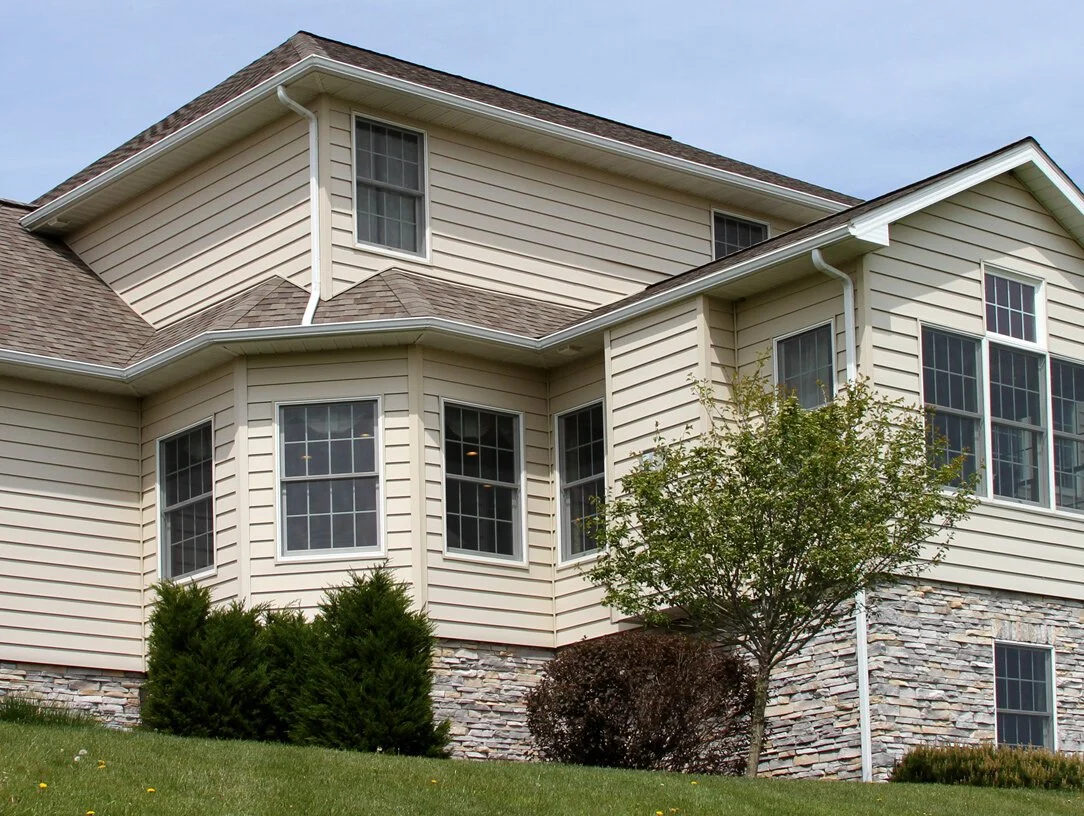
Material Failure Across Multiple Elevations
If the north side, west side, and south side all show cracking, warping, or brittleness, your siding has reached the end of its material lifespan. This isn't damage from an event — it's age-related deterioration.
Vinyl becomes brittle after 25-30 years of UV exposure and freeze-thaw cycles. It cracks when you try to remove a panel. The color has faded unevenly. At that point, even if you repair one section, the rest will start failing within a year or two.
Aluminum siding from the 1970s-1980s often shows this pattern too — dents, chalking, paint failure across the entire house. You can't repair your way back to a sound envelope.
Age-Related Brittleness and Fading
Even if your siding isn't actively leaking, severe fading and brittleness are signs that the material has degraded to the point where it's no longer protecting your home effectively.
We see this a lot with builder-grade vinyl from the 1990s and early 2000s. The color has faded from dark blue to pale gray. The panels are so brittle that they crack if you lean a ladder against them. Technically, the siding is still "attached," but it's not doing its job anymore.
Modern vinyl siding — especially premium lines like CertainTeed Cedar Impressions or Monogram — has significantly better fade resistance and impact strength. If you're dealing with old, degraded vinyl, replacement with a higher-quality product is the right move.
Insulation and Sheathing Concerns
If your home has little to no wall insulation (common in homes built before 1980), a siding replacement is an opportunity to add insulated sheathing or foam board behind the new siding. That can boost your wall R-value from R-3 to R-8 or higher, which makes a noticeable difference in heating costs during Michigan winters.
We can't do that with a repair. If energy efficiency is a concern — and it should be, given Michigan's climate — replacement makes more sense than patching old siding on an under-insulated wall.
The Real Cost Math: Repair vs. Replace in Southeast Michigan
Let's talk actual numbers. Costs vary based on material, home size, and complexity, but here's what we typically see in Macomb, Oakland, and St. Clair counties.
Typical Repair Costs
- Minor vinyl panel replacement (2-5 panels): $300-$600
- Moderate vinyl repair (10-15 panels, one elevation): $800-$1,500
- Fiber cement board replacement (3-6 boards): $500-$1,200
- Aluminum siding dent repair/panel replacement: $400-$900
- Trim and caulking repair: $200-$500
These assume the underlying structure is sound and we're just addressing surface damage. If we find sheathing rot or moisture barrier failure during the repair, costs go up significantly — and often push the project into replacement territory.
Full Replacement Investment Ranges
For a typical 1,800-2,200 sq ft two-story home in Southeast Michigan:
- Vinyl siding (mid-grade): $8,000-$12,000
- Vinyl siding (premium, like CertainTeed Cedar Impressions): $12,000-$18,000
- LP SmartSide engineered wood: $14,000-$20,000
- James Hardie fiber cement: $18,000-$26,000
These prices include removal of old siding, new moisture barriers (Tyvek or similar), trim, soffit and fascia if needed, and professional installation. They do NOT include window replacement or exterior painting, which are separate line items if needed.
Long-Term Value and Energy Considerations
A repair saves money now. A replacement saves money over the next 20-40 years.
New siding with proper insulation and air sealing can reduce heating costs by 10-20% in a typical Michigan home. That's $200-$400 per year in savings. Over 20 years, that's $4,000-$8,000 — a significant chunk of the replacement cost paid back through energy savings alone.
Add in the fact that you won't be dealing with ongoing repairs, paint touch-ups, or moisture damage, and the total cost of ownership tilts heavily toward replacement for homes with aging siding systems.
When "Cheaper Now" Costs More Later
We've seen this pattern dozens of times: homeowner spends $1,200 on a repair. Two years later, different section fails. Another $900 repair. A year after that, moisture damage shows up inside. Now they're looking at $2,500 in drywall and insulation work on top of the siding replacement they should have done three years ago.
Total cost: $4,600 in repairs plus $10,000 in replacement = $14,600. If they'd replaced the siding initially, total cost would have been $10,000-$12,000.
This isn't a scare tactic. It's the math we've watched play out on job after job. Sometimes the cheaper option up front is the expensive option in the long run.
Material Matters: How Siding Type Changes the Equation
Not all siding materials repair the same way. Here's how the decision changes based on what's currently on your house.
Vinyl Siding Repair Limitations
Vinyl is the most common siding in Michigan, and it's also one of the hardest to repair well. The problem: color matching. Vinyl fades over time, especially on south and west elevations. Even if we find the exact same product line, a new panel installed next to 15-year-old faded panels will look noticeably different.
If the damaged area is on a less visible elevation (back of the house, garage side), the color mismatch might not bother you. If it's front and center, it's going to look like a patch job.
The other issue: panel availability. If your vinyl was installed 20+ years ago, the manufacturer may have discontinued that color or profile. We can usually find something close, but "close" isn't "identical."
That said, vinyl repairs are mechanically straightforward. Panels interlock, so we can remove damaged sections and snap in new ones without disturbing the surrounding siding. If color match isn't a concern and the damage is isolated, vinyl repairs work fine.
Fiber Cement (James Hardie) Repair Feasibility
James Hardie fiber cement is more repair-friendly than vinyl in one key way: it's painted, so we can match the color exactly. If a board is damaged, we replace it, prime it, and paint it to match the existing siding. Done right, the repair is invisible.
The challenge: fiber cement is labor-intensive to work with. Each board is heavy, requires cutting with specialized tools, and needs to be fastened precisely to avoid cracking. Labor costs for fiber cement repairs are higher than vinyl — typically $100-$150 per board installed and painted.
But if your James Hardie siding is less than 15 years old and in good overall condition, repairing damaged boards is absolutely viable. The material itself is durable enough that localized repairs hold up well in Michigan's climate.
LP SmartSide Engineered Wood Considerations
LP SmartSide is similar to fiber cement in terms of repair feasibility. It's a wood-based product with a factory-applied finish, so color matching is straightforward. We replace the damaged board, prime the cut edges (critical for moisture protection), and paint to match.
The main consideration with LP SmartSide: if the damage was caused by moisture exposure (improper installation, failed flashing, etc.), we need to fix the underlying issue before replacing the board. Otherwise, the new board will fail the same way.
LP SmartSide has a 50-year limited warranty, but that warranty is void if the product wasn't installed per manufacturer specs. If we're seeing premature failure, it's often an installation issue, not a product issue — and that might indicate broader problems with the siding system.

Older Materials (Aluminum, Wood) Replacement Reality
If you have aluminum siding from the 1970s-1980s, repair options are limited. Aluminum dents easily, paint chalks and fades, and finding replacement panels that match is nearly impossible. You can patch small sections, but it's going to look like a patch.
Wood siding — whether cedar clapboard or board-and-batten — can be repaired if the rot is localized. We replace the damaged boards, prime and paint, and it blends reasonably well. But if you're seeing widespread paint failure, rot at the bottom edges, or warping across multiple elevations, you're looking at replacement.
The good news: replacing old aluminum or wood siding with modern vinyl, fiber cement, or engineered wood is a significant upgrade in durability, maintenance, and energy efficiency. You'll never have to scrape and paint again, and the new siding will handle Michigan weather far better than the old stuff ever did.
What a Proper Siding Assessment Actually Involves
A real assessment isn't a guy walking around your house for five minutes and giving you a number. Here's what we actually do when a homeowner calls us about siding damage.
Exterior Inspection for Damage Patterns
We walk the entire perimeter of the house, looking at every elevation. We're not just noting cracked or missing panels — we're looking for patterns. Is the damage isolated to one area, or is it showing up on multiple sides? Is it concentrated on south and west exposures (UV damage), or is it near roof lines and deck ledgers (moisture issues)?
We check for warping, which indicates either poor installation (panels nailed too tight) or heat-related expansion. We look for gaps in caulk joints, loose trim, and any areas where siding meets dissimilar materials (brick, stone, roofing).
We also look up. Problems with gutters, downspouts, or roof drainage often cause siding damage. If your gutters are overflowing or your roof is shedding water directly onto the siding, that's the root cause — and it needs to be fixed whether you repair or replace the siding.
Interior Inspection for Moisture Damage
This is the part most contractors skip, and it's the most important. We ask to look inside the house, especially near areas where you've noticed exterior damage.
We're looking for water stains on drywall or plaster, peeling paint, soft spots in the wall, or musty odors. If we find any of those, it means moisture has been getting past the siding for a while — and that changes the entire scope of work.
Sometimes we'll use a moisture meter to check wall cavities near windows, doors, or corners. If the readings are high, we know there's an active moisture problem that needs to be addressed.
Sheathing and Insulation Evaluation
If the damage is significant enough, we'll remove a section of siding to inspect the sheathing underneath. This tells us whether the problem is just cosmetic (siding surface damage) or structural (rotted sheathing, failed moisture barriers).
In older homes, we often find original sheathing that's been compromised by decades of moisture exposure. Replacing a few boards of sheathing adds cost, but it's non-negotiable if the structure is compromised. You can't put new siding over rotted wood and expect it to perform.
We also assess insulation. If there's none (common in homes built before 1980), or if it's compressed and ineffective, we'll discuss options for adding insulated sheathing or foam board during the siding replacement.
Manufacturer Warranty Considerations
If your siding is relatively new (less than 10-15 years old) and showing premature failure, there may be a manufacturer warranty claim. CertainTeed, James Hardie, LP SmartSide, and other major brands all have warranties that cover material defects.
We'll check the product line, installation date, and failure mode to determine if a warranty claim is viable. If it is, we'll help you file it. That can significantly reduce the cost of repair or replacement.
The catch: most warranties require professional installation by a certified contractor. If your siding was installed by a handyman or unlicensed contractor, the warranty may be void. That's one reason we always recommend working with licensed, credentialed contractors — the warranty protection alone is worth it.
Building Code Compliance for Older Homes
If your home was built before modern building codes were adopted (pre-1990 in most of Michigan), a siding replacement may require bringing the wall assembly up to current code. That can include adding a weather-resistant barrier, improving flashing around windows and doors, and ensuring proper ventilation.
This isn't a bad thing — it means your home will be more durable and energy-efficient. But it does add cost, and it's something we discuss up front so there are no surprises.
How We Help Michigan Homeowners Make This Decision
We don't walk onto a job assuming it's a replacement. We assess the situation, explain what we're seeing, and give you the options with real numbers attached.
If a repair makes sense — if it solves the problem, fits your budget, and doesn't just delay the inevitable — we'll tell you that. We've done plenty of $500 repairs that saved the homeowner $10,000 they didn't need to spend yet.
If the damage is widespread, if moisture has compromised the structure, or if your siding is near the end of its lifespan, we'll explain why replacement is the better long-term investment. We'll show you what we're seeing (photos help), walk you through the cost comparison, and let you make the call.
Our Process: Free on-site assessment. Written estimate with line-item pricing. Photo documentation of any damage or underlying issues. No pressure, no gimmicks. You get the information you need to make the right decision for your home and budget.
We've been doing this since 1988. We've seen every siding scenario Michigan weather can throw at a house. And we've learned that the best jobs are the ones where the homeowner understands exactly what they're getting and why it's the right solution.
Whether it's a repair or a replacement, the work gets done the same way: carefully, correctly, and with the goal of protecting your home for the next 20-30 years. That's what NEXT Exteriors' full range of services is built on — honest assessments, quality work, and results that last.
If you're trying to decide between repair and replacement, the best first step is to get an honest assessment from someone who's seen both scenarios play out hundreds of times. We're happy to be that resource — no obligation, no sales pitch, just straight answers about what your home actually needs.
Ready to Get Started?
NEXT Exteriors has been protecting Michigan homes since 1988. Get a free, no-pressure estimate from a team that shows up on time and does the job right.
Get Your Free QuoteOr call us: (844) 770-6398