

Contractors Siding Installation Michigan: What to Expect

We've been installing siding in Southeast Michigan since 1988, and here's what we've learned: the difference between a siding job that lasts 30 years and one that starts failing in five comes down to how the work gets done—not just what materials you choose.
When you hire house siding contractors in Detroit, you should know exactly what's happening at your home. Not vague promises about "quality work," but the actual process—what happens each day, what the crew is checking, and why certain steps matter in Michigan's climate.
This isn't a sales pitch. It's a walkthrough of what professional siding installation looks like when it's done right, based on 35+ years of jobsite experience across Macomb, Oakland, and St. Clair counties. Whether you're replacing vinyl siding on a 1960s ranch in Sterling Heights or upgrading to James Hardie on a Colonial in Rochester Hills, the fundamentals don't change.
Before the Crew Arrives: Pre-Installation Prep
Good siding jobs start before anyone shows up with a truck. Here's what should happen in the week leading up to installation.
Site Inspection and Material Delivery
A few days before installation, your contractor should walk the property again—not the initial estimate visit, but a pre-job inspection. We're looking at access points for equipment, where to stage materials, and any last-minute issues that might slow the crew down. Overgrown bushes near the foundation? Outdoor furniture that needs moving? Electrical lines too close to the work area?
Materials typically arrive 2-3 days before the crew. Vinyl siding needs to acclimate to outdoor temperature—especially important in Michigan where we see 40-degree temperature swings between morning and afternoon in spring and fall. James Hardie fiber cement doesn't need acclimation, but it's heavy, so we need clear staging areas close to the house.
Michigan-Specific Consideration: We won't start a siding job if temperatures are forecast to drop below 40°F or if heavy rain is expected within the first 48 hours. Vinyl becomes brittle in cold weather and cracks during installation. Moisture barriers need dry conditions to adhere properly. A reputable contractor will reschedule rather than rush a job in bad weather.
Permits and Inspections
Most municipalities in Southeast Michigan require permits for siding replacement. Your contractor should pull these—not you. In Macomb County, Oakland County, and St. Clair County, permit requirements vary by township, but the contractor's responsibility doesn't change.
At NEXT Exteriors, we handle all permit paperwork as part of our exterior services in Detroit and surrounding communities. We know which jurisdictions require mid-job inspections and which only need final sign-off. This matters because an inspector can shut down a job if the moisture barrier isn't installed correctly—and that costs you time and money.
What You Should Do as a Homeowner
Move anything within 10 feet of the house. Grills, patio furniture, potted plants, garden hoses—everything. The crew needs clear access to all walls, and debris will fall during tear-off.
Clear a path to electrical outlets. We'll need power for saws, compressors, and other tools. If your exterior outlets aren't working, let the contractor know before the crew arrives.
Talk to your neighbors. Siding installation is loud. Circular saws, pneumatic nail guns, and the sound of old siding hitting a dumpster carry. A quick heads-up to the people next door goes a long way.

Day One: Tear-Off and Inspection
The first day is all about removal and discovery. This is when you find out what's really behind your old siding.
Old Siding Removal
Vinyl siding comes off fast—usually a full single-story ranch can be stripped in a day. Aluminum siding takes longer because it's often nailed more aggressively. Wood siding is the slowest because crews have to work carefully to avoid damaging sheathing underneath.
We start at the top and work down. Siding overlaps like shingles, so removing it in reverse order prevents unnecessary damage to the house wrap or felt paper underneath. Corner trim, J-channel around windows, and soffit come off first, then the panels.
Everything goes into a dumpster or trailer. Responsible contractors don't leave piles of old siding in your yard overnight.
Sheathing Inspection: What We're Looking For
Once the old siding is off, we inspect every inch of sheathing. In Michigan homes built before 1980, you'll often find board sheathing (individual planks) instead of plywood or OSB. In homes from the 1980s-2000s, you'll see 7/16" OSB, which is prone to water damage if the old siding leaked.
Common problems we find:
- Rot around windows and doors: Old flashing fails, water gets behind the siding, and the wood rots. This is especially common on north-facing walls that don't get sun to dry out moisture.
- Water stains near the foundation: Splash-back from missing or clogged gutters soaks the bottom courses of siding and the sheathing behind it.
- Insect damage: Carpenter ants and termites love damp wood. If we find soft, spongy sheathing, there's usually an insect problem that needs addressing before new siding goes on.
- Missing or damaged house wrap: Older homes often have tar paper instead of modern synthetic house wrap. If it's torn or deteriorated, we replace it.
Any damaged sheathing gets replaced before we move forward. This isn't an upsell—it's a structural necessity. New siding can't be fastened to rotten wood, and covering up water damage just moves the problem down the road.
Why This Matters in Michigan: Our freeze-thaw cycles accelerate water damage. A small leak that might take 10 years to cause rot in a warmer climate can destroy sheathing in 3-4 Michigan winters. When water gets behind siding, freezes, expands, and then thaws repeatedly, it destroys wood fiber fast.
Moisture Barrier and Flashing Installation
Before any new siding goes up, we install a weather-resistant barrier (WRB). Most contractors use Tyvek or a similar synthetic house wrap. This layer is critical—it keeps wind-driven rain out while allowing water vapor from inside the house to escape.
We overlap seams by at least 6 inches and tape all joints with contractor-grade seam tape. The bottom edge laps over the foundation flashing. The top edge tucks under the drip edge at the roofline. Every penetration—outlets, dryer vents, hose bibs—gets sealed with flashing tape.
Window and door flashing is where most amateurs fail. We use a combination of adhesive flashing tape and metal flashing depending on the opening. The goal is to create a drainage plane that directs water down and out, not into the wall cavity.
If your home also needs window replacement in Detroit, we coordinate that work before siding installation. New windows get flashed into the WRB, then the siding integrates with the window trim. Doing it in the wrong order creates leak points.
The Installation Process: What Happens Each Day
Once the house is wrapped and flashed, siding installation moves fast—assuming the weather cooperates.
Starter Strips and Corner Posts
Siding installation starts at the bottom. We snap a level chalk line around the entire house, usually 1-2 inches above the foundation. The starter strip gets nailed along this line—it's a small J-shaped piece that the first course of siding locks into.
Corner posts go up next. Outside corners use a pre-formed corner channel. Inside corners use J-channel or a corner post depending on the siding profile. Everything gets checked for plumb with a 4-foot level. If corners aren't perfectly vertical, the siding panels won't fit right and you'll see gaps.
Panel Installation: Expansion Gaps Matter
Vinyl siding expands and contracts with temperature. A 12-foot panel can grow or shrink up to 3/8 inch between a 90°F summer day and a 0°F winter night. That's why proper fastening technique is non-negotiable.
Here's how we do it:
- Fasteners go in the center of the nail slot, not at the top or bottom. This allows the panel to move side-to-side as it expands and contracts.
- We don't nail tight. There should be about 1/32 inch of space between the nail head and the siding. Over-driven nails lock the panel in place, and it will buckle or warp.
- Fasteners are spaced 16 inches on center along studs, not random nailing into sheathing. Siding needs solid backing.
- Each panel overlaps the one below by about 1 inch. Too little overlap and wind-driven rain gets in. Too much overlap and the siding looks wavy.
James Hardie fiber cement doesn't expand like vinyl, but it's brittle, so we pre-drill nail holes and leave a 1/8-inch gap between panel ends. Hardie also requires specific nails—galvanized or stainless steel roofing nails, not the staples some contractors try to use.
Window and Door Trim Work
Trimming windows and doors is where craftsmanship shows. We install J-channel around each opening, mitered at the corners so water drains away from the frame. The siding panels slide into the J-channel, creating a clean, finished look with no exposed cut edges.
On homes with brick or stone accent walls, we use a combination of J-channel and metal flashing to transition between materials. The flashing tucks under the brick ledge and laps over the siding below.
Soffit, Fascia, and Ventilation
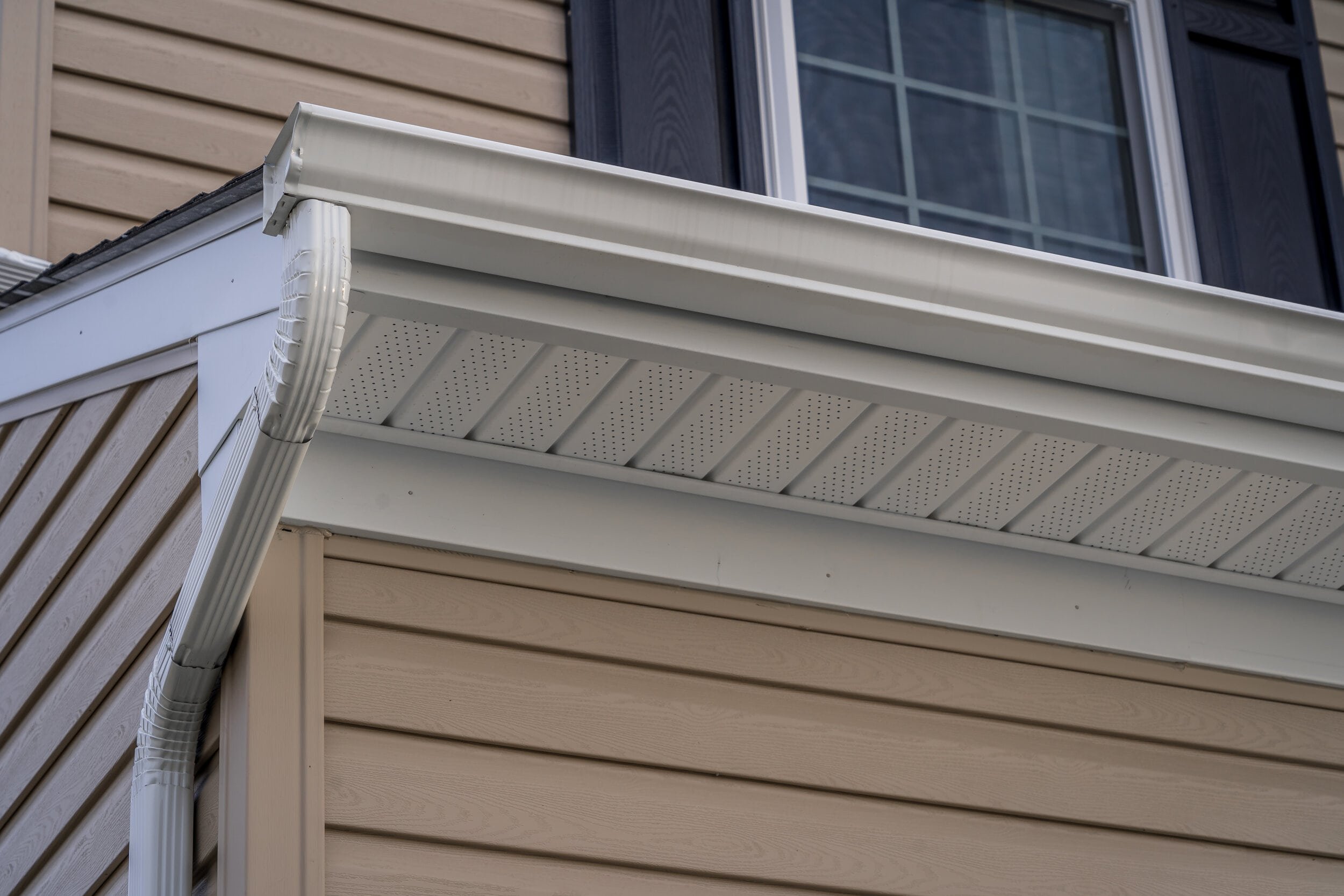
Soffit and fascia work happens near the end of the job. Vented soffit panels allow air to flow into the attic—critical for preventing ice dams in Michigan winters. We calculate the net free ventilation area (NFVA) to make sure there's enough intake to match the roof's exhaust vents.
If your home needs better attic ventilation, we often recommend combining siding work with attic insulation upgrades in Metro Detroit. Proper ventilation keeps your roof cold in winter (preventing ice dams) and your attic cooler in summer (reducing cooling costs).
Fascia covers the exposed ends of roof rafters. We typically use aluminum-wrapped fascia boards—they're maintenance-free and won't rot like wood. The fascia also provides backing for seamless gutters in Detroit, MI, so it needs to be solid and level.
Quality Checkpoints During Installation
Professional contractors don't wait until the end to check their work. Here's what we verify throughout the job.
Level and Plumb Verification
Every few courses, we check level. Siding that's even slightly off-level compounds as you go up—by the time you reach the soffit, panels won't fit properly and you'll see gaps. We use a 4-foot level and a laser level for long runs.
Corner posts and J-channel get checked for plumb. If they're leaning, the siding panels won't lock in correctly.
Fastener Spacing and Placement
We randomly inspect fastener placement throughout the job. Nails should be centered in the slot, not over-driven, and spaced consistently. This is where inexperienced crews cut corners—they nail too fast, miss studs, or drive fasteners too tight.
Weather Sealing Around Penetrations
Every time we cut siding for a vent, outlet, or fixture, we seal the opening. We use a combination of caulk and flashing tape depending on the penetration. The goal is to prevent water and air infiltration without trapping moisture inside the wall.
Ventilation Verification
Before we close up the soffit, we verify that attic ventilation isn't blocked. Insulation sometimes gets pushed into the soffit area during insulation installation, blocking airflow. We install baffles if needed to maintain a clear path from soffit to ridge vent.
Timeline: How Long Does Siding Installation Take?
Homeowners always ask: "How long will the crew be here?" The answer depends on house size, siding type, and weather.
Average Project Duration for Michigan Homes
- Single-story ranch (1,200-1,500 sq ft): 3-5 days
- Two-story Colonial (2,000-2,500 sq ft): 5-7 days
- Large two-story or complex architecture (3,000+ sq ft): 7-10 days
James Hardie fiber cement takes 20-30% longer than vinyl because it's slower to cut and install. LP SmartSide engineered wood falls somewhere in between.
Weather Delays and Contingencies
In Michigan, weather delays are inevitable. We don't work in heavy rain—moisture barriers need dry conditions. We don't install vinyl below 40°F—it becomes brittle. We don't work in high winds—loose panels become dangerous projectiles.
Spring and fall are the trickiest seasons. A warm, dry week can turn into three days of rain overnight. Summer is the most predictable, but even then, afternoon thunderstorms can shut down work for a few hours.
A good contractor builds weather contingency into the schedule and communicates delays promptly. We don't ghost you when it rains—we call or text to let you know the crew won't be there and when we expect to resume.
Multi-Story vs. Ranch Timeline Differences
Single-story homes are faster because there's no scaffolding setup. Two-story homes require staging—either scaffolding or pump jacks—which adds a day to the schedule. Homes with complex rooflines, dormers, or turrets take longer because every angle requires custom cuts and flashing details.
After Installation: Cleanup and Final Inspection
The job isn't done when the last panel goes up. Professional contractors finish with thorough cleanup and a walkthrough.
Site Cleanup Standards
At the end of each day, the crew should pick up major debris and secure materials. At the end of the job, we do a complete site cleanup:
- Dumpster or trailer removed with all old siding and construction waste
- Magnetic sweep of the yard to pick up nails and metal scraps
- Landscaping restoration if we damaged plants or grass during work
- Pressure washing of driveways and walkways to remove sawdust and debris
We also clean gutters if debris fell into them during installation. If your home needs new seamless gutters in Detroit, we coordinate that installation after siding is complete so the gutters mount to fresh, solid fascia.
Final Walkthrough Checklist
Before we ask you to sign off, we walk the property together. We're looking at:
- Siding alignment and appearance—no waves, no gaps
- Trim work around windows and doors—clean miters, no exposed cut edges
- Caulking around penetrations—smooth, consistent beads
- Soffit and fascia—straight, properly vented
- Cleanup completeness—no trash, no debris
If you spot anything that doesn't look right, we address it before leaving. This is your home—it should look as good as ours would.
Warranty Documentation
You should receive two types of warranty documentation:
- Manufacturer's warranty on the siding material itself (typically 25 years to lifetime depending on product)
- Contractor's workmanship warranty covering installation (we offer a 5-year workmanship warranty at NEXT Exteriors)
Keep these documents with your home records. If you sell the house, transferable warranties add value.
Maintenance Recommendations
Vinyl and fiber cement siding are low-maintenance, but not no-maintenance. We recommend:
- Annual inspection for cracks, loose panels, or failed caulk
- Washing once a year with a garden hose or pressure washer on low setting (high pressure can damage siding)
- Trimming vegetation away from the house—bushes and vines trap moisture against siding
- Checking caulk around windows and doors every 3-5 years and re-caulking as needed
If your siding is part of a larger exterior upgrade that included Detroit roofing services or exterior painting in Southeast Michigan, coordinate maintenance schedules so everything gets checked at the same time.

Signs You're Working With the Right Contractor
Not all contractors operate the same way. Here's how to tell if you've hired someone who does the job right.
They Show Up When They Say They Will
This sounds basic, but it's where many contractors fail. Professional crews arrive on time, work a full day, and communicate if delays happen. At NEXT Exteriors, we text or call the night before to confirm the next day's schedule. If weather forces a delay, you hear from us before you're standing in your driveway wondering where the crew is.
They Pull Permits and Handle Inspections
Contractors who skip permits are cutting corners. Permits aren't just bureaucracy—they ensure the work meets code and protects your home's resale value. If a contractor says "permits aren't necessary" or "we can save money by skipping that," walk away.
They Explain What They're Doing and Why
You shouldn't need a construction degree to understand what's happening at your house. Good contractors explain the process, point out issues when they find them, and give you options with honest pros and cons. We don't upsell—we educate.
They Protect Your Property
Tarps under work areas. Plywood over landscaping near the foundation. Careful handling of old siding to avoid denting your car or breaking windows. Professional crews treat your property like their own.
They Stand Behind Their Work
A workmanship warranty isn't just a piece of paper—it's a commitment. If something goes wrong with the installation (not the material, but the installation), the contractor fixes it. We've been in business since 1988 because we honor that commitment. If you call us five years after installation with a problem, we come back and make it right.
Ready to Get Started?
NEXT Exteriors has been protecting Michigan homes since 1988. Get a free, no-pressure estimate from a team that shows up on time and does the job right. We serve homeowners across Macomb County, Oakland County, and St. Clair County with honest pricing and old-school craftsmanship.
Get Your Free QuoteOr call us: (844) 770-6398
Frequently Asked Questions About Siding Installation in Michigan
Vinyl siding typically runs $6-10 per square foot installed, depending on quality and profile. James Hardie fiber cement costs $10-14 per square foot. LP SmartSide engineered wood falls in between at $8-12 per square foot. For an average 2,000 sq ft two-story home, expect total project costs between $12,000-$28,000 depending on material choice and whether you need sheathing repairs. These are 2026 prices for Southeast Michigan—costs vary by contractor and project complexity.
Vinyl siding should not be installed when temperatures are below 40°F—it becomes brittle and cracks during cutting and nailing. James Hardie fiber cement can be installed in colder weather (down to 25°F) but requires special handling. Most contractors in Michigan schedule siding work between April and October to avoid weather complications. If you need emergency siding repair in winter after storm damage, temporary weatherproofing is installed until spring when full replacement can happen safely.
If the existing house wrap (Tyvek or similar weather-resistant barrier) is intact, dry, and properly installed, it can stay. However, in Michigan homes built before 1990, you often find tar paper instead of modern synthetic wrap—and it's usually deteriorated. Any time we find torn, water-stained, or missing house wrap, we replace it. The cost to add new house wrap is $0.50-1.00 per square foot, and it's cheap insurance against moisture problems down the road.
You won't know until the old siding comes off. Signs of sheathing damage include soft, spongy wood when you press on it; dark water stains; visible rot or mold; and insect damage. In Michigan, the most common problem areas are around windows and doors (where flashing failed), near the foundation (from splash-back), and on north-facing walls (which stay damp longer). Damaged sheathing must be replaced before new siding goes on—it's not optional.
Vinyl is lighter, less expensive, and easier to install. It expands and contracts with temperature, so proper installation technique is critical in Michigan's climate. Fiber cement (James Hardie) is heavier, more expensive, and more durable. It doesn't expand like vinyl, resists impact damage better, and holds paint longer if you choose a painted finish. Both perform well in Michigan if installed correctly. Vinyl is the practical choice for most homeowners. Fiber cement is worth the upgrade if you want maximum durability and plan to stay in the house long-term.
If your windows are 20+ years old, drafty, or showing signs of seal failure (condensation between panes), yes—replace them before siding. New windows get flashed into the weather-resistant barrier, then the siding integrates with the window trim. Doing it in the wrong order creates leak points. You also save money on labor because the crew is already there with scaffolding set up. If your windows are newer and in good shape, you can leave them and just trim around them with the new siding.
Vinyl siding lasts 25-40 years in Michigan if installed correctly. Cheaper vinyl fades and becomes brittle faster—premium vinyl with UV inhibitors and thicker profiles lasts longer. James Hardie fiber cement lasts 30-50 years and often outlasts the house. LP SmartSide engineered wood lasts 25-35 years with proper maintenance. The key factor isn't just the material—it's the installation quality. Poor installation (wrong fastener placement, no expansion gaps, inadequate flashing) cuts lifespan in half regardless of material quality.